


The army conducted combat readiness exercises in Hsinchu early yesterday morning, deploying M1A2T tanks and armored vehicles in anti-infiltration and anti-airborne drills aimed at demonstrating its ability to defend key coastal landing areas amid continued military pressure from China.
The exercises, carried out by the 6th Army Command, marked the second anniversary of President William Lai’s (賴清德) inauguration.
The army launched the combat readiness patrol before dawn. Six M1A2T tanks were mobilized from the 584 Combined Arms Brigade alongside CM32 and CM33 eight-wheeled armored vehicles, as well as tube-launched, optically tracked, wire-guided missile vehicles.
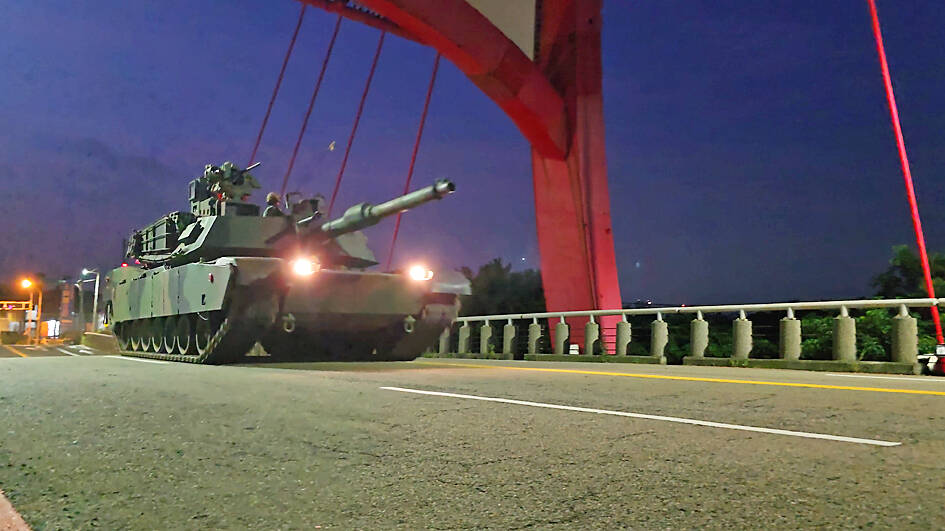
Photo: Fang Wei-li, Taipei Times
The convoy drove to Provincial Highway No. 1 for tactical maneuvers, with exercises focused on securing key bridges and river crossings.
Under the cover of darkness, the forces quickly reached the Jiougang (舊港) and Baidi (白地) bridges in the Toucian River (頭前溪) area, testing how quickly troops could respond and deploy after receiving orders.
Those bridges are key transportation links between the main and tributary channels of the Toucian River.
Nanliao Beach (南寮) to the west near the river mouth is one of Taiwan’s “red beaches,” or coastal areas considered highly vulnerable to large-scale amphibious landings by enemy forces.
If enemy troops landed at Nanliao, they could advance along the corridors on both sides of the Toucian River toward strategic political and economic sites, including Hsinchu Air Base and Hsinchu Science Park.
To prevent enemy forces from pushing inland, the exercise sent a reconnaissance platoon ahead to secure the area and provide cover.
The tank convoy then moved in with increased spacing between vehicles and crossed in staggered groups to reduce the risk of being targeted or hit all at once.
The realistic training scenario not only tested long-distance mobility and road movement, but also tested soldiers’ ability to respond under pressure, showing the armored unit’s capability to seize key bridges, and carry out defensive and counterattack operations, company commander Captain Lu Chun-ying (盧俊穎) said.
After crossing, the convoy moved to tactical positions to rehearse protection of key targets and critical infrastructure.
Lieutenant Colonel Huang Chen-yung (黃禎詠), head of the 3rd Combined Arms Battalion under the 584th Armored Brigade, said that although the M1A2Ts weigh nearly 70 tonnes, they did not affect the civilian bridges they crossed in the Hsinchu area.
Their weight is evenly distributed over seven load-bearing wheels, so each tank exerts an average ground pressure of 1.1kg per cm2, lower than the nearly 9kg by heavy trucks often seen around Taiwan, Huang said.
The mission was designed knowing that the M1A2Ts are obvious targets for enemy attacks, he said, adding that to prevent an enemy strike from disabling the lead tank and blocking those behind it, the convoy crossed bridges in batches and one tank at a time.
Before tanks crossed a bridge, army troops would establish bridgehead outposts to ensure safe passage, Huang said.
The exercise was conducted after former National Security Bureau chief and army commander Lee Shying-jow (李翔宙) questioned whether the tanks could safely cross bridges without causing structural damage.
Addressing discussions about the readiness and maintenance of the M1A2T tanks, deputy brigade commander Colonel Chang Chia-hsien (張嘉顯) of the 584 Combined Arms Brigade said the unit carries out regular inspections and maintenance, and maintains a high operational readiness rate.
Any issues identified during routine checks were fixed with the help of US-trained personnel and technical advisers from the US, Chang said.
The army has sufficient spare parts and, together with US technical support and domestic maintenance capacity, is fully capable of ensuring the new tanks meet operational needs, he added.
Additional reporting by CNA
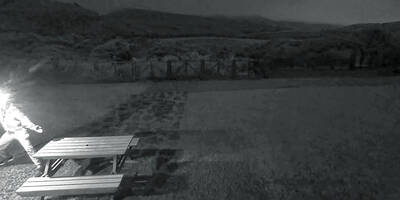
Yangmingshan National Park authorities yesterday urged visitors to respect public spaces and obey the law after a couple was caught on a camera livestream having sex at the park’s Qingtiangang (擎天崗) earlier in the day. The Shilin Police Precinct in Taipei said it has identified a suspect and his vehicle registration number, and would summon him for questioning. The case would be handled in accordance with public indecency charges, it added. The couple entered the park at about 11pm on Thursday and began fooling around by 1am yesterday, the police said, adding that the two were unaware of the park’s all-day live
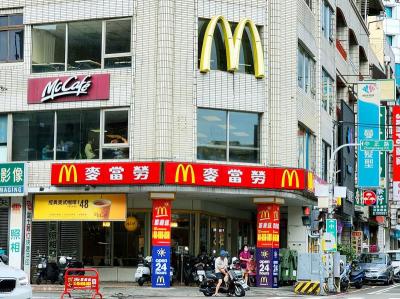
Fast food chain McDonald's is to raise prices by up to NT$5 on some products at its restaurants across Taiwan, starting on Wednesday next week, the company announced today. The prices of all extra value meals and sharing boxes are to increase by NT$5, while breakfast combos and creamy corn soup would go up by NT$3, the company said in a statement. The price of the main items of those meals, if ordered individually, would remain the same. Meanwhile, the price of a medium-sized lemon iced tea and hot cappuccino would rise by NT$3, extra dipping sauces for chicken nuggets would go up
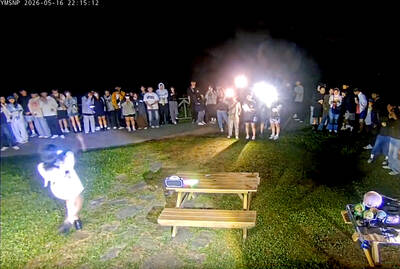
Yangmingshan National Park’s Qingtiangang (擎天崗) nature area has gone viral after a park livestream camera observed a couple in the throes of intimate congress, which was broadcast live on YouTube, drawing large late-night crowds and sparking a backlash over noise, bright lights and disruption to wildlife habitat. The area’s livestream footage appeared to show a couple engaging in sexual activity on a picnic table in the park on Friday last week, with the uncensored footage streamed publicly online. The footage quickly spread across social media, prompting a tide of visitors to travel to the site to “check in” and recreate the

Minister of Digital Affairs Lin Yi-ching (林宜敬) yesterday cited regulatory issues and national security concerns as an expert said that Taiwan is among the few Asian regions without Starlink. Lin made the remarks on Facebook after funP Innovation Group chief executive officer Nathan Chiu (邱繼弘) on Friday said Taiwan and four other countries in Asia — China, North Korea, Afghanistan and Syria — have no access to Starlink. Starlink has become available in 166 countries worldwide, including Ukraine, Malaysia, the Philippines and Vietnam, in the six years since it became commercial, he said. While China and North Korea block Starlink, Syria is not


 RSS
RSS