


The Executive Yuan yesterday approved an initial NT$295 billion (US$9.32 billion) special defense budget for a package of weapons already approved for sale to Taiwan by the US, and is being sent to the Legislative Yuan for a final review.
The budget request earmarks about NT$8.8 billion for this year, which would be covered by government borrowing under the Fiscal Discipline Act (財政紀律法).
The budget includes five procurement items: High Mobility Artillery Rocket Systems (HIMARS), M109A7 self-propelled howitzers, anti-armor drone weapon systems, Javelin anti-tank missiles, and tube-launched, optically tracked, wire-guided 2B anti-armor missiles, Premier Cho Jung-tai (卓榮泰) said.
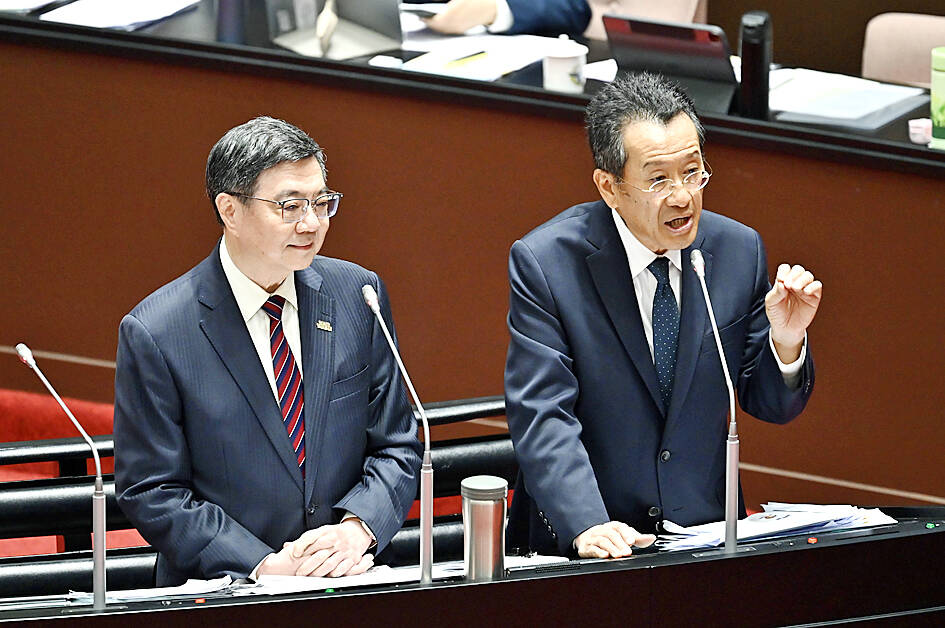
Photo: George Tsorng, Taipei Times
The proposal was approved after the Legislative Yuan passed a special act earlier this month authorizing up to NT$780 billion in spending on two batches of US arms purchases between this year and 2033.
Under the act, funding for the first batch of weapons purchases approved by the US in December last year is capped at NT$300 billion. The Cabinet’s proposal is to request almost all of that amount.
The Legislative Yuan is set to expedite the review of the first batch of arms procurements.
Cho reported to the Legislative Yuan on Tuesday regarding the first phase of the special defense procurement budget.
Lawmakers had reached a consensus allowing it to proceed with drafting a budget under the special law aimed at bolstering national security and asymmetric defense capabilities, and agreed to continue the briefing on the budget yesterday afternoon.
With the first payment for the HIMARS due on May 31, Minister of National Defense Wellington Koo (顧立雄) said that if the budget has not yet been approved by then, the government would invoke Article 84 of the Budget Act (預算法) to seek approval for payment.
Special budgets could be appropriated “in response to emergency needs,” the article states.
Given the time constraint, the Legislative Yuan has accelerated its review process, with the legislature’s Finance Committee tentatively scheduling hearings for Monday next week, followed by a review and handling of the proposal on Wednesday and Thursday next week.
Cho urged all lawmakers to support the bill, so that it could pass as quickly as possible to safeguard national security, and maintain regional peace and stability.
Under the special act passed by the Legislative Yuan, although spending caps were approved, procurement proposals are still subject to final legislative review.
The act’s spending cap for a second arms package expected to be announced by Washington was NT$480 billion.

Yangmingshan National Park authorities yesterday urged visitors to respect public spaces and obey the law after a couple was caught on a camera livestream having sex at the park’s Qingtiangang (擎天崗) earlier in the day. The Shilin Police Precinct in Taipei said it has identified a suspect and his vehicle registration number, and would summon him for questioning. The case would be handled in accordance with public indecency charges, it added. The couple entered the park at about 11pm on Thursday and began fooling around by 1am yesterday, the police said, adding that the two were unaware of the park’s all-day live

Fast food chain McDonald's is to raise prices by up to NT$5 on some products at its restaurants across Taiwan, starting on Wednesday next week, the company announced today. The prices of all extra value meals and sharing boxes are to increase by NT$5, while breakfast combos and creamy corn soup would go up by NT$3, the company said in a statement. The price of the main items of those meals, if ordered individually, would remain the same. Meanwhile, the price of a medium-sized lemon iced tea and hot cappuccino would rise by NT$3, extra dipping sauces for chicken nuggets would go up
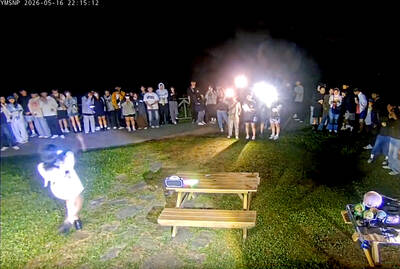
Yangmingshan National Park’s Qingtiangang (擎天崗) nature area has gone viral after a park livestream camera observed a couple in the throes of intimate congress, which was broadcast live on YouTube, drawing large late-night crowds and sparking a backlash over noise, bright lights and disruption to wildlife habitat. The area’s livestream footage appeared to show a couple engaging in sexual activity on a picnic table in the park on Friday last week, with the uncensored footage streamed publicly online. The footage quickly spread across social media, prompting a tide of visitors to travel to the site to “check in” and recreate the

Minister of Digital Affairs Lin Yi-ching (林宜敬) yesterday cited regulatory issues and national security concerns as an expert said that Taiwan is among the few Asian regions without Starlink. Lin made the remarks on Facebook after funP Innovation Group chief executive officer Nathan Chiu (邱繼弘) on Friday said Taiwan and four other countries in Asia — China, North Korea, Afghanistan and Syria — have no access to Starlink. Starlink has become available in 166 countries worldwide, including Ukraine, Malaysia, the Philippines and Vietnam, in the six years since it became commercial, he said. While China and North Korea block Starlink, Syria is not


 RSS
RSS