


The opposition-controlled Legislative Yuan is to vote tomorrow on a rare, but largely symbolic, motion to impeach President William Lai (賴清德).
The Chinese Nationalist Party (KMT) and Taiwan People’s Party (TPP) in December announced that they would try to impeach Lai after Premier Cho Jung-tai (卓榮泰) refused to countersign amendments to a local revenue-sharing law the legislature passed on Nov. 14.
The bill would have increased the allocation of public funds to local governments.
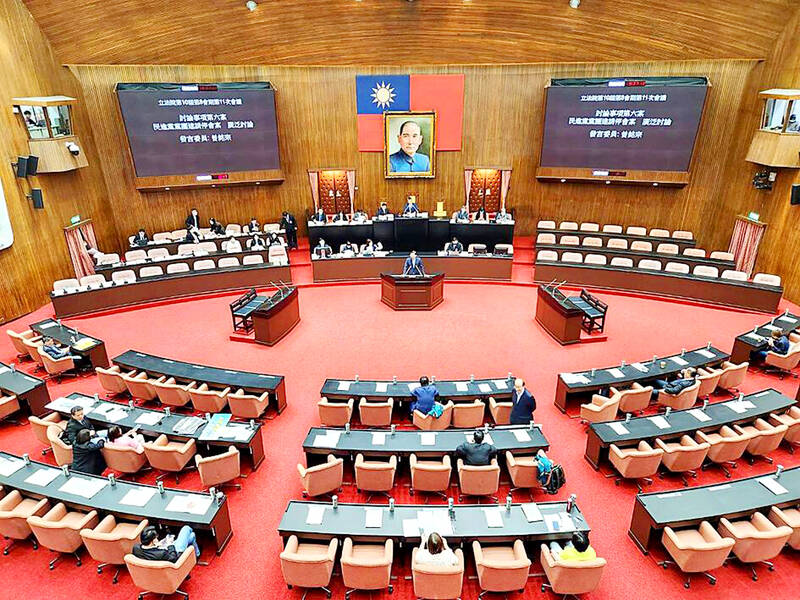
Photo: Taipei Times
Cho’s refusal to countersign the legislation was unprecedented and constitutionally untested, and meant that the amendments would not be promulgated by the president.
KMT spokesman Niu Hsu-ting (牛煦庭) has said the executive branch’s refusal to promulgate laws passed by the legislature “distorted” the Constitution and undermined the rule of law.
Cho said that the amendments to the revenue-sharing law violated the constitutional principle of the separation of powers, and would cause “irreparable and serious harm” to national development.
Because of an ongoing deadlock at the Constitutional Court, not countersigning the amendments represented the executive branch’s “final means” to correct what it considered legislative wrongdoing, he said.
The decision did not amount to authoritarianism or executive overreach, because the Legislative Yuan still retained a constitutional check at its disposal, Cho said, referring to the legislature’s ability to initiate a no-confidence vote against the premier.
Under normal circumstances, the Constitutional Court could be asked to rule on the constitutionality of the amendments to the local revenue-sharing law, or the premier’s refusal to countersign them, but the court, which normally has 15 justices, has only eight justices, two fewer than the legal threshold for adjudication.
After the legislature rejected Lai’s justice nominees in December 2024, and in July last year, he has not submitted a new slate.
According to the Additional Articles of the Constitution of the Republic of China (中華民國憲法增修條文), a motion to impeach the president or vice president can be initiated with the backing of one-half of all lawmakers.
The motion must then gain the approval of two-thirds of all lawmakers before being sent to the Constitutional Court, which must rule in favor with the support of two-thirds of sitting justices.
While the KMT-led coalition and TPP hold a combined 62 seats in the legislature, they fall short of the 76-vote (two-thirds) supermajority required to refer the case to the Constitutional Court.
Even if the motion somehow cleared the legislature, the lack of a quorum of sitting Constitutional Court justices would present an additional hurdle.
Compared with the high threshold for impeaching the president, the Constitution makes it relatively easy for the legislature to remove the premier.
Under the Additional Articles of the Constitution, the legislature can pass a no-confidence vote against the premier with a majority of all lawmakers, forcing the premier to step down.
However, within 10 days of such a motion being passed, the president has the option to dissolve the legislature, which would trigger new legislative elections, to be held within 60 days.
The legislature has opted not to pursue this option.

Yangmingshan National Park authorities yesterday urged visitors to respect public spaces and obey the law after a couple was caught on a camera livestream having sex at the park’s Qingtiangang (擎天崗) earlier in the day. The Shilin Police Precinct in Taipei said it has identified a suspect and his vehicle registration number, and would summon him for questioning. The case would be handled in accordance with public indecency charges, it added. The couple entered the park at about 11pm on Thursday and began fooling around by 1am yesterday, the police said, adding that the two were unaware of the park’s all-day live

A former soldier and an active-duty army officer were yesterday indicted for allegedly selling classified military training materials to a Chinese intelligence operative for a total of NT$79,440. The Taipei District Prosecutors’ Office indicted Chen Tai-yin (陳泰尹) and Lee Chun-ta (李俊達) for contravening the National Security Act (國家安全法) and the Anti-Corruption Act (貪污治罪條例). Chen left the military in September 2013 after serving alongside then-staff sergeant Lee, now an army lieutenant, at the 21st Artillery Command of the army’s Sixth Corps from 2011 to 2013, according to the indictment. Chen met a Chinese intelligence operative identified as “Wang” (王) through a friend in November

Minister of Digital Affairs Lin Yi-ching (林宜敬) yesterday cited regulatory issues and national security concerns as an expert said that Taiwan is among the few Asian regions without Starlink. Lin made the remarks on Facebook after funP Innovation Group chief executive officer Nathan Chiu (邱繼弘) on Friday said Taiwan and four other countries in Asia — China, North Korea, Afghanistan and Syria — have no access to Starlink. Starlink has become available in 166 countries worldwide, including Ukraine, Malaysia, the Philippines and Vietnam, in the six years since it became commercial, he said. While China and North Korea block Starlink, Syria is not
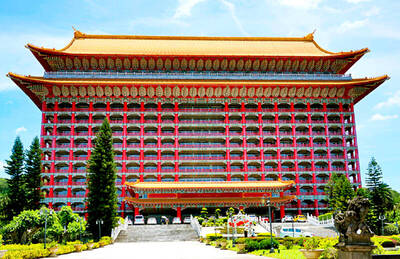
The Grand Hotel Taipei has rejected media reports claiming that the hotel had prevented CBS from broadcasting coverage of the Beijing summit between U.S. President Donald Trump and Chinese President Xi Jinping (習近平) on its premises. Media reports alleging that the hotel owner, dissatisfied with CBS’s coverage, prohibited the network from broadcasting political content on the hotel premises, are not true, the hotel said in a statement issued last night. The reports were “inconsistent with how the hotel actually handled the matter,” it said. The hotel said it received a refund request from a


 RSS
RSS