


A resident whose property is subject to expropriation under the Taoyuan Aerotropolis development project yesterday along with civic groups filed a petition for constitutional review of relevant regulations.
The project is an urban development project initiated by the central government more than a decade ago to facilitate industrial and economic development around Taiwan Taoyuan International Airport.
The first phase of the zone expropriation plan was approved by the Ministry of the Interior in 2020, with the Civil Aviation Administration and the Taoyuan City Government being the land acquisition agencies.
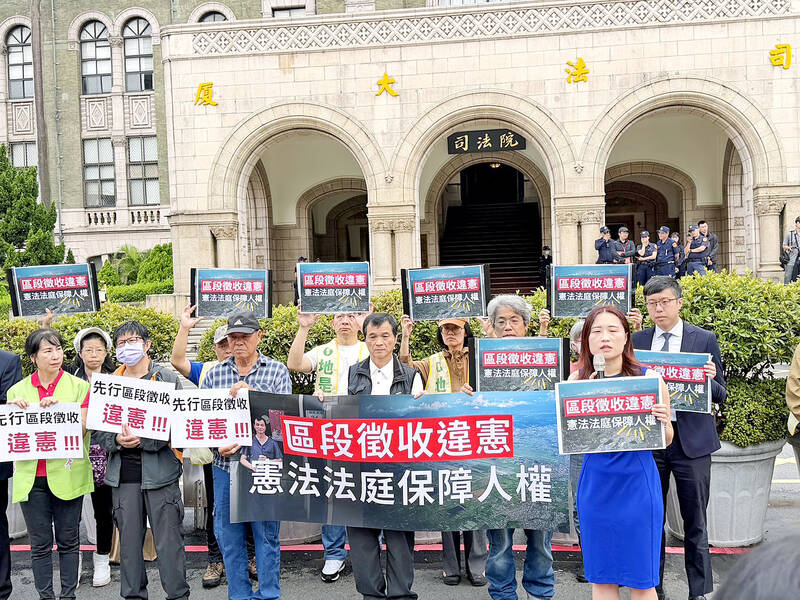
Photo: Yang Hisn-hui, Taipei Times
Chen Chien-ho (陳健和), a local resident who acts as the petitioner for the constitutional review, said much of the farmland around where he lives has been expropriated.
His property in the city’s Jhuwei Borough (竹圍) falls within the project’s designated area for use by the airport.
The borough was excluded from the zone appropriation in the ministry’s Urban Planning Commission No. 818 meeting in 2013.
However, it was included around the beginning of 2021 as a priority relocation area due to the construction of the airport’s third runway.
Chen said more than 4,000 hectares of land is being expropriated while only about 700 hectares are designated as aviation land.
Many residents like Chen were forced into a difficult situation as the government failed to fulfil its pledge to build relocation housing before demolishing their present residences, he said.
Chen is seeking constitutional review of relevant regulations as his case was dismissed by the Supreme Administrative Court in its final and binding judgement.
Civic groups said such zone expropriation might be unconstitutional as part of the expropriated land is not used specifically for public infrastructure construction and would be sold to private businesses via tender calls.
Litigation team attorney Lin Hsu-feng (林旭峰) said Paragraph 1, Article 4 of the Land Expropriation Act (土地徵收條例) might be unconstitutional as it allows zone expropriation that benefits private businesses without specifying reasons.
Such a mechanism does not align with the Constitution’s requirement that land expropriation should serve a significant public interest, he said.
Litigation team attorney Hsiung Yi-ling (熊依翎) said the act’s Paragraph 2, Article 4 might also be unconstitutional, as it allows zone expropriation before announcing its urban planning project.
Regulations governing the implementation of zone expropriation also include provisions that might be unconstitutional for similar reasons, she said.
National Chengchi University land economics professor Hsu Shih-jung (徐世榮) said Taiwan’s zone expropriation mechanism can be traced back to the excess condemnation approach adopted by some European countries in the 19th century.
The approach would excessively expropriate land around a project site and then sell the land at rising prices to compensate for costs of public infrastructure construction, he said.
Such approaches were already rejected by many US state supreme courts and abandoned by European countries, he added.

FUKUOKA SITUATION: Japanese media reported that the pathogen is expected to be identified by the summer, while the CDC downplayed the idea that it was hMPV A “mysterious cold-like illness” reported in Japan’s Fukuoka Prefecture does not seem to be a new disease, but Japanese authorities have been asked about the situation, the Centers for Disease Control (CDC) said yesterday. The Fukuoka Prefectural Medical Association on Wednesday told a news conference that a “mystery cold” that has become a hot topic on social media is “highly likely to be caused by some kind of viral infection,” Japan’s KBC News reported. “Many people are experiencing symptoms starting with a sore throat, followed by a runny nose, phlegm and a severe cough,” KBC News reported, citing association officials. Health authorities are

Nvidia Corp CEO Jensen Huang (黃仁勳) arrived in Taiwan yesterday ahead of upcoming AI and technology events, saying he plans to meet with clients and Taiwan Semiconductor Manufacturing Co Chairman C.C. Wei (魏哲家) during his visit. After landing at Taipei Songshan Airport, Huang posed for photos with fans and handed out Yakult drinks to reporters and supporters waiting at the scene, saying he has “a lot to do” during the trip. Asked about reports that Nvidia’s planned headquarters site in Taipei’s Beitou Shilin Technology Park could break ground on May 27, Huang said that if the company holds an event, he would

The Ministry of Finance this afternoon announced the winning numbers for the March-April uniform invoice lottery. The winning number for the NT$10 million (US$318,060) special prize is 19531471, and the winning number for the NT$2 million grand prize is 85941329. Three numbers were drawn for the NT$200,000 first prize: 07225810, 20231230 and 83518781. Those with receipts matching the last seven digits of any of the first-prize numbers will win the NT$40,000 second prize, while those matching the last six digits will win the NT$10,000 third prize. Those whose receipts match the last five digits of the first-prize numbers can claim the NT$4,000 fourth prize,
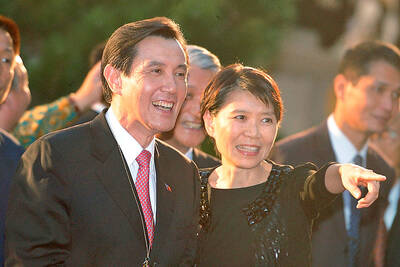
Former president Ma Ying-jeou (馬英九) yesterday expressed “shock and regret” over a statement issued by his wife without his consent, and rejected her assertion that his eldest sister, Ma Yi-nan (馬以南), would manage his medical care or act as his spokesperson amid an ongoing embezzlement probe into his foundation. Ma Ying-jeou in a statement said he was shocked by a statement by his wife, Chou Mei-ching (周美青), regarding his affairs. Ma Yi-nan “must not” be in charge of his healthcare and other personal affairs, nor can she be allowed to represent the Ma family, the former president said. He said he was also


 RSS
RSS