


More than 1,000 nurses today protested outside the Ministry of Health and Welfare, handing in a petition demanding that a proposed nurse-to-patient ratio system be put into law after two years of promises.
The system would set minimum nurse-to-patient ratios for day, evening and night shifts across medical centers and hospitals that would prevent nurses from being overworked, guaranteeing adequate staffing levels and protecting patient safety, they said.
Department of Nursing and Healthcare Director-General Tsai Shu-feng (蔡淑鳳) accepted the petition and promised that the ministry would hold a meeting on Friday to discuss the legislative timeline and related measures.

Photo: CNA
Minister of Health and Welfare Shih Chung-liang (石崇良) later held a closed-door meeting with representatives from the groups, during which he said that a draft amendment would be released as early as Tuesday next week, on International Nurses’ Day.
When he took office, President William Lai (賴清德) promised that the three-shift system would be codified into law during his first two years.
In July 2024, the Executive Yuan approved a 12-point program to address nursing shortages that included retention and night shift incentives, overhauling the work environment and implementing a standard 1-3 nurse-to-patient ratio per shift.
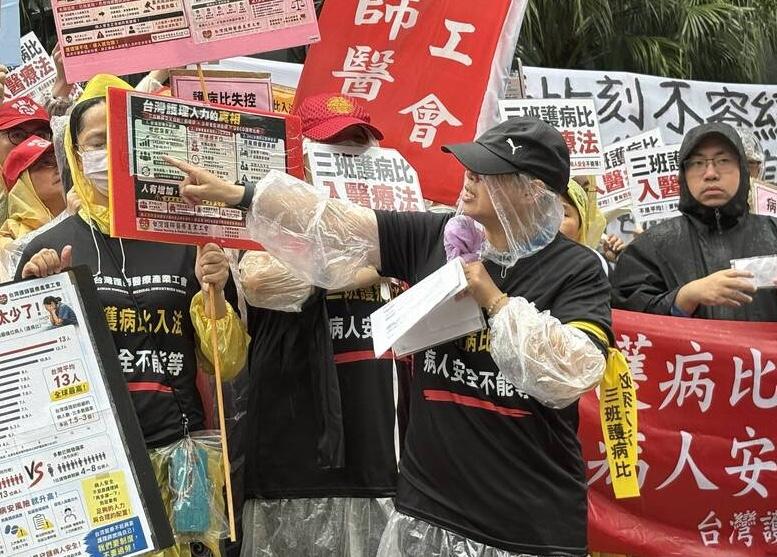
Photo: Chen Chih-yi, Taipei Times
The incentives were expected to be codified into law within two years and would require four years to be fully implemented.
Nursing groups today stood outside the ministry holding placards and chanting protest slogans, accusing the government of changing its proposals and standards.
The ministry has allocated NT$6 billion (US$190 million) annually to the program since 2024, showing that the government has adequate funding to move the proposal forward, Taiwan Union of Nurses Association president Chen Li-chin (陳麗琴) said.
The delay shows a disregard for patient safety and quality of care, she said.
While the nursing community can understand the need for a “buffer period,” it cannot accept policy stagnation, Chen said.
Only by legislating the standard promptly and incorporating penalties can it truly protect nurses and patients, she added.
The nursing groups proposed three demands.
First, the government should immediately revise the Establishment Standards for Medical Institutions (醫療機構設置標準) and implement the new ratio system by May 20, they said.
Second, the ministry should draft a legislative amendment to be submitted to the Cabinet, revising Article 12 of the Medical Care Act (醫療法) to codify the three-shift nurse-to-patient ratio into law, they said.
Last, the government should amend Article 102 of the same act to introduce reasonable penalties and establish an enforcement mechanism to act as a deterrent, they added.
According to a report last year by the Organisation for Economic Co-operation and Development (OECD), Taiwan has 7.29 hospital beds per 1,000 people, far above the OECD average of 4.3 and up to 2.5 times more than in Europe and the US, the groups said.
Taiwan does not lack beds, but struggles in the retention of nursing staff, they said.
Once the ministry finalizes the details, the legislation would enter a 60-day public notice period before official promulgation, although the ministry would try to expedite the process for formal publication by the end of July, Shih said.
Hospitals would then have a two-year buffer period before enforcement, he added.

FUKUOKA SITUATION: Japanese media reported that the pathogen is expected to be identified by the summer, while the CDC downplayed the idea that it was hMPV A “mysterious cold-like illness” reported in Japan’s Fukuoka Prefecture does not seem to be a new disease, but Japanese authorities have been asked about the situation, the Centers for Disease Control (CDC) said yesterday. The Fukuoka Prefectural Medical Association on Wednesday told a news conference that a “mystery cold” that has become a hot topic on social media is “highly likely to be caused by some kind of viral infection,” Japan’s KBC News reported. “Many people are experiencing symptoms starting with a sore throat, followed by a runny nose, phlegm and a severe cough,” KBC News reported, citing association officials. Health authorities are

Nvidia Corp CEO Jensen Huang (黃仁勳) arrived in Taiwan yesterday ahead of upcoming AI and technology events, saying he plans to meet with clients and Taiwan Semiconductor Manufacturing Co Chairman C.C. Wei (魏哲家) during his visit. After landing at Taipei Songshan Airport, Huang posed for photos with fans and handed out Yakult drinks to reporters and supporters waiting at the scene, saying he has “a lot to do” during the trip. Asked about reports that Nvidia’s planned headquarters site in Taipei’s Beitou Shilin Technology Park could break ground on May 27, Huang said that if the company holds an event, he would

The Ministry of Finance this afternoon announced the winning numbers for the March-April uniform invoice lottery. The winning number for the NT$10 million (US$318,060) special prize is 19531471, and the winning number for the NT$2 million grand prize is 85941329. Three numbers were drawn for the NT$200,000 first prize: 07225810, 20231230 and 83518781. Those with receipts matching the last seven digits of any of the first-prize numbers will win the NT$40,000 second prize, while those matching the last six digits will win the NT$10,000 third prize. Those whose receipts match the last five digits of the first-prize numbers can claim the NT$4,000 fourth prize,

Taiwan Travelogue (臺灣漫遊錄), which earlier this week became the first Taiwanese novel to win the International Booker Prize, is to be adapted into a television series through a Taiwan-Japan coproduction, producer Chang Chen-yu (張辰漁) said yesterday. Chang, a producer at World Softest Production Film Co, wrote on Facebook that the company had been searching for projects with international appeal that retain a strong Taiwanese identity after colleagues and Japanese partners strongly recommended the novel. After reading the book, Chang said he immediately decided to pursue the screen rights. “A great story has the power to transcend time and borders, and connect countless people,”


 RSS
RSS