


The nation’s first space startup hub is scheduled to begin operations in Q3 this year, the Taiwan Space Agency (TASA) said yesterday.
TASA iSPARK (星創基地) was created to combine technology and business resources and attract more start-ups in the space industry by lowering the entry threshold, the agency said.
The hub will be on National Yangming Chiaotung University’s Boai campus in Hsinchu City, it said.
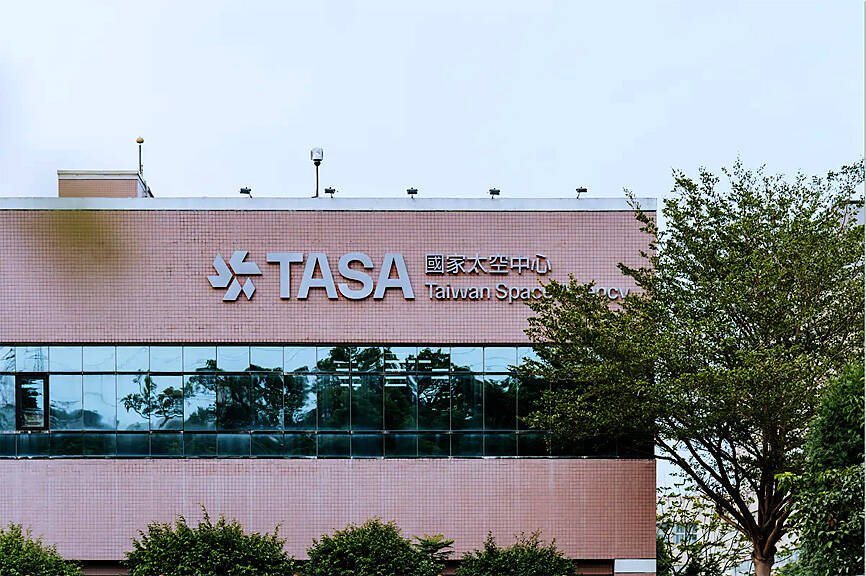
Photo: Screen grab from the agency’s Web site
The location was chosen near TASA and Hsinchu Science Park, ensuring ease of access to research and development capability, talent and innovative technologies, the agency said.
Space agencies in the US, Europe and Japan have established mechanisms to support startups, the agency said. NASA promotes commercialization of space technologies through programs such as its Small Business Innovation Research initiative, which provides phased funding to early-stage companies. It has supported firms including Firefly Aerospace and Redwire in developing commercial space capabilities.
The European Space Agency’s Business Incubation Centers support startups across Europe by providing office space, technical expertise and seed funding. The network has backed more than 2,200 startups to date
The Japan Aerospace Exploration Agency has its engineers codevelop projects with private enterprises, reducing the technical threshold and research and development risks. Axelspace, a Japanese private space company focused on microsatellites — small, relatively low-cost satellites used for Earth observation and other services, was founded through the Japanese model, the agency said.
TASA iSPARK is positioned as an Asia-based gateway for space innovation, centered on a market-driven approach and integrating technology validation with international connections, the agency said.
The agency is reviewing the applications filed by more than 20 start-up teams, with research interests spanning from satellites, communications, remote sensing and optics, as well as cross-disciplinary groups from information and technology (ICT) and semiconductor sectors, traditional manufacturers transitioning into space-related applications and international start-up seeking to establish bases in Taiwan.
TASA iSpark aims to become an incubator for three key industries: the satellite manufacturing supply chain, group equipment and satellite system integration technologies, and data applications and AI services, the agency said, adding that this would enable Taiwan to become a supplier and commercially influential player in the space industry.
The hub’s short-term goal is to connect with global hubs such as Silicon Valley in the US and the UK’s Satellite Applications Catapult, as well as space industry networks in Europe and Japan, to build a Taiwanese space startup cluster, the agency said.
The goal in the medium term is to accelerate the first cohort of teams into the international space supply chain and connect them with mainstream commercial markets, while the long-term goal is to cultivate globally competitive Taiwanese aerospace companies and foster the country’s first space-industry unicorn, the agency said.
Separately, National Central University (NCU) announced yesterday that it would partner with Hong Hai Precision Industry Co for the second time on the “Pearl-1 Inter-Satellite Link” mission, which includes two CubeSats named Pearl-1A and Pearl-1B.
The two formed their first collaboration two years ago on the Pearl CubeSat missions 1C and 1H for broadband communications.
The two satellites carry multiple payloads, including an inter-satellite communication payload developed by Taoyuan-based Raitek LTD, as well as a small ionospheric probe and solar cell payloads developed in-house by NCU. The satellites are going to be launched via a SpaceX Falcon 9 rocket into a 590-kilometer sun-synchronous orbit, where they would conduct a five-year mission focused on inter-satellite broadband communication experiments and space environment monitoring.
The inter-satellite communication payload was commissioned by NCU and would perform in-orbit validation of hardware and software technologies developed by the Industrial Technology Research Institute’s Information and Communications Research Laboratories, the university said.
“This marks Taiwan’s first Ka-band inter-satellite broadband link demonstration using a dual-satellite configuration,” it said. “It will further advance Ka-band broadband communications between satellites and ground stations and help domestic low earth orbit satellite terminal manufacturers conduct communication testing with satellites.”
The small ionospheric probe would, for the first time, conduct dual-satellite co-orbital observations to reveal and distinguish the spatiotemporal variations of ionospheric plasma density irregularities in equatorial regions, the university said, adding this would help improve understanding of the causes and impacts of space communication interference.
The solar cell payload is supported by a National Science and Technology Council undergraduate research program, enabling an in-orbit engineering demonstration of solar cells developed by domestic company Hongtai Optoelectronics (鋐泰光電) and the Institute of Physics at the National Atomic Research Institute.

FUKUOKA SITUATION: Japanese media reported that the pathogen is expected to be identified by the summer, while the CDC downplayed the idea that it was hMPV A “mysterious cold-like illness” reported in Japan’s Fukuoka Prefecture does not seem to be a new disease, but Japanese authorities have been asked about the situation, the Centers for Disease Control (CDC) said yesterday. The Fukuoka Prefectural Medical Association on Wednesday told a news conference that a “mystery cold” that has become a hot topic on social media is “highly likely to be caused by some kind of viral infection,” Japan’s KBC News reported. “Many people are experiencing symptoms starting with a sore throat, followed by a runny nose, phlegm and a severe cough,” KBC News reported, citing association officials. Health authorities are

Nvidia Corp CEO Jensen Huang (黃仁勳) arrived in Taiwan yesterday ahead of upcoming AI and technology events, saying he plans to meet with clients and Taiwan Semiconductor Manufacturing Co Chairman C.C. Wei (魏哲家) during his visit. After landing at Taipei Songshan Airport, Huang posed for photos with fans and handed out Yakult drinks to reporters and supporters waiting at the scene, saying he has “a lot to do” during the trip. Asked about reports that Nvidia’s planned headquarters site in Taipei’s Beitou Shilin Technology Park could break ground on May 27, Huang said that if the company holds an event, he would

The Ministry of Finance this afternoon announced the winning numbers for the March-April uniform invoice lottery. The winning number for the NT$10 million (US$318,060) special prize is 19531471, and the winning number for the NT$2 million grand prize is 85941329. Three numbers were drawn for the NT$200,000 first prize: 07225810, 20231230 and 83518781. Those with receipts matching the last seven digits of any of the first-prize numbers will win the NT$40,000 second prize, while those matching the last six digits will win the NT$10,000 third prize. Those whose receipts match the last five digits of the first-prize numbers can claim the NT$4,000 fourth prize,
Taiwan Travelogue (臺灣漫遊錄), which earlier this week became the first Taiwanese novel to win the International Booker Prize, is to be adapted into a television series through a Taiwan-Japan coproduction, producer Chang Chen-yu (張辰漁) said yesterday. Chang, a producer at World Softest Production Film Co, wrote on Facebook that the company had been searching for projects with international appeal that retain a strong Taiwanese identity after colleagues and Japanese partners strongly recommended the novel. After reading the book, Chang said he immediately decided to pursue the screen rights. “A great story has the power to transcend time and borders, and connect countless people,”


 RSS
RSS