


Families who hire migrant caregivers rallied in Taipei yesterday to call for lower fees and stronger support for households reliant on those workers, as the Ministry of Labor (MOL) pledged to review care services and a migrant worker rights advocate warned against weakening worker protections.
“Citizens first, employers rise,” chanted rallygoers, many of them wheelchair users or older adults, during the first-ever “Employers’ Day” rally on Ketagalan Boulevard in front of the Presidential Office, one day after Workers' Day.
Among them was Calven Su (蘇煥凱), 27, who was paralyzed from the neck down in a motorcycle accident five years ago.
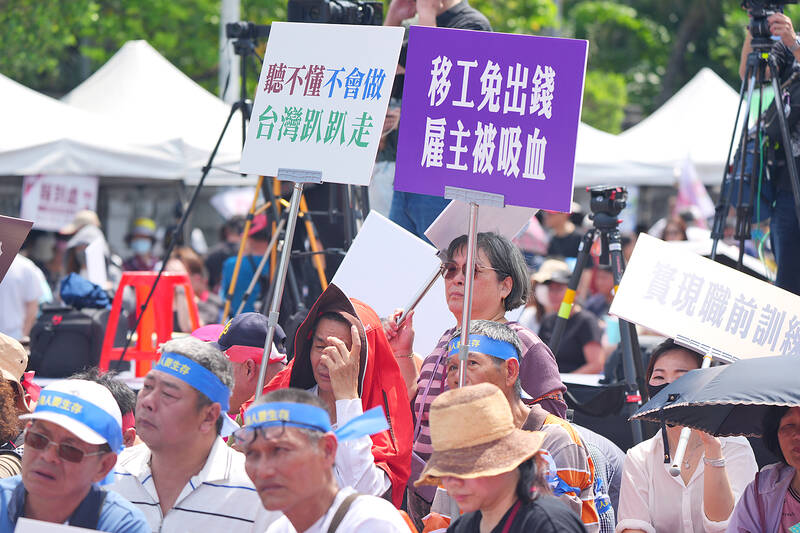
Photo: CNA
“MOL has leaned heavily toward protecting migrant workers’ rights while ignoring employers’ voices,” said Su, who was accompanied to the rally by his Filipino caregiver.
Su cited the employment security fee, which employers of migrant workers must pay under the Employment Service Act (就業服務法) to support national employment, labor welfare and the management of foreign worker employment.
For those who hire migrant caregivers, the fee is NT$2,000 per month per worker.
Su argued that families hiring caregivers should not have to bear that cost, saying the money was being used in ways unrelated to their care needs.
His concerns echoed demands made by the International Association of Family and Employers with Disabilities, an NGO formed by employers of migrant caregivers that organized the event.
The association called for abolishing the employment security fee for families hiring migrant caregivers, arguing that the monthly payment “does not ensure stable care human resources.”
It also urged a “zero care gap” mechanism to ensure families caring for people with severe illnesses or disabilities are not left without support when migrant caregivers go missing, transfer to another employer, or are delayed by administrative procedures.
In response, the MOL said it would work with the Ministry of Health and Welfare to review existing respite and short-term care services, including raising the current 52-day cap.
Regarding the employment security fee, the ministry said it was also “willing to take a comprehensive look” at ways to further reduce the financial and care burden on families caring for people with severe illnesses, adding that related assessments “have already begun.”
Migrant worker rights advocate Lennon Wang (汪英達) said that calls to abolish the employment security fee “could be discussed,” but warned that scrapping it entirely would seriously undermine migrant worker protections.
Wang said the fee supports services for migrant workers, including the 1955 labor hotline, interpreters, labor inspectors and shelters.
Without the fee, many of those services could disappear, he said, describing that as a “major step backward” for migrant workers’ rights.
On Friday, nearly 100 migrant workers rallied at the same venue, calling for all domestic service workers to be covered by labor insurance, which provides benefits in cases of maternity, injury, illness, disability and old age.

FUKUOKA SITUATION: Japanese media reported that the pathogen is expected to be identified by the summer, while the CDC downplayed the idea that it was hMPV A “mysterious cold-like illness” reported in Japan’s Fukuoka Prefecture does not seem to be a new disease, but Japanese authorities have been asked about the situation, the Centers for Disease Control (CDC) said yesterday. The Fukuoka Prefectural Medical Association on Wednesday told a news conference that a “mystery cold” that has become a hot topic on social media is “highly likely to be caused by some kind of viral infection,” Japan’s KBC News reported. “Many people are experiencing symptoms starting with a sore throat, followed by a runny nose, phlegm and a severe cough,” KBC News reported, citing association officials. Health authorities are

Nvidia Corp CEO Jensen Huang (黃仁勳) arrived in Taiwan yesterday ahead of upcoming AI and technology events, saying he plans to meet with clients and Taiwan Semiconductor Manufacturing Co Chairman C.C. Wei (魏哲家) during his visit. After landing at Taipei Songshan Airport, Huang posed for photos with fans and handed out Yakult drinks to reporters and supporters waiting at the scene, saying he has “a lot to do” during the trip. Asked about reports that Nvidia’s planned headquarters site in Taipei’s Beitou Shilin Technology Park could break ground on May 27, Huang said that if the company holds an event, he would

The Ministry of Finance this afternoon announced the winning numbers for the March-April uniform invoice lottery. The winning number for the NT$10 million (US$318,060) special prize is 19531471, and the winning number for the NT$2 million grand prize is 85941329. Three numbers were drawn for the NT$200,000 first prize: 07225810, 20231230 and 83518781. Those with receipts matching the last seven digits of any of the first-prize numbers will win the NT$40,000 second prize, while those matching the last six digits will win the NT$10,000 third prize. Those whose receipts match the last five digits of the first-prize numbers can claim the NT$4,000 fourth prize,
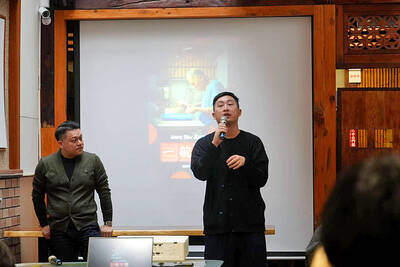
Taiwan Travelogue (臺灣漫遊錄), which earlier this week became the first Taiwanese novel to win the International Booker Prize, is to be adapted into a television series through a Taiwan-Japan coproduction, producer Chang Chen-yu (張辰漁) said yesterday. Chang, a producer at World Softest Production Film Co, wrote on Facebook that the company had been searching for projects with international appeal that retain a strong Taiwanese identity after colleagues and Japanese partners strongly recommended the novel. After reading the book, Chang said he immediately decided to pursue the screen rights. “A great story has the power to transcend time and borders, and connect countless people,”


 RSS
RSS