


China and Russia have shifted to using bots to spread disinformation by blending together truths and falsehoods to dominate online discourse, a Japanese analyst said earlier this week, calling for greater psychological resilience rather than trying to take down every bit of misinformation.
Beijing and Moscow no longer use wholly untruthful narratives online, but have turned to mixing lies with facts, Japan Nexus Intelligence chief executive officer Masakazu Takamori told reporters at a seminar in Taiwan.
Foreign operatives are increasingly making use of generative artificial intelligence that avoids mistakes commonly made by non-native speakers to obscure the foreign origin of the content, he said.
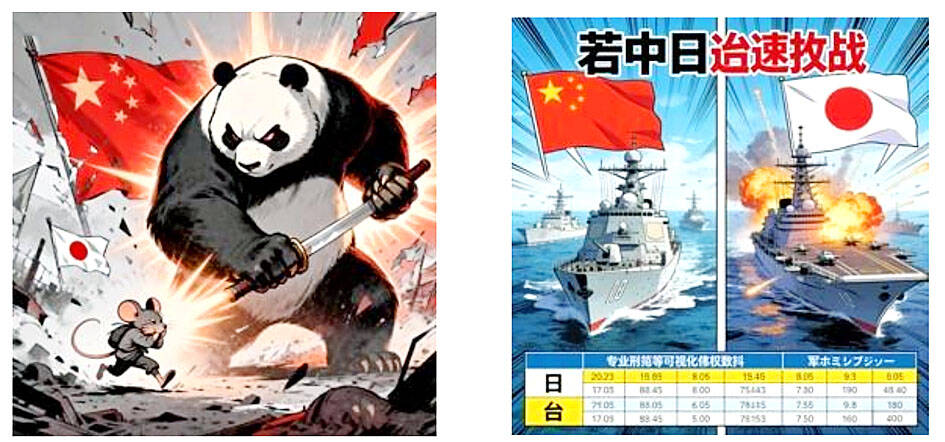
Photo courtesy of Masakazu Takamori
In Japan, analysts have detected signs of “bot bombs,” or algorithms that identify key words and compose massive amounts of content to shape specific narratives and push them with fake engagement rates, he said.
This allows select controversies to be speedily boosted to the top of social media platforms, Takamori said.
Foreign-directed cognitive warfare against Japan focuses on just a handful of topics, he said.
Okinawa independence is one, with content claiming that it is a Chinese territory that had been forcibly annexed by Japan, he said.
Foreign operatives also target US military bases in Japan by amplifying the “unequal burden” placed on local residents, she said.
The aim is to incite anti-US sentiment and discontent against the central government in Tokyo, Takamori said.
These hostile forces labor to generate the impression that Japan and Taiwan are militarily helpless compared with China, using numbers, infographics and psychological warfare caricatures, he said.
Takamori presented a propaganda image that portrays China as a giant panda, and Japan and Taiwan as small rats being chased underfoot.
Foreign-sourced disinformation seeks to label Japanese Prime Minister Sanae Takaichi as a right-winger and target her with personal attacks, while suggesting that Japanese enterprises tied to Takaichi could be subject to retaliation by the Chinese government, he said.
These tactics are being used in an attempt to impede the Takaichi administration’s stance on national security and defense, he said.
Japan’s adversaries have locked onto controversies concerning gender equality and resource distribution in a bid to fan youth discontent against the “status quo,” he said.
Foreign propaganda often accuses Tokyo of mounting ineffectual responses to natural disasters, and not providing victims with relief to spark panic and anger against the government, Takamori said.
The pattern of cognitive warfare attacks targeting Taiwan is almost identical, especially during elections, he added.
The government’s stance on China has become core to Japanese political discourse, with certain parties emphasizing the importance of maintaining friendly ties with Beijing and not “excessively provoking” China, he said.
“The only difference between the disinformation being deployed against Japan and Taiwan is perhaps the language in which they are written,” Takamori said, adding that hostile forces are exploiting freedom of speech in democracies to spread their lies.
Japan, like Taiwan, is constrained in its ability to hit back at disinformation with direct or forcible responses, and must instead rely on using commentators, influencers and academics to counter propaganda, he said.
However, the “fire brigade” approach is not a viable long-term strategy, as it puts the government on reaction mode, Takamori said.
Defending against cognitive warfare requires governments to predict foreign propaganda and take pre-emptive measures to increase the public’s psychological resilience, he said.
This makes international cooperation in sharing data about hostile disinformation campaigns more important, Takamori said in a call to enhance Taiwan-Japan collaboration.

The military has spotted two Chinese warships operating in waters near Penghu County in the Taiwan Strait and sent its own naval and air forces to monitor the vessels, the Ministry of National Defense (MND) said. Beijing sends warships and warplanes into the waters and skies around Taiwan on an almost daily basis, drawing condemnation from Taipei. While the ministry offers daily updates on the locations of Chinese military aircraft, it only rarely gives details of where Chinese warships are operating, generally only when it detects aircraft carriers, as happened last week. A Chinese destroyer and a frigate entered waters to the southwest

Japanese Prime Minister Sanae Takaichi’s comment last year on Tokyo’s potential reaction to a Taiwan-China conflict has forced Beijing to rewrite its invasion plans, a retired Japanese general said. Takaichi told the Diet on Nov. 7 last year that a Chinese naval blockade or military attack on Taiwan could constitute a “survival-threatening situation” for Japan, potentially allowing Tokyo to exercise its right to collective self-defense. Former Japan Ground Self-Defense Force general Kiyofumi Ogawa said in a recent speech that the remark has been interpreted as meaning Japan could intervene in the early stages of a Taiwan Strait conflict, undermining China’s previous assumptions
Taiwan Railways Corp (TRC) today announced that Shin Kong Mitsukoshi has been selected as the preferred bidder to operate the Taipei Railway Station shopping mall, replacing the current operator, Breeze Development Co Ltd. Among eight qualified firms that delivered presentations and were evaluated by a review committee, Shin Kong Mitsukoshi was ranked first, while Breeze was named the runner-up, the rail company said in a statement. Contract negotiations are to proceed in accordance with regulations, it said, adding that if negotiations with the top bidder fail, it could invite the second-ranked applicant to enter talks. Breeze in a statement today expressed doubts over

UNFOUNDED CONCERNS: Public concerns that allowing Indian workers to come and work in Taiwan would lead to increased sex crimes are baseless, the labor ministry said Amid public concern over the government’s plan to bring Indian workers to Taiwan, the Ministry of Labor (MOL) pointed to past intake and said that public safety remained stable. Minister of Labor Hung Sun-han (洪申翰) on April 9 told the legislature that the first group of Indian workers could arrive as early as the end of this year. Taiwan and India signed a memorandum of understanding (MOU) in February 2024 to address Taiwan’s labor shortage. The MOU was sent to the Legislative Yuan for review in mid-2024 and received cross-party backing, prompting the MOL to begin follow-up negotiations with India, Hung said. Public


 RSS
RSS