


The Ministry of Health and Welfare yesterday detailed amendments to the Medical Care Act (醫療法) governing doctors and hospital workers, as well as plans for new regulations to protect physicians employed as visiting staff.
Despite being first previewed in 2019, the proposed changes to the act went through multiple revisions before the Legislative Yuan accepted it for review.
The ministry said in a news release that the amendments require hospitals to contractually guarantee doctors’ labor rights and mandate a seniority system for promotions and assignments.
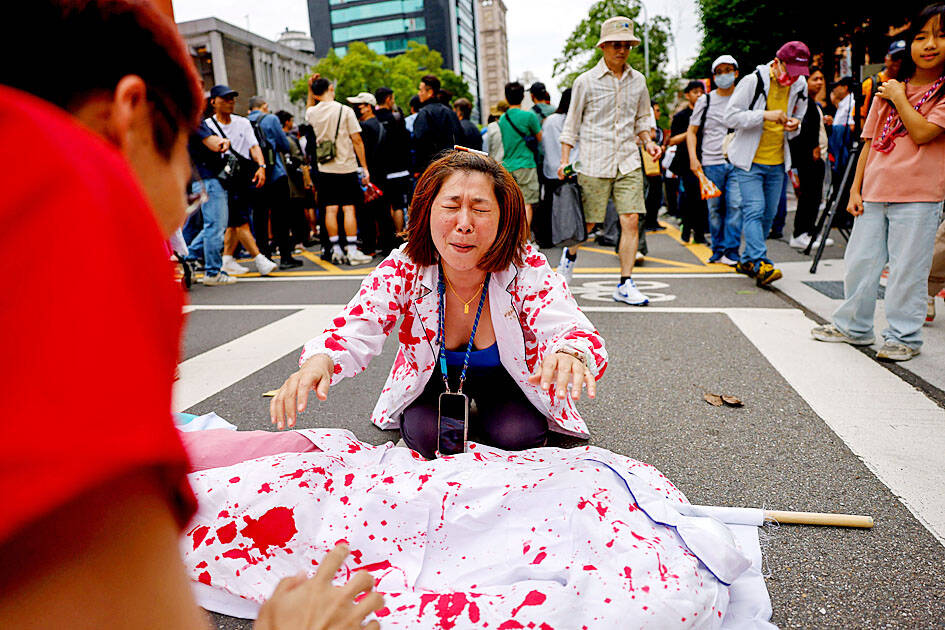
Photo: Reuters, Ann Wang
Doctors increasingly work out of hospitals rather than private practices, resulting in complaints of labor abuses from doctors’ unions.
The amendment would govern doctors under the Labor Occupational Accident Insurance and Protection Act (勞工職業災害保險及保護法) to ensure compensation for occupational accidents, the ministry said.
Hospitals would be required to provide necessary safety precautions and hygienic facilities for doctors working at night, including places to sleep if public transportation is not available, it said.
Accommodations and safety policies must be put in place for pregnant doctors, and retirement funds established to secure a future for doctors after they age out of the profession, the ministry said.
Guidelines governing contracts between doctors and hospitals and the formulas for calculating compensation for work-related hazards are not yet decided as the topics are still being debated, it said.
The ministry is erring on the side of caution to make sure the rules would be practical and suitable for governing a complex industry, the ministry said.
Labor officials are crafting guidelines governing contracts between doctors employed as attending physicians and hospitals to be implemented in the latter half of this year, it said.
The nation in 2023 already promulgated guidelines governing contracts between clinical research fellows and medical institutions, the ministry said.
Separately, Taipei Doctors’ Union president Chen Liang-fu (陳亮甫) urged strong regulations to protect attending physicians, who play a key role in hospital operations, but do not receive equal legal protections.
The union hopes that the proposed changes to the Medical Care Act would include special provisions to protect female attending physicians working night shifts and would limit the penalty for breaching contracts, Chen said.
The amendments should also stipulate the structure of fixed-term contracts, severance packages and compensation for occupational accidents, he said.
These regulations would be important for protecting attending physicians, as people working on fixed-term contracts can be dismissed without warning or severance, he said.
Doctors employed as attending physicians are also at risk of being fined for breach of contract should they resign before fulfilling their term, Chen said.
This often stems from disagreements over what constitutes reasonable cause for suspending or terminating a contract in favor of attending specialist training or enrolling in classes abroad, he said.
The Labor Standards Act (勞動基準法) exempts pregnant or breastfeeding women from night shifts, and bans all work for those who are about to give birth, recently gave birth or suffered a recent miscarriage, Chen said.
The union agreed to the ministry’s proposed legal changes to allow attending physicians in these types of situations to work with their consent as a compromise, he said.
These protections are not afforded to attending physicians, as they are excluded from the legal category of full-time workers due to the unique structure of their employment, he said.
The union’s hope is for the government to create a law that specifically governs the rights of attending physicians outside of the Labor Standards Act, or write a new chapter of that legislation for the profession, he said.

Yangmingshan National Park authorities yesterday urged visitors to respect public spaces and obey the law after a couple was caught on a camera livestream having sex at the park’s Qingtiangang (擎天崗) earlier in the day. The Shilin Police Precinct in Taipei said it has identified a suspect and his vehicle registration number, and would summon him for questioning. The case would be handled in accordance with public indecency charges, it added. The couple entered the park at about 11pm on Thursday and began fooling around by 1am yesterday, the police said, adding that the two were unaware of the park’s all-day live

Fast food chain McDonald's is to raise prices by up to NT$5 on some products at its restaurants across Taiwan, starting on Wednesday next week, the company announced today. The prices of all extra value meals and sharing boxes are to increase by NT$5, while breakfast combos and creamy corn soup would go up by NT$3, the company said in a statement. The price of the main items of those meals, if ordered individually, would remain the same. Meanwhile, the price of a medium-sized lemon iced tea and hot cappuccino would rise by NT$3, extra dipping sauces for chicken nuggets would go up

Yangmingshan National Park’s Qingtiangang (擎天崗) nature area has gone viral after a park livestream camera observed a couple in the throes of intimate congress, which was broadcast live on YouTube, drawing large late-night crowds and sparking a backlash over noise, bright lights and disruption to wildlife habitat. The area’s livestream footage appeared to show a couple engaging in sexual activity on a picnic table in the park on Friday last week, with the uncensored footage streamed publicly online. The footage quickly spread across social media, prompting a tide of visitors to travel to the site to “check in” and recreate the

Minister of Digital Affairs Lin Yi-ching (林宜敬) yesterday cited regulatory issues and national security concerns as an expert said that Taiwan is among the few Asian regions without Starlink. Lin made the remarks on Facebook after funP Innovation Group chief executive officer Nathan Chiu (邱繼弘) on Friday said Taiwan and four other countries in Asia — China, North Korea, Afghanistan and Syria — have no access to Starlink. Starlink has become available in 166 countries worldwide, including Ukraine, Malaysia, the Philippines and Vietnam, in the six years since it became commercial, he said. While China and North Korea block Starlink, Syria is not


 RSS
RSS