


A proposed amendment to the National Security Act (國安法) that would impose fines of up to NT$1 million (US$31,598) for publicly advocating for armed unification or undermining Taiwanese autonomy was temporarily shelved by a legislative committee yesterday, following objections from opposition lawmakers over freedom of speech concerns.
The proposed amendment to Article 2 states that no person shall openly incite, call for or support foreign states, the Mainland Area, Hong Kong or Macau to wage war on Taiwan or pursue unpeaceful means against its autonomy.
The text was retained and forwarded for cross-caucus negotiations, according to Democratic Progressive Party (DPP) Legislator Lee Po-yi (李柏毅), convener of the Legislative Yuan’s Internal Administration Committee.

Photo: CNA
Under the proposal, authorities could impose fines ranging from NT$100,000 to NT$1 million for contraventions.
Independent Legislator May Chin (高金素梅) said that granting administrative agencies oversight of political speech risks censorship, and blurs the line between casual debate and punishable conduct, such as discussions of the risks of cross-strait war or expressions of political preference.
She also questioned whether the proposal would blur the separation of powers.
Chinese Nationalist Party (KMT) Legislator Liao Hsien-hsiang (廖先翔) said the amendment, if approved, could be applied to a wide range of speech, including saying that Taiwan is the 51st US state, which undermines the sovereignty of the Republic of China, and that pro-independence support is, on a level, inciting China to attack Taiwan.
Liao also raised concerns about how indirect expression — such as art or wordplay — might be interpreted.
KMT Legislator Alicia Wang (王鴻薇) criticized the vagueness of definitions of the terms such as “any person” and “foreign enemy forces.”
DPP Legislator Huang Jie (黃捷) said the proposal aligns with international practice, and is intended to safeguard national security and democratic governance.
Deputy Minister of the Interior Wu Tang-an (吳堂安) said the measure applies only to “public” acts and that “any person” refers to people and legal entities.
Messages that are not shared publicly would not be subject to the fines, Wu said,
Mainland Affairs Council Deputy Minister and spokesman Liang Wen-chieh (梁文傑) said the amendment is aimed in part at countering disinformation linked to the Chinese Communist Party.
While the language can be refined, Taiwan requires legal tools to address such risks, he added.

Yangmingshan National Park authorities yesterday urged visitors to respect public spaces and obey the law after a couple was caught on a camera livestream having sex at the park’s Qingtiangang (擎天崗) earlier in the day. The Shilin Police Precinct in Taipei said it has identified a suspect and his vehicle registration number, and would summon him for questioning. The case would be handled in accordance with public indecency charges, it added. The couple entered the park at about 11pm on Thursday and began fooling around by 1am yesterday, the police said, adding that the two were unaware of the park’s all-day live

Fast food chain McDonald's is to raise prices by up to NT$5 on some products at its restaurants across Taiwan, starting on Wednesday next week, the company announced today. The prices of all extra value meals and sharing boxes are to increase by NT$5, while breakfast combos and creamy corn soup would go up by NT$3, the company said in a statement. The price of the main items of those meals, if ordered individually, would remain the same. Meanwhile, the price of a medium-sized lemon iced tea and hot cappuccino would rise by NT$3, extra dipping sauces for chicken nuggets would go up
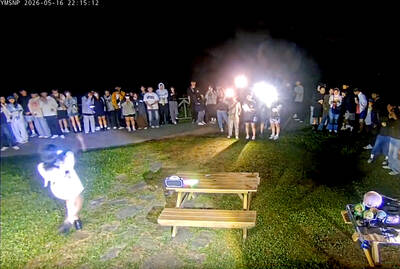
Yangmingshan National Park’s Qingtiangang (擎天崗) nature area has gone viral after a park livestream camera observed a couple in the throes of intimate congress, which was broadcast live on YouTube, drawing large late-night crowds and sparking a backlash over noise, bright lights and disruption to wildlife habitat. The area’s livestream footage appeared to show a couple engaging in sexual activity on a picnic table in the park on Friday last week, with the uncensored footage streamed publicly online. The footage quickly spread across social media, prompting a tide of visitors to travel to the site to “check in” and recreate the

Minister of Digital Affairs Lin Yi-ching (林宜敬) yesterday cited regulatory issues and national security concerns as an expert said that Taiwan is among the few Asian regions without Starlink. Lin made the remarks on Facebook after funP Innovation Group chief executive officer Nathan Chiu (邱繼弘) on Friday said Taiwan and four other countries in Asia — China, North Korea, Afghanistan and Syria — have no access to Starlink. Starlink has become available in 166 countries worldwide, including Ukraine, Malaysia, the Philippines and Vietnam, in the six years since it became commercial, he said. While China and North Korea block Starlink, Syria is not


 RSS
RSS