


Former US Indo-Pacific Command director of intelligence Michael Studeman has called on the Legislative Yuan to pass a NT$1.25 trillion (US$39.6 billion) supplementary defense budget "with all due haste," saying that Taiwan should look beyond this year and not allow "temporary" headwinds to derail its critical defense strategy.
Studeman, a recognized expert on Asian affairs and national security, is in Taiwan to meet with government officials to discuss issues relating to Taiwan's security and promote the Chinese-language edition of his book Might of the Chain: Forging Leaders of Iron Integrity.
"The Davidson window" still stands, despite a report published last month by the US Intelligence Community assessing that Chinese leaders do not plan to invade Taiwan next year, Studeman said in an interview yesterday.

Photo: CNA
The Davidson window refers to a time frame first brought to the attention of the US Senate in 2021 by former Indo-Pacific Command commander Philip Davidson, which indicated that the Chinese military was working to develop the capabilities to attempt a takeover of Taiwan between then and next year, under the direction of Chinese President Xi Jinping (習近平).
Studeman, a retired US Navy rear admiral, said that time frame was meant to highlight China's overarching strategic ambition, not to predict what would happen.
However, Taiwan needs to "meet that strategic ambition with strategic defense ambition that would truly be up to the task," he said.
Citing the occasional large-scale Chinese military exercises that have encircled Taiwan over the past few years and China's intensifying "gray zone" harassment, Studeman said that Taiwan should be "on guard."
"The world is proving to be volatile and unpredictable, and any combination of events can skew things into a different situation altogether," said Studeman, who also served as director of the National Maritime Intelligence-Integration Office, commander of the Office of Naval Intelligence and director of intelligence at the US Southern Command.
Studeman urged foresight in reviewing the NT$1.25 trillion special defense budget, which was proposed by the Cabinet and includes funding for future arms purchases from the US, but has been stalled in the legislature for months.
The opposition Chinese Nationalist Party (KMT) and Taiwan People's Party, which together hold a legislative majority, have been blocking the eight-year special defense budget, saying that, among other issues, its approval would give the government a blank check to bypass routine annual legislative oversight.
Political commentators in Taiwan have said another factor might be the low chances of the US Congress approving additional arms sales to Taiwan this year, given that US President Donald Trump seems poised to strike a trade deal with Xi when they meet in Beijing on May 14 and 15.
However, "the importance of getting the US$40 billion through the Legislative Yuan is indisputable in terms of the danger to Taiwan and the need to get real capability real fast," Studeman said.
While there might be some efforts to create a positive atmosphere for a trade deal, they are temporary and only apply in the near term, he said.
"Over the long haul, Taiwan needs to get that money allocated so you can do the multi-year planning and funding for a full variety of weapon systems," Studeman said.
While much of the attention on the defense budget is focused on the estimated NT$800 billion in US foreign military sales to Taiwan, there are funds earmarked for direct commercial sales that would give Taiwan more "options," he said.
"The foreign military sales program tends to be very structured, very disciplined, very set-piece and very slow," Studeman said, adding that there are different routes to access the capabilities Taiwan seeks.
"Where one may slow down, the dynamic decisions within the government should be to be able to adjust paths and look at other ways to be able to get the capability in," Studeman said.
The special defense budget, planned by the Ministry of National Defense in consultation with the US government, is "sound and reasonable," and should therefore be pursued "with all due haste," he said.
The fact that there are "obstructionists" in the legislature "makes little sense," he added.
"We need to make sure that we have a sense of urgency on this," Studeman said. "And those people in the Legislative Yuan who want to slow this down and dilute the budget, to me, are risking Taiwan's freedom by delaying it."
In his book, Studeman writes that he believes China could launch an attack on Taiwan within this decade.
Asked about Taiwan and the US improving intelligence sharing, Studeman said that Taiwan first has to step up its counterintelligence work against China.
There has been a "night-and-day" difference between the current level of information sharing and what existed six or seven years ago between the US and Taiwan, driven by deepening trust and more frequent contact, Studeman said.
"At the same time, what limits some of the cooperation is the ability to protect secrets," he said, adding that the counterintelligence challenge in Taiwan is "one of the most significant on Earth."
"We have to be very sensitive about how much detail, how much information we provide, because we can't just give it over knowing that the Chinese are going to get it soon after," Studeman said.
While Taiwan has made progress in bolstering cybersecurity and physical security, and has stiffened penalties for people found to have leaked secrets to China, its work in these areas "could be much better," he said.
When Taipei has improved its ability to protect intelligence, the US would likely be willing to share even more, Studeman said.
However, the Taiwanese public "would be pleasantly reassured that there is the right amount of dialogue going on in the right places," he said.

FUKUOKA SITUATION: Japanese media reported that the pathogen is expected to be identified by the summer, while the CDC downplayed the idea that it was hMPV A “mysterious cold-like illness” reported in Japan’s Fukuoka Prefecture does not seem to be a new disease, but Japanese authorities have been asked about the situation, the Centers for Disease Control (CDC) said yesterday. The Fukuoka Prefectural Medical Association on Wednesday told a news conference that a “mystery cold” that has become a hot topic on social media is “highly likely to be caused by some kind of viral infection,” Japan’s KBC News reported. “Many people are experiencing symptoms starting with a sore throat, followed by a runny nose, phlegm and a severe cough,” KBC News reported, citing association officials. Health authorities are

Nvidia Corp CEO Jensen Huang (黃仁勳) arrived in Taiwan yesterday ahead of upcoming AI and technology events, saying he plans to meet with clients and Taiwan Semiconductor Manufacturing Co Chairman C.C. Wei (魏哲家) during his visit. After landing at Taipei Songshan Airport, Huang posed for photos with fans and handed out Yakult drinks to reporters and supporters waiting at the scene, saying he has “a lot to do” during the trip. Asked about reports that Nvidia’s planned headquarters site in Taipei’s Beitou Shilin Technology Park could break ground on May 27, Huang said that if the company holds an event, he would

The Ministry of Finance this afternoon announced the winning numbers for the March-April uniform invoice lottery. The winning number for the NT$10 million (US$318,060) special prize is 19531471, and the winning number for the NT$2 million grand prize is 85941329. Three numbers were drawn for the NT$200,000 first prize: 07225810, 20231230 and 83518781. Those with receipts matching the last seven digits of any of the first-prize numbers will win the NT$40,000 second prize, while those matching the last six digits will win the NT$10,000 third prize. Those whose receipts match the last five digits of the first-prize numbers can claim the NT$4,000 fourth prize,
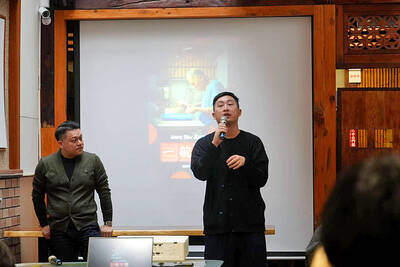
Taiwan Travelogue (臺灣漫遊錄), which earlier this week became the first Taiwanese novel to win the International Booker Prize, is to be adapted into a television series through a Taiwan-Japan coproduction, producer Chang Chen-yu (張辰漁) said yesterday. Chang, a producer at World Softest Production Film Co, wrote on Facebook that the company had been searching for projects with international appeal that retain a strong Taiwanese identity after colleagues and Japanese partners strongly recommended the novel. After reading the book, Chang said he immediately decided to pursue the screen rights. “A great story has the power to transcend time and borders, and connect countless people,”


 RSS
RSS