


Student association leaders and lawmakers today advocated for abolishing curfews at university dorms today, saying that they infringe on the rights of university students as legal adults.
Student rights advocates held a news conference at the Legislative Yuan, led by National Students’ Union of Taiwan chair Chen Yu-jen (陳昱仁), Student Rights Committee chair Huang Lang-teng (黃莨騰), Chung Yuan Christian University Student Association director Shih Yu-feng (施宥烽), Democratic Progressive Party Legislator Rosalia Wu (吳思瑤) and Chinese Nationalist Party (KMT) Legislator Ko Ju-chun (葛如鈞).
A surprising number of universities still have dormitory curfews and enforce them through attendance, locking doors after hours and not allowing students out, Chen said.
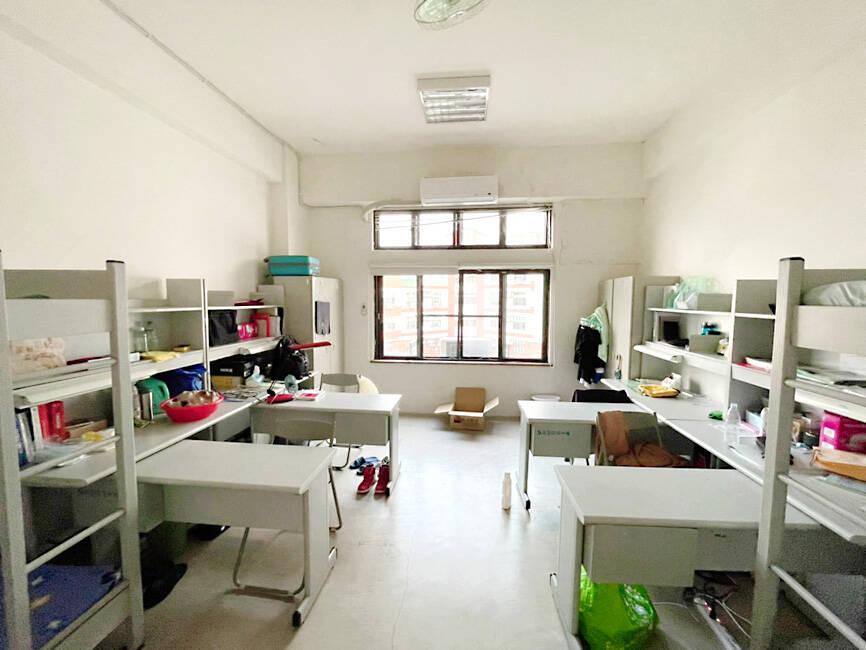
Photo courtesy of National Chi Nan University
If students return late, schools notify parents, issue demerit points and may even evict students from dorms, he said.
This is harmful to students, as they may disregard their own safety as they rush back to the dorm, Chen said.
Economically disadvantaged students who work part-time may miss curfew because of working overtime, and their financial situation would only worsen if they were subsequently evicted and need to find other housing, he added.
For adult university students, curfews are a form of imprisonment, preventing them from even buying a late-night snack or breakfast in the morning, Chen said, urging the Ministry of Education to address the issue and ensure equality across campuses.
Sixty-nine universities and colleges in Taiwan still enforce dormitory curfews, with such rules in place at 67.4 percent of private institutions and 14.9 percent of public ones, Huang said.
Dorm curfews are a means of infantilizing and controlling university students, the student leader said, advocating that curfews should be abolished and students allowed to enter and exit freely with access cards or student IDs.
Dorm safety should be ensured through access control systems, adequate lighting and proper reporting mechanisms, rather than restricting students’ freedom of movement, Wu said.
Since the law recognizes university students aged 18 and over as adults, schools should trust them and let them manage themselves independently, she said.
Dormitory curfews are an outdated, unreasonable and unfair practice that is not necessarily effective in ensuring safety, Ko said, adding it is no longer needed in today’s technologically advanced era.
Ko questioned why schools restrict university students as if they were minors when they are already adults.
The Ministry of Education should help universities strengthen students’ safety and education and cultivate responsible modern citizens, rather than students who blindly obey rules, he added.

SECURITY: Starlink owner Elon Musk has taken pro-Beijing positions, and allowing pro-China companies to control Taiwan’s critical infrastructure is risky, a legislator said Starlink was reluctant to offer services in Taiwan because of the nation’s extremely high penetration rates in 4G and 5G services, the Ministry of Digital Affairs said yesterday. The ministry made the comments at a meeting of the legislature’s Transportation Committee, which reviewed amendments to Article 36 of the Telecommunications Management Act (電信管理法). Article 36 bans foreigners from holding more than 49 percent of shares in public telecommunications networks, while shares foreigners directly and indirectly hold are also capped at 60 percent of the total, unless specified otherwise by law. The amendments, sponsored by Chinese Nationalist Party (KMT) Legislator Ko

The eastern extension of the Taipei MRT Red Line could begin operations as early as late June, the Taipei Department of Rapid Transit Systems said yesterday. Taipei Rapid Transit Corp said it is considering offering one month of free rides on the new section to mark its opening. Construction progress on the 1.4km extension, which is to run from the current terminal Xiangshan Station to a new eastern terminal, Guangci/Fengtian Temple Station, was 90.6 percent complete by the end of last month, the department said in a report to the Taipei City Council's Transportation Committee. While construction began in October 2016 with an

NON-RED SUPPLY: Boosting the nation’s drone industry is becoming increasingly urgent as China’s UAV dominance could become an issue in a crisis, an analyst said Taiwan’s drone exports to Europe grew 41.7-fold from 2024 to last year, with demand from Ukraine’s fight against Russian aggression the most likely driver of growth, a study showed. The Institute for Democracy, Society and Emerging Technology (DSET) in a statement on Wednesday said it found that many of Taiwan’s uncrewed aerial vehicle (UAV) sales were from Poland and the Czech Republic. These countries likely transferred the drones to Ukraine to aid it in its fight against the Russian invasion that started in 2022, it said. Despite the gains, Taiwan is not the dominant drone exporter to these markets, ranking second and fourth

The military has spotted two Chinese warships operating in waters near Penghu County in the Taiwan Strait and sent its own naval and air forces to monitor the vessels, the Ministry of National Defense (MND) said. Beijing sends warships and warplanes into the waters and skies around Taiwan on an almost daily basis, drawing condemnation from Taipei. While the ministry offers daily updates on the locations of Chinese military aircraft, it only rarely gives details of where Chinese warships are operating, generally only when it detects aircraft carriers, as happened last week. A Chinese destroyer and a frigate entered waters to the southwest


 RSS
RSS