


The successful connection between the 8U CubeSat Black Kite-2 and ground stations marks "a key step" toward multi-satellite system verification, Taiwan-based wireless technology company RapidTek said yesterday.
CubeSats are small, box-shaped satellites typically launched into low Earth orbit (LEO) for Earth observation, communications testing and experimental missions.
An "8U" designation means the satellite is composed of eight standardized units.

Photo courtesy of Rapidtek
RapidTek chair Arthur Wang (王奕翔) said that while initial missions focus on verifying the functionality of a single satellite, the long-term goal of LEO development lies in reliably replicating mission procedures and accumulating orbital data to enable coordinated operations among multiple satellites.
Black Kite-2, the second of four 8U CubeSats commissioned by the Taiwan Space Agency (TASA), represents a transition from single-satellite validation to system-level verification, Wang said.
Launched at about 9:28pm on March 30 (Taiwan time) from the Vandenberg Space Force Base, the satellite received a beacon signal within 20 minutes of entering orbit — significantly faster than its predecessor — indicating improved mission preparation and operational procedures, RapidTek said in a news release.
The satellite is now maintaining stable connections with multiple overseas ground stations, demonstrating reliable continuous communications and system integration.
It is currently adjusting its Attitude Determination and Control System to achieve stable orientation.
Once stabilized, it would begin sequential in-orbit verification of its payloads to assess communication performance and application potential, the company said.
Compared to Black Kite-1, which orbits at about 510km, Black Kite-2 operates at an altitude of 590km to gather data under different orbital conditions, providing a reference for future system optimization and mission design.
RapidTek said it would continue expanding its LEO satellite deployment and work toward building small satellite constellations for practical applications.
The company expects to launch two more 8U CubeSats by the end of this year, incorporating inter-satellite communication capabilities to test data-sharing functions and gradually develop an autonomous LEO-based Internet of Things network.
The Black Kite satellites are part of a TASA-initiated program to establish a domestic CubeSat industry, in which the agency cooperates with industrial manufacturers to develop constellation missions with commercial application value.

Actor Darren Wang (王大陸) was sentenced to six months in prison, commutable to a fine, by the New Taipei District Court today for contravening the Personal Data Protection Act (個人資料保護法) in a case linked to an alleged draft-dodging scheme. Wang allegedly paid NT$3.6 million (US$114,380) to an illegal group to help him evade mandatory military service through falsified medical documents, prosecutors said. He transferred the funds to Chen Chih-ming (陳志明), the alleged mastermind of a draft-evasion ring, although he lost contact with him as he was already in detention on fraud charges, they said. Chen is accused of helping a

SECURITY: Starlink owner Elon Musk has taken pro-Beijing positions, and allowing pro-China companies to control Taiwan’s critical infrastructure is risky, a legislator said Starlink was reluctant to offer services in Taiwan because of the nation’s extremely high penetration rates in 4G and 5G services, the Ministry of Digital Affairs said yesterday. The ministry made the comments at a meeting of the legislature’s Transportation Committee, which reviewed amendments to Article 36 of the Telecommunications Management Act (電信管理法). Article 36 bans foreigners from holding more than 49 percent of shares in public telecommunications networks, while shares foreigners directly and indirectly hold are also capped at 60 percent of the total, unless specified otherwise by law. The amendments, sponsored by Chinese Nationalist Party (KMT) Legislator Ko

The eastern extension of the Taipei MRT Red Line could begin operations as early as late June, the Taipei Department of Rapid Transit Systems said yesterday. Taipei Rapid Transit Corp said it is considering offering one month of free rides on the new section to mark its opening. Construction progress on the 1.4km extension, which is to run from the current terminal Xiangshan Station to a new eastern terminal, Guangci/Fengtian Temple Station, was 90.6 percent complete by the end of last month, the department said in a report to the Taipei City Council's Transportation Committee. While construction began in October 2016 with an
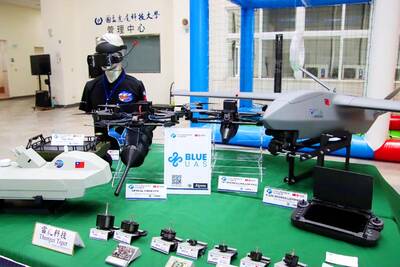
NON-RED SUPPLY: Boosting the nation’s drone industry is becoming increasingly urgent as China’s UAV dominance could become an issue in a crisis, an analyst said Taiwan’s drone exports to Europe grew 41.7-fold from 2024 to last year, with demand from Ukraine’s fight against Russian aggression the most likely driver of growth, a study showed. The Institute for Democracy, Society and Emerging Technology (DSET) in a statement on Wednesday said it found that many of Taiwan’s uncrewed aerial vehicle (UAV) sales were from Poland and the Czech Republic. These countries likely transferred the drones to Ukraine to aid it in its fight against the Russian invasion that started in 2022, it said. Despite the gains, Taiwan is not the dominant drone exporter to these markets, ranking second and fourth


 RSS
RSS