


The Taiwan People’s Party (TPP) has a rational, pragmatic and scientific approach for reviewing defense budgets and would “not oppose just for the sake of opposition,” TPP Chairman Huang Kuo-chang (黃國昌) said yesterday at a defense forum.
The forum, called “From Military Procurement to Combat Capability: A Review of Defense Policy and Oversight Mechanisms,” was hosted by the party and attended by military analysts including former captain Huang Cheng-hui (黃征輝) and former defense official Lu Te-yun (盧德允).
The party has consistently supported enhancing national defense, Huang Kuo-chang said, adding that the TPP caucus during the 2025 defense budget review did not propose any cuts except for concerns it raised about the illegal use of Chinese-made products in the “Intelligent Surveillance and Monitoring System for Key Defense Camps” and called for a temporary freeze on the allocation of a significant follow-up budget for the locally built submarine Hai Kun (海鯤), as the first vessel has not yet even completed sea trials.
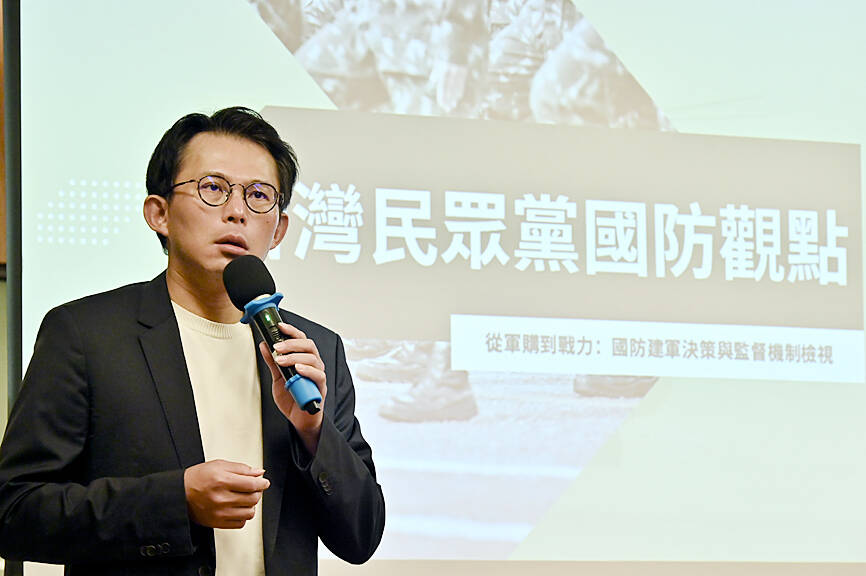
Photo: George Tsorng, Taipei Times
The caucus requested the executive branch provide corrections and clarifications before the freeze is lifted, he said.
“The freeze is an oversight measure, not opposition to national defense,” he said. “Responsible legislative oversight ensures taxpayers’ money is spent effectively and that our frontline military personnel receive the best training and equipment.”
Regarding the Cabinet’s proposed NT$1.25 trillion (US$39.7 billion) special defense budget, he said the two special defense budgets allocated during the eight-year presidency of former president Tsai Ing-wen (蔡英文) totaled about NT$400 billion, whereas President William Lai (賴清德), still not halfway through his term, has proposed a budget of NT$1.25 trillion, “a big amount with its details remaining unclear.”
The legislature and the public were not formally informed by the executive branch, he said. Instead, they learned about the proposal through foreign media reports, he said, adding that “this should never be considered acceptable in a democratic country.”
Huang Cheng-hui said Taiwan’s military development should seek to build a lean, professional army and invest more resources in uncrewed vehicles, artificial intelligence-driven systems and distributed operation capabilities.
For the navy, equipment such as landing craft, transport ships or rescue boats can be obtained via the private sector or wartime mobilization, he said.
Such resources should not be maintained with the military’s personnel and budgets for the long term, he added.
The army and air force should reconsider the number of battle tanks and advanced fighters actually required, he said, adding that the phrase “the more the better” is a myth.
Society for Strategy Studies senior researcher Chang Ching (張競) said the executive branch proposed the NT$1.25 trillion budget bill in the name of urgent security needs, but did not fully explain to the public and the legislature the proposed budget’s specific items, procurement reasons, delivery timelines and risk control.
That is procedurally imbalanced and irresponsible defense planning, with the legislature limited to choosing “between ‘a menu without dishes served’ and ‘a chef’s tasting menu’” and asked to pay the check without questions, he said.
Lu said defense procurement should not only align with the US military-industrial complex’s interests, but must also fulfill Taiwan’s defense requirements.
If Taiwan cannot effectively buttress its defense capability through arms deals, poor allocation of limited resources could be weaken the nation as a whole, he said.
That might not align with the US’ national interests in its pursuit of maintaining stability in the first island chain, he added.

Yangmingshan National Park authorities yesterday urged visitors to respect public spaces and obey the law after a couple was caught on a camera livestream having sex at the park’s Qingtiangang (擎天崗) earlier in the day. The Shilin Police Precinct in Taipei said it has identified a suspect and his vehicle registration number, and would summon him for questioning. The case would be handled in accordance with public indecency charges, it added. The couple entered the park at about 11pm on Thursday and began fooling around by 1am yesterday, the police said, adding that the two were unaware of the park’s all-day live

A former soldier and an active-duty army officer were yesterday indicted for allegedly selling classified military training materials to a Chinese intelligence operative for a total of NT$79,440. The Taipei District Prosecutors’ Office indicted Chen Tai-yin (陳泰尹) and Lee Chun-ta (李俊達) for contravening the National Security Act (國家安全法) and the Anti-Corruption Act (貪污治罪條例). Chen left the military in September 2013 after serving alongside then-staff sergeant Lee, now an army lieutenant, at the 21st Artillery Command of the army’s Sixth Corps from 2011 to 2013, according to the indictment. Chen met a Chinese intelligence operative identified as “Wang” (王) through a friend in November

Minister of Digital Affairs Lin Yi-ching (林宜敬) yesterday cited regulatory issues and national security concerns as an expert said that Taiwan is among the few Asian regions without Starlink. Lin made the remarks on Facebook after funP Innovation Group chief executive officer Nathan Chiu (邱繼弘) on Friday said Taiwan and four other countries in Asia — China, North Korea, Afghanistan and Syria — have no access to Starlink. Starlink has become available in 166 countries worldwide, including Ukraine, Malaysia, the Philippines and Vietnam, in the six years since it became commercial, he said. While China and North Korea block Starlink, Syria is not
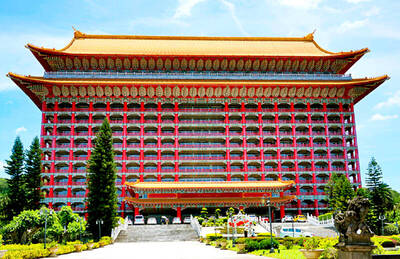
The Grand Hotel Taipei has rejected media reports claiming that the hotel had prevented CBS from broadcasting coverage of the Beijing summit between U.S. President Donald Trump and Chinese President Xi Jinping (習近平) on its premises. Media reports alleging that the hotel owner, dissatisfied with CBS’s coverage, prohibited the network from broadcasting political content on the hotel premises, are not true, the hotel said in a statement issued last night. The reports were “inconsistent with how the hotel actually handled the matter,” it said. The hotel said it received a refund request from a


 RSS
RSS