


More than 250 academics have signed a petition calling for the termination of an incinerator project in Nantou County’s Mingjian Township (名間), the fourth scoping meeting of which is scheduled to be held on Monday and Tuesday.
The county government’s push to set up an incinerator in the tea-rich township has been raising wide backlash for months.
Speaking on behalf of more than 250 domestic and international academics, Soochow University sociology associate professor Sana Ho (何撒娜) yesterday told a news conference that the project poses a threat to the nation’s food security amid increasing geopolitical tensions.
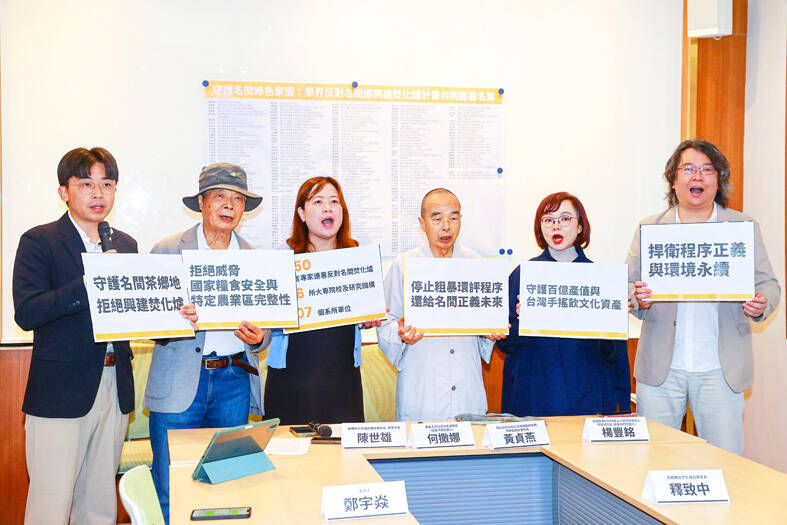
Photo: CNA
Tea and hand-shaken drinks are a significant cultural capital of Taiwan and symbolize Taiwanese national identity internationally, she said, calling for protection of the tea industry, which is worth more than NT$10 billion (US$317.3 million) per year.
“We attended meetings multiple times and saw that the county government disregarded the law at the expense of procedural justice and people’s environmental rights,” Ho said, urging the county government not to undermine the bedrock of agriculture.
Former Mingdao University president and organic farming expert Eddie Chen (陳世雄) said advanced industrial countries such as Japan and Germany value farmland and uphold environmental resilience.
“Zero alternative” is a core principle guiding the site selection process of large infrastructure projects in Germany, he said.
The county government is making a big mistake, as it has many alternatives to the township’s special agricultural zone, Chen said.
More than 73 percent of the county’s GDP, including 21 percent in agriculture and 52 percent in tourism, are related to land and environment, he said.
The incinerator would cause irreparable damage to local agriculture and tourism, he added.
Huang Jan-yen (黃貞燕), director of the Graduate Institute of Museum Studies at the Taipei National University of the Arts, said the township’s tea industry is a cultural heritage of Taiwan.
Tea cultivation sites in Asia have become a category of the globally important agricultural heritage systems (GIAHS) recognized by the UN Food and Agriculture Organization, she said.
Three tea production regions in China, one in Japan and one in South Korea have been recognized as tea GIAHS sites, she added.
Taiwan’s tea production areas, such as the township, have the potential to earn such a recognition, Huang said, adding that Mingjian Puzhong Tea has since 2019 been listed by the county government as an intangible cultural heritage.
The township’s tea industry is not one that could thrive as well if it is relocated, as it is intertwined with the land, ecosystems and local communities, she added.

Yangmingshan National Park authorities yesterday urged visitors to respect public spaces and obey the law after a couple was caught on a camera livestream having sex at the park’s Qingtiangang (擎天崗) earlier in the day. The Shilin Police Precinct in Taipei said it has identified a suspect and his vehicle registration number, and would summon him for questioning. The case would be handled in accordance with public indecency charges, it added. The couple entered the park at about 11pm on Thursday and began fooling around by 1am yesterday, the police said, adding that the two were unaware of the park’s all-day live

A former soldier and an active-duty army officer were yesterday indicted for allegedly selling classified military training materials to a Chinese intelligence operative for a total of NT$79,440. The Taipei District Prosecutors’ Office indicted Chen Tai-yin (陳泰尹) and Lee Chun-ta (李俊達) for contravening the National Security Act (國家安全法) and the Anti-Corruption Act (貪污治罪條例). Chen left the military in September 2013 after serving alongside then-staff sergeant Lee, now an army lieutenant, at the 21st Artillery Command of the army’s Sixth Corps from 2011 to 2013, according to the indictment. Chen met a Chinese intelligence operative identified as “Wang” (王) through a friend in November

Minister of Digital Affairs Lin Yi-ching (林宜敬) yesterday cited regulatory issues and national security concerns as an expert said that Taiwan is among the few Asian regions without Starlink. Lin made the remarks on Facebook after funP Innovation Group chief executive officer Nathan Chiu (邱繼弘) on Friday said Taiwan and four other countries in Asia — China, North Korea, Afghanistan and Syria — have no access to Starlink. Starlink has become available in 166 countries worldwide, including Ukraine, Malaysia, the Philippines and Vietnam, in the six years since it became commercial, he said. While China and North Korea block Starlink, Syria is not
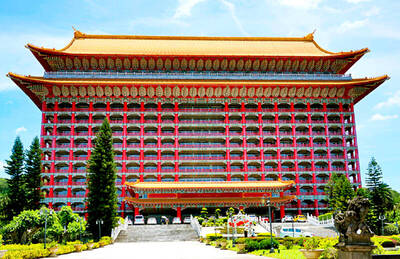
The Grand Hotel Taipei has rejected media reports claiming that the hotel had prevented CBS from broadcasting coverage of the Beijing summit between U.S. President Donald Trump and Chinese President Xi Jinping (習近平) on its premises. Media reports alleging that the hotel owner, dissatisfied with CBS’s coverage, prohibited the network from broadcasting political content on the hotel premises, are not true, the hotel said in a statement issued last night. The reports were “inconsistent with how the hotel actually handled the matter,” it said. The hotel said it received a refund request from a


 RSS
RSS