


Environmental activists yesterday urged the Kaohsiung City Government and Taiwan Semiconductor Manufacturing Co (TSMC) to accelerate the adoption of green energy as the Ministry of Environment proceeds with an environmental impact assessment for Phase II of the Nanzih Park development project.
The activists yesterday afternoon held a news conference at the ministry’s headquarters in Taipei ahead of an environmental impact assessment meeting on the project.
TSMC has planned to build five 2-nanometer wafer plants on the site previously used by the Kaohsiung refinery inside the Nanzih Park, with two of the plants being scheduled to start operations by the end of last year and this year.
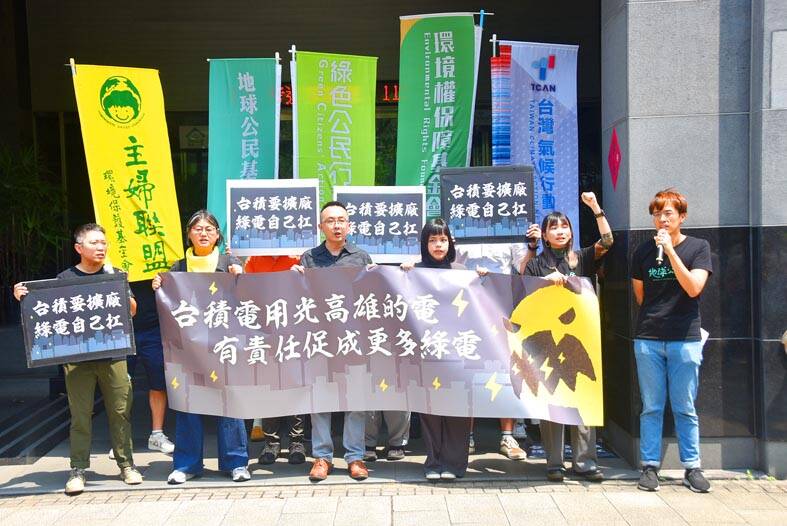
Photo: Wu Po-hsuan, Taipei Times
The project’s annual power consumption is estimated to reach about 112 gigawatt-hours, which is equivalent to that of Kaohsiung’s residential and commercial districts last year, activists said.
“If you look at the data, it is no exaggeration to say that TSMC would exhaust the electricity grid in Kaohsiung,” they said.
TSMC has planned to build new wafer plants across the nation, Citizen of the Earth, Taiwan media marketing director Teng Yu-yu (鄧宇佑) said, adding that 10 percent of the nation’s electricity would be consumed by the chipmaker.
“The issue does not merely concern TSMC. It concerns Taiwan’s energy policy and development of green energy,” Teng said.
TSMC has pledged to raise the use of renewable energy to 60 percent by 2030 and 100 percent by 2040, but said its power would be supplied by Taiwan Power Co (Taipower), Teng said.
The chipmaker should take a more proactive role by committing to work with local governments to invest resources in developing regional renewable energy, he said.
This includes helping assess local green energy potential, investing in more environmentally and socially responsible renewable energy project models, and funding community-based power plants, he added.
Demand for renewable energy is high in Kaohsiung, Homemakers United Foundation southern office director Chen Wan-e (陳婉娥) said.
In addition to TSMC plants in Kaohsiung’s Nanzih District (楠梓), there are other development plans in the city for industries such as semiconductor packaging and uncrewed aerial vehicles, Chen said.
Taipower statistics show that Kaohsiung’s renewable energy capacity had reached only about 1.55 megawatts as of February, she said.
The city government needs to develop new renewable energy policies and take greater responsibility for local electricity planning, she said, adding that all 22 administrative regions in Taiwan should take responsibility for their own electricity demand, rather than shifting the burden to Taipower.
Even if the Ma-anshan Nuclear Power Plant in Pingtung County is restarted, the power plant could only provide about 2 gigawatts (GW) of electricity monthly, which is far below the estimated 3.5GW demand from the Nanzih and Shalun areas combined, Environmental Rights Foundation director Tang Lin-hsiang (湯琳翔) said.
The government plans to depend on the Hsinta Power Plant in Kaohsiung to meet most of the new electricity demand, which required expansion of multiple large gas units while preventing retirement of older ones, Tang said.
Such a method is not environmentally sustainable, Tang said.
The Southern Taiwan Science Park (南部科學園區), the project’s developer, said the project aims to host emerging industries such as software services, artificial intelligence of things, 5G and green energy.
It is expected to create about 6,600 jobs and generate an annual output value of about NT$960 billion (US$30.49 billion), with construction scheduled for completion by the end of 2033, it said.
All companies involved have committed to installing solar systems on office rooftops and are working toward the goal of having 100 percent renewable energy by 2040, it said.
They have partnered with renewable energy providers — including wind, solar and small hydropower — and signed long-term agreements, reaching about 3.1GW in total renewable capacity, the park administration said.
That reflects a strong commitment to expanding green energy use and achieving environmental sustainability, it added.

UPGRADE: The Kang Ding-class frigate is replacing its Chaparall missiles with Tien Chien II and Hua Yang VLS, which would provide it with long-range, 360° air defense Taiwan plans to produce 1,200 to 1,376 Hai Chien II missiles (海劍二, Sea Sword II) — also known as TC-2N — to serve as the standard air defense system of the navy’s surface combatant fleet, a source said yesterday. Last week, the Hai Chien II, the naval version of the Tien Kung II missile (天劍二, Sky Sword II), completed a live-fire test in waters off the National Chungshan Institute of Science and Technology’s Jiupeng facility (九鵬) in Pingtung County’s Manjhou Township (滿州). The MIM72 Chaparral and other dated air defense missiles that currently arm Taiwanese ships have inadequate range to combat Chinese

REASONS FOR TRAVEL: An assistant professor said that proposed amendments to penalize drivers if they used drugs overseas would not deter people from traveling People who operate a motor vehicle under the influence of marijuana would have their driver’s license revoked, even if they used the substance while overseas, the Ministry of Transportation and Communications said yesterday, citing proposed amendments to the Road Traffic Management and Penalty Act (道路交通管理處罰條例). The amendments would also authorize the government to revoke the licenses of people determined to have used Category 1 or Category 2 narcotics, even if they were not operating a vehicle while under the influence of drugs, as well as ban them from taking the license test for three years, the ministry said. People aged 18 or

HEAVY WEATHER: Typhoon Jangmi is due to crash straight into the Ryukyus as airlines look to shift flights to larger aircraft or cancel flights to Okinawa entirely Taiwan’s international air carriers announced flight adjustments over the weekend as Typhoon Jangmi is forecast to hit the Ryukyu Islands today and tomorrow. The Central Weather Administration (CWA) upgraded Jangmi from a tropical storm to a typhoon at 8am yesterday, with the eye located 580km south of Naha city. It was moving north at 19kph. Today, China Airlines’ CI-120, CI-121, CI-122 and CI-123 flights between Taoyuan and Naha, Okinawa, have been canceled as well as CI-132 and CI-133 between Kaohsiung and Naha. EVA Air’s BR-112, BR-113, BR-186 and BR-185 flights between Taoyuan and Naha are also canceled. Low-cost carrier Tigerair Taiwan canceled IT-230,
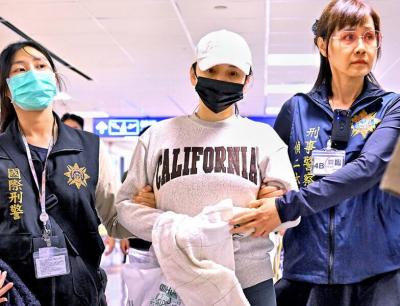
Johanne Liou (劉喬安), a Taiwanese woman who shot to unwanted fame during the Sunflower movement protests in 2014, returned to Taiwan last night after being deported from the US. She is to stand trial in Taiwan for charges involving embezzlement, fraud and drug crimes. The Criminal Investigation Bureau (CIB) said it took her into custody at Taiwan Taoyuan International Airport and would first question her before transferring her to the New Taipei District Prosecutors’ Office. She was arrested upon disembarking a flight from San Francisco that landed shortly before 7pm. Liou absconded to the US in 2019 after jumping bail


 RSS
RSS