


The Democratic Progressive Party (DPP) caucus yesterday criticized China’s latest so-called “incentives,” accusing Beijing of using economic incentives for political leverage.
The caucus made the statement after General Chamber of Commerce chairman Paul Hsu (許舒博) earlier in the day convened representatives from seven major industry associations, urging the government to accept Beijing’s 10 newly announced measures.
DPP caucus deputy chief executive Chen Pei-yu (陳培瑜) said China is simultaneously increasing military pressure while offering trade incentives.
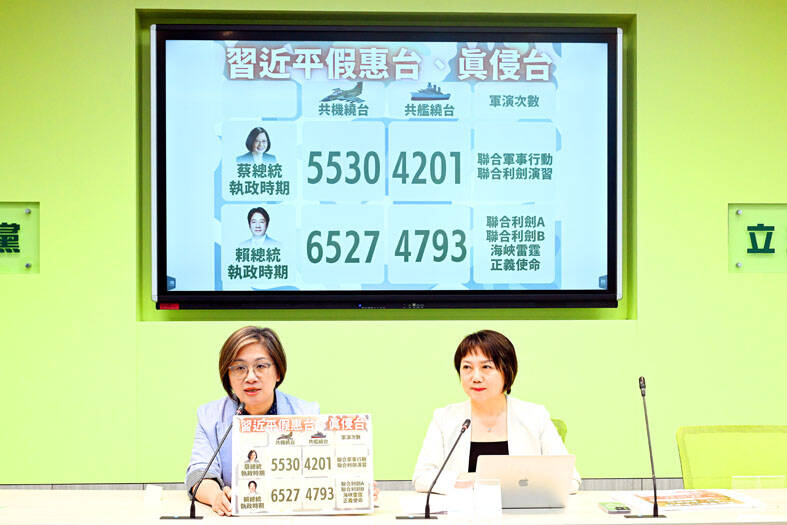
Photo: Liao Chen-huei, Taipei Times
She cited DPP-led local governments, including Chiayi County Commissioner Weng Chang-liang (翁章梁), Kaohsiung Mayor Chen Chi-mai (陳其邁), Pingtung County Commissioner Chou Chun-mi (周春米) and Tainan Mayor Huang Wei-che (黃偉哲), as promoting Taiwanese produce in Japan, South Korea and Malaysia.
She said the Ministry of Agriculture has expanded agricultural exports, which rose from 75,000 tonnes in 2023 to 84,000 tonnes in 2024.
DPP caucus secretary-general Fan Yun (范雲) said Taiwan supports market opening with China but added that it must be reciprocal and not used for political pressure.
She cited China’s use of similar tactics against other countries, including tourism restrictions on Japan and trade disputes with Australia.
Taiwan should continue engaging globally rather than be confined to a “one China framework,” she said.
Separately, a source involved in cross-strait affairs, speaking anonymously, said China is likely to continue abruptly restricting Taiwan’s access to its market in response to political developments, making its latest promises difficult to trust.
Excluding two items involving exchanges between the Chinese Nationalist Party (KMT) and the Chinese Communist Party (CCP), the remaining eight measures in China’s latest offers concern sectors Beijing has repeatedly opened and closed over the past two decades for what the source described as “unfounded reasons.”
“Those shifting policies have caused repeated losses for Taiwanese industries and farmers,” the source said.
They added that Taiwan’s economy today is far less dependent on China than in 2005, when then-KMT chairman Lien Chan (連戰) met then-Chinese president Hu Jintao (胡錦濤) in Beijing, and has expanded globally.
“The one China market model is unworkable and would tie Taiwan to Beijing at the cost of democracy and freedoms,” the source said, adding that stable and predictable policy is essential for an export-oriented economy.
They said Beijing has provided no clear timetable or guarantees against renewed import suspensions, undermining confidence among affected industries.
An Executive Yuan official, who declined to be named, emphasized yesterday that China often exhibits high uncertainty and even selectivity in related exchange measures, which could lead to additional risks for businesses.
The Mainland Affairs Council (MAC) said last night that China’s ten 10 Taiwan-related measures is not only a political arrangement between the CCP and the KMT, but also hinges on the so-called "1992 Consensus" and "opposing Taiwan independence."
The MAC argued that these measures clearly compromise Taiwan’s sovereignty, allowing the CCP to extend its influence into Taiwan, attempt internal division, and interfere in elections through united front tactics.
Such actions, the MAC said, are in direct violation of the nation’s broader interests and mainstream public opinion.
The council said it believes that most businesses, once they understand the true nature and potential risks of these measures, will adopt a cautious stance and support the government’s position.
The "1992 consensus" refers to a tacit understanding between the KMT and the CCP that both sides of the Taiwan Strait acknowledge that there is "one China," with each side having its own interpretation of what "China" means.
The DPP has never acknowledged the "1992 consensus," saying that Beijing does not recognize the Republic of China and acceptance of the understanding would imply agreement with China’s claim over Taiwan.
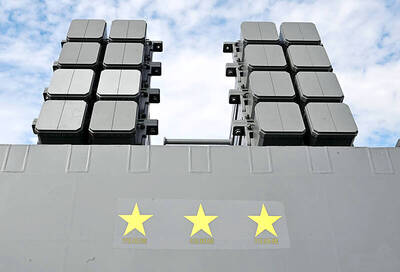
UPGRADE: The Kang Ding-class frigate is replacing its Chaparall missiles with Tien Chien II and Hua Yang VLS, which would provide it with long-range, 360° air defense Taiwan plans to produce 1,200 to 1,376 Hai Chien II missiles (海劍二, Sea Sword II) — also known as TC-2N — to serve as the standard air defense system of the navy’s surface combatant fleet, a source said yesterday. Last week, the Hai Chien II, the naval version of the Tien Kung II missile (天劍二, Sky Sword II), completed a live-fire test in waters off the National Chungshan Institute of Science and Technology’s Jiupeng facility (九鵬) in Pingtung County’s Manjhou Township (滿州). The MIM72 Chaparral and other dated air defense missiles that currently arm Taiwanese ships have inadequate range to combat Chinese

REASONS FOR TRAVEL: An assistant professor said that proposed amendments to penalize drivers if they used drugs overseas would not deter people from traveling People who operate a motor vehicle under the influence of marijuana would have their driver’s license revoked, even if they used the substance while overseas, the Ministry of Transportation and Communications said yesterday, citing proposed amendments to the Road Traffic Management and Penalty Act (道路交通管理處罰條例). The amendments would also authorize the government to revoke the licenses of people determined to have used Category 1 or Category 2 narcotics, even if they were not operating a vehicle while under the influence of drugs, as well as ban them from taking the license test for three years, the ministry said. People aged 18 or

HEAVY WEATHER: Typhoon Jangmi is due to crash straight into the Ryukyus as airlines look to shift flights to larger aircraft or cancel flights to Okinawa entirely Taiwan’s international air carriers announced flight adjustments over the weekend as Typhoon Jangmi is forecast to hit the Ryukyu Islands today and tomorrow. The Central Weather Administration (CWA) upgraded Jangmi from a tropical storm to a typhoon at 8am yesterday, with the eye located 580km south of Naha city. It was moving north at 19kph. Today, China Airlines’ CI-120, CI-121, CI-122 and CI-123 flights between Taoyuan and Naha, Okinawa, have been canceled as well as CI-132 and CI-133 between Kaohsiung and Naha. EVA Air’s BR-112, BR-113, BR-186 and BR-185 flights between Taoyuan and Naha are also canceled. Low-cost carrier Tigerair Taiwan canceled IT-230,
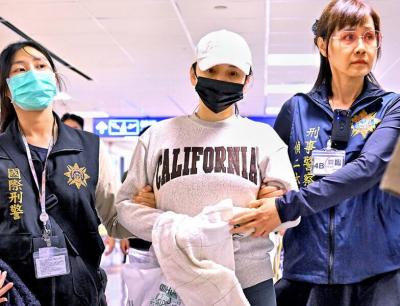
Johanne Liou (劉喬安), a Taiwanese woman who shot to unwanted fame during the Sunflower movement protests in 2014, returned to Taiwan last night after being deported from the US. She is to stand trial in Taiwan for charges involving embezzlement, fraud and drug crimes. The Criminal Investigation Bureau (CIB) said it took her into custody at Taiwan Taoyuan International Airport and would first question her before transferring her to the New Taipei District Prosecutors’ Office. She was arrested upon disembarking a flight from San Francisco that landed shortly before 7pm. Liou absconded to the US in 2019 after jumping bail


 RSS
RSS