


Beijing is employing a “carrot and stick” strategy that combines engagement with coercion, as Chinese military incursions around Taiwan peaked on the day Chinese Nationalist Party (KMT) Chairwoman Cheng Li-wun (鄭麗文) met with Chinese President Xi Jinping (習近平), underscoring that party exchanges would not reduce military pressure, Taiwanese academics said.
During Cheng’s visit to China from Tuesday last week to Sunday, Chinese military aircraft and vessels conducted daily incursions around Taiwan, reaching a peak when Cheng met with Xi on Friday.
That reflects the Chinese Communist Party’s (CCP) tactic of “applying pressure through engagement and coercion,” said Su Tzu-yun (蘇紫雲), director of the Institute for National Defense and Security Research’s Defense Strategy and Resources Division.
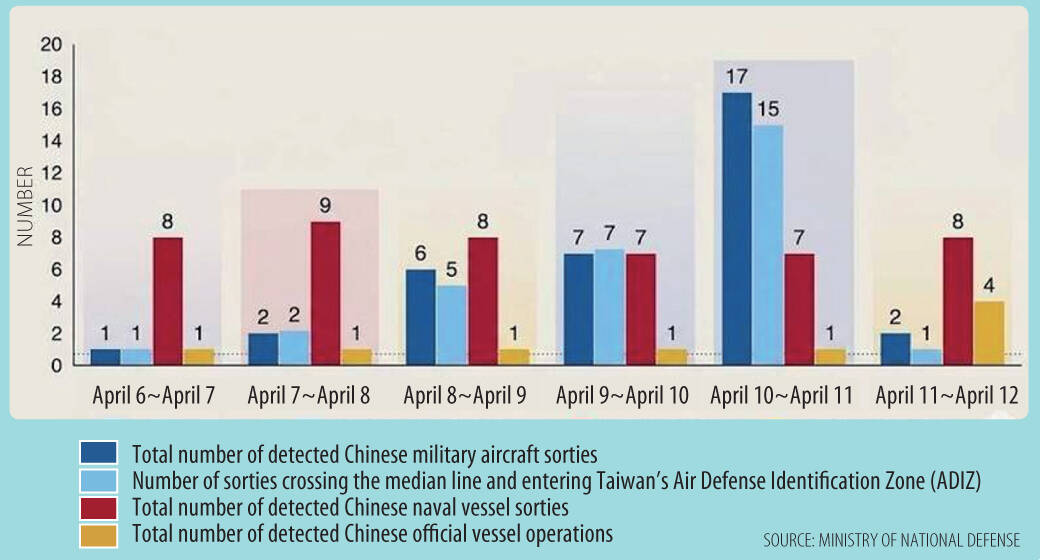
Source: Ministry of National Defense
China on Sunday announced 10 preferential measures for Taiwan to promote exchanges, which added pressure on the “engagement” side, Su said.
Through KMT-CCP cooperation, China aims to weaken Taiwan’s public morale and defenses, he said.
A KMT promotional video claiming that “only with peace can we lie flat” has been ineffective, and its proposed notion of peace is actually surrender, he said.
China continued to dispatch military aircraft and vessels to harass Taiwan during Cheng’s visit, showing that the KMT’s so-called olive branch was actually a smokescreen, Su said.
Talks should not be approached naively, and saying that a threatening party “has a good side” reflects a flawed mindset, and Taiwan should move away from this kind of collective Stockholm syndrome, he said.
Chinese military activity around Taiwan does not fluctuate with political exchanges, but is a long-standing norm, Tunghai University Center for Mainland China and Regional Development Research deputy director Hung Pu-chao (洪浦釗) said.
For China, cross-strait engagement is an ongoing process without a clear endpoint, and military operations are part of its overall Taiwan policy, which would not change because of a single visit, he said.
China is using a “carrot and stick” strategy against Taiwan, providing incentives with exchanges and economic opportunities while maintaining pressure with military activities, Hung said.
Military activity is not just a security measure, but aligned with broader political arrangements, making certain forms of engagement appear more necessary, he added.
The spike in Chinese military activity around Taiwan on the day of the Cheng-Xi meeting is a clear illustration of the “carrot and stick” strategy, Hung said.
China would not reduce military pressure because of party-to-party exchanges, while sustained pressure serves to legitimize the “peaceful” pathway defined by Beijing, he said.

FUKUOKA SITUATION: Japanese media reported that the pathogen is expected to be identified by the summer, while the CDC downplayed the idea that it was hMPV A “mysterious cold-like illness” reported in Japan’s Fukuoka Prefecture does not seem to be a new disease, but Japanese authorities have been asked about the situation, the Centers for Disease Control (CDC) said yesterday. The Fukuoka Prefectural Medical Association on Wednesday told a news conference that a “mystery cold” that has become a hot topic on social media is “highly likely to be caused by some kind of viral infection,” Japan’s KBC News reported. “Many people are experiencing symptoms starting with a sore throat, followed by a runny nose, phlegm and a severe cough,” KBC News reported, citing association officials. Health authorities are

Nvidia Corp CEO Jensen Huang (黃仁勳) arrived in Taiwan yesterday ahead of upcoming AI and technology events, saying he plans to meet with clients and Taiwan Semiconductor Manufacturing Co Chairman C.C. Wei (魏哲家) during his visit. After landing at Taipei Songshan Airport, Huang posed for photos with fans and handed out Yakult drinks to reporters and supporters waiting at the scene, saying he has “a lot to do” during the trip. Asked about reports that Nvidia’s planned headquarters site in Taipei’s Beitou Shilin Technology Park could break ground on May 27, Huang said that if the company holds an event, he would

The Ministry of Finance this afternoon announced the winning numbers for the March-April uniform invoice lottery. The winning number for the NT$10 million (US$318,060) special prize is 19531471, and the winning number for the NT$2 million grand prize is 85941329. Three numbers were drawn for the NT$200,000 first prize: 07225810, 20231230 and 83518781. Those with receipts matching the last seven digits of any of the first-prize numbers will win the NT$40,000 second prize, while those matching the last six digits will win the NT$10,000 third prize. Those whose receipts match the last five digits of the first-prize numbers can claim the NT$4,000 fourth prize,
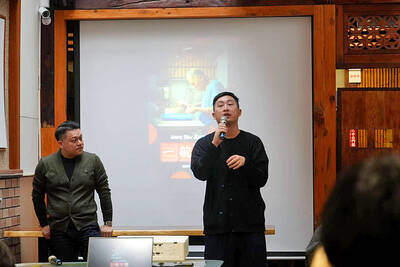
Taiwan Travelogue (臺灣漫遊錄), which earlier this week became the first Taiwanese novel to win the International Booker Prize, is to be adapted into a television series through a Taiwan-Japan coproduction, producer Chang Chen-yu (張辰漁) said yesterday. Chang, a producer at World Softest Production Film Co, wrote on Facebook that the company had been searching for projects with international appeal that retain a strong Taiwanese identity after colleagues and Japanese partners strongly recommended the novel. After reading the book, Chang said he immediately decided to pursue the screen rights. “A great story has the power to transcend time and borders, and connect countless people,”


 RSS
RSS