


Chinese Nationalist Party (KMT) Chairwoman Cheng Li-wun (鄭麗文) is “playing with fire” with her remark that the Taiwan Strait should “never be a chessboard for interference by external forces,” Premier Cho Jung-tai (卓榮泰) said yesterday.
Cheng on Friday made the remark during a meeting with Chinese President Xi Jinping (習近平) in Beijing as she called for Taiwan and China to forge closer ties and avoid conflict.
The Taiwan Strait is an international waterway open to free transit and Cheng’s remark revealed an “erroneous” strategy that unilaterally panders to China, Cho said.
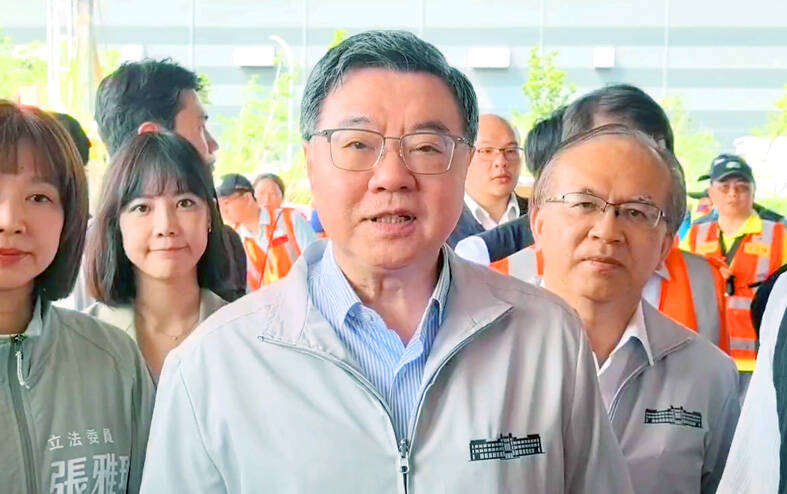
Photo: Hsieh Wu-hsiung, Taipei Times
Cheng’s stance puts Taiwan’s future, and its people’s free and democratic way of life at risk, he said.
She also deserves criticism for echoing Xi’s remarks about facilitating the “great rejuvenation of the Chinese nation,” Cho said.
Her comments were a mistake, as they might have added fuel to China’s ambition to absorb the Taiwan Strait and Taiwan, he said.

Photo: CNA
The phrase “rejuvenation of the Chinese nation” refers to the Chinese Communist Party’s (CCP) goal to turn China into a great power by 2049, the 100th anniversary of the People’s Republic of China (PRC), which includes making Taiwan officially part of the PRC.
China’s “national reunification,” which includes annexing Taiwan, is an “essential step toward national rejuvenation,” a white paper published in 2022 by China’s Taiwan Affairs Office, and official speeches and other documents showed.
The KMT and the CCP “engaged in nearly 100 years of political struggle. Yet during Friday’s meeting, the KMT appeared to have completely lost confidence,” Cho said.
Cheng’s proposal of a cross-strait peace framework to “institutionalize peace” was another misstep, he said.
History has proven that in negotiations between the KMT and the CCP — and in China’s dealings with Tibet and Hong Kong — “peace without strength is bound to fail,” he said.
“Such peace can embolden aggressors and only peace backed by strength can serve as the foundation of national power,” he said.
In a statement later yesterday, the KMT rejected Cho’s comments, saying that his Democratic Progressive Party (DPP) is unable to handle cross-strait relations and is resorting to falsely calling the opposition pro-China.
The DPP government, despite years in power, has only escalated confrontations with and created hostility toward Beijing, the statement said.
Comparing the history of Hong Kong and Tibet to Taiwan’s situation “exposes the DPP’s helplessness on cross strait issues” and its inability to engage in dialogue with China, it said.
“Repeatedly using Taiwan’s security as a tool for political struggle is truly playing with fire, the statement said, adding that the DPP has “gone too far.”
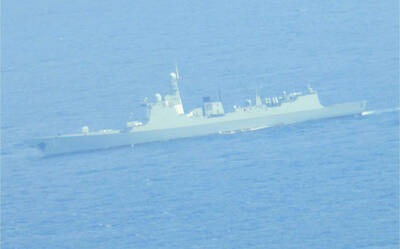
The military has spotted two Chinese warships operating in waters near Penghu County in the Taiwan Strait and sent its own naval and air forces to monitor the vessels, the Ministry of National Defense (MND) said. Beijing sends warships and warplanes into the waters and skies around Taiwan on an almost daily basis, drawing condemnation from Taipei. While the ministry offers daily updates on the locations of Chinese military aircraft, it only rarely gives details of where Chinese warships are operating, generally only when it detects aircraft carriers, as happened last week. A Chinese destroyer and a frigate entered waters to the southwest
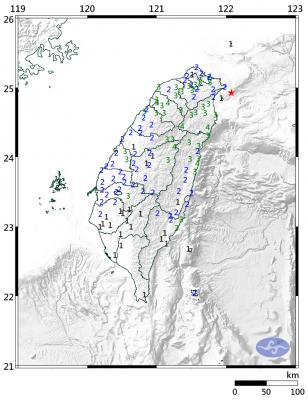
A magnitude 6.1 earthquake struck off the coast of Yilan County at 8:39pm tonight, the Central Weather Administration (CWA) said, with no immediate reports of damage or injuries. The epicenter was 38.7km east-northeast of Yilan County Hall at a focal depth of 98.3km, the CWA’s Seismological Center said. The quake’s maximum intensity, which gauges the actual physical effect of a seismic event, was a level 4 on Taiwan’s 7-tier intensity scale, the center said. That intensity level was recorded in Yilan County’s Nanao Township (南澳), Hsinchu County’s Guansi Township (關西), Nantou County’s Hehuanshan (合歡山) and Hualien County’s Yanliao (鹽寮). An intensity of 3 was
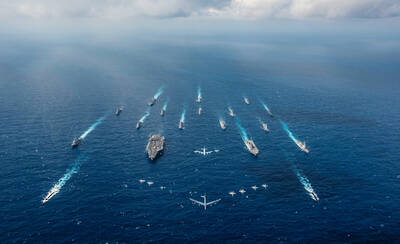
Japanese Prime Minister Sanae Takaichi’s comment last year on Tokyo’s potential reaction to a Taiwan-China conflict has forced Beijing to rewrite its invasion plans, a retired Japanese general said. Takaichi told the Diet on Nov. 7 last year that a Chinese naval blockade or military attack on Taiwan could constitute a “survival-threatening situation” for Japan, potentially allowing Tokyo to exercise its right to collective self-defense. Former Japan Ground Self-Defense Force general Kiyofumi Ogawa said in a recent speech that the remark has been interpreted as meaning Japan could intervene in the early stages of a Taiwan Strait conflict, undermining China’s previous assumptions
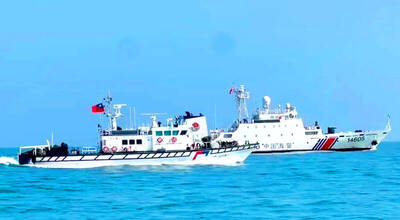
Instead of focusing solely on the threat of a full-scale military invasion, the US and its allies must prepare for a potential Chinese “quarantine” of Taiwan enforced through customs inspections, Stanford University Hoover fellow Eyck Freymann said in a Foreign Affairs article published on Wednesday. China could use various “gray zone” tactics in “reconfiguring the regional and ultimately the global economic order without a war,” said Freymann, who is also a nonresident research fellow at the US Naval War College. China might seize control of Taiwan’s links to the outside world by requiring all flights and ships entering or leaving Taiwan


 RSS
RSS