


Taiwanese officials are tracking what they view as a worrying rise in Chinese naval activity and military pressure against the nation, even as Beijing presses a message of peace and cooperation in meetings with Taiwan’s opposition leader.
China’s tactics are all the more unnerving for the government, given that the opposition continues to stymie a defense spending rise that Washington has pushed for.
The buildup also comes at a time with the US focused on the conflict in the Middle East and US President Donald Trump readying for a meeting next month with Chinese President Xi Jinping (習近平).
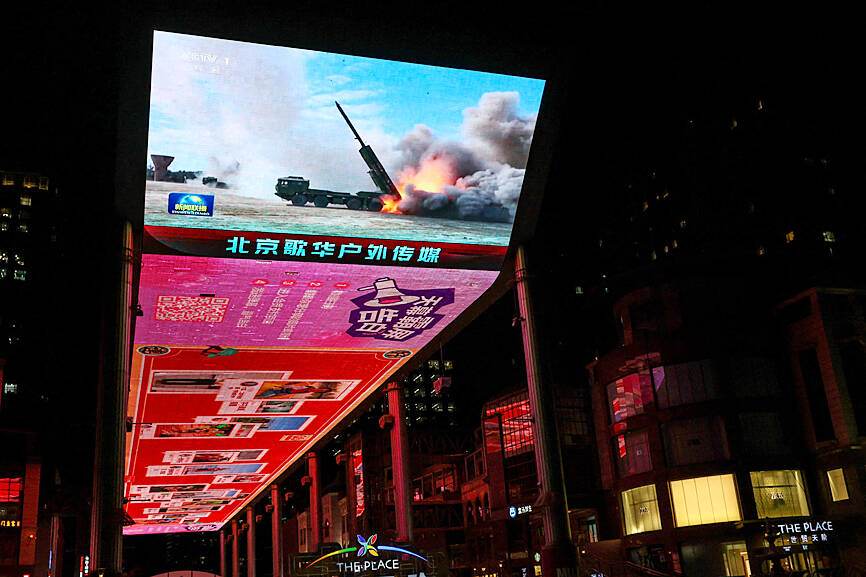
Photo: Reuters
“China is continuously and persistently expanding its military capabilities, and the military threat it poses to us is becoming increasingly severe,” Minister of National Defense Wellington Koo (顧立雄) told lawmakers on Thursday amid anger among the ruling party over the decision by members of the Chinese Nationalist Party (KMT) to skip talks on stalled defense spending.
Taiwan has to show its determination to defend itself to the US and other like-minded partners, he added.
“But the most frightening scenario is — if all of our international allies were to question whether we have such resolve, what would we face? I cannot imagine it,” he said.
Two Taiwanese security officials told Reuters that China has deployed nearly 100 naval and coast guard vessels in and around the South and East China seas this week.
One official said China usually deploys about 50 to 60 ships in the region, so the increase in the past weeks was “very rare,” especially because this time of year is not usually busy for Chinese naval drills.
A second official highlighted the timing of the increased presence, coming with Washington focused on Iran, and as KMT Chairwoman Cheng Li-wun (鄭麗文) visits China.
Meeting Cheng in Beijing yesterday, Xi said people on both sides of the Taiwan Strait want peace and cooperation, but added that China would “absolutely not tolerate” independence for Taiwan.
The KMT says there is “no connection whatsoever” between Cheng’s trip and government defense spending plans.
The Chinese Ministry of National Defense did not respond to a request for comment.
The number of vessels was corroborated by separate intelligence reports reviewed by Reuters, which showed a notable increase in Chinese vessels over the past few weeks, from nearly 70 at the end of last month to nearly 100 this week.
Two other non-Taiwanese security sources confirmed the numbers, adding that they viewed it as more of a “new normal” from China rather than an alarming anomaly.
Reuters was not able to independently verify the numbers of the Chinese ships around the same time last year.
China’s daily military activities around Taiwan have been maintained during Cheng’s China visit.
Yesterday, the Ministry of National Defense reported seven Chinese military aircraft operating around the nation in the previous 24 hours, as well as seven warships.
Ocean Affairs Council Minister Kuan Bi-ling (管碧玲) this week took the unusual step of posting on her Facebook page the locations and names of the Chinese warships in waters around Taiwan.
“Because the leader of the main opposition party is planning to meet with Chinese leadership ... it is necessary to appropriately disclose to the public and the international community the situation of China’s harassment in our waters, so that our people are informed and understand the serious implications,” she wrote.
Aside from the naval activity, China has also declared “reserved” airspace off its eastern coast, running from March 27 to May 5 — about a week before Trump is due to visit China.
China has provided no explanation, but it has previously issued such notifications defining a block of airspace as off-limits to civilian or foreign aircraft ahead of military drills.
Speaking to reporters in Taipei on Wednesday, National Security Bureau Director-General Tsai Ming-yen (蔡明彥) said he believed China was using this to test how often US aircraft operate in the area.
“This may also be politically intended to demonstrate the state of US air activity in the Indo-Pacific region prior to the Trump-Xi meeting,” he added.

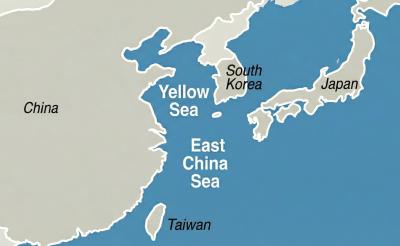
China has reserved offshore airspace in the Yellow Sea and East China Sea from March 27 to May 6, issuing alerts usually used to warn of military exercises, although no such exercises have been announced, the Wall Street Journal (WSJ) reported yesterday. Reserving such a large area for 40 days without explanation is an “unusual step,” as military exercises normally only last a few days, the paper said. These alerts, known as Notice to Air Missions (Notams), “are intended to inform pilots and aviation authorities of temporary airspace hazards or restrictions,” the article said. The airspace reserved in the alert is
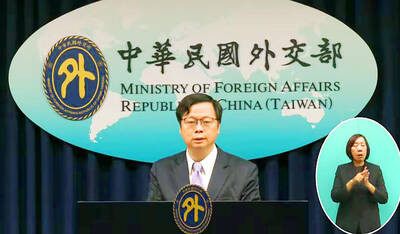
NAMING SPAT: The foreign ministry called on Denmark to propose an acceptable solution to the erroneous nationality used for Taiwanese on residence permits Taiwan has revoked some privileges for Danish diplomatic staff over a Danish permit that lists “Taiwan” as “China,” Eric Huang (黃鈞耀), head of the Ministry of Foreign Affairs’ Department of European Affairs, told a news conference in Taipei yesterday. Reporters asked Huang whether the Danish government had responded to the ministry’s request that it correct the nationality on Danish residence permits of Taiwanese, which has been listed as “China” since 2024. Taiwan’s representative office in Denmark continues to communicate with the Danish government, and the ministry has revoked some privileges previously granted to Danish representatives in Taiwan and would continue to review
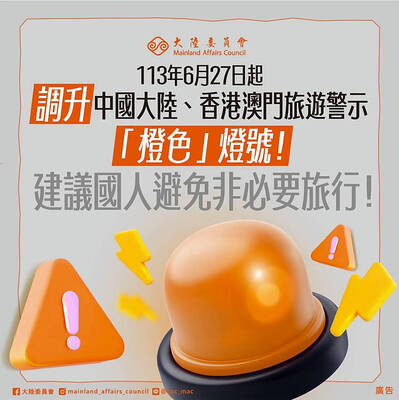
More than 6,000 Taiwanese students have participated in exchange programs in China over the past two years, despite the Mainland Affairs Council’s (MAC) “orange light” travel advisory, government records showed. The MAC’s publicly available registry showed that Taiwanese college and university students who went on exchange programs across the Strait numbered 3,592 and 2,966 people respectively. The National Immigration Agency data revealed that 2,296 and 2,551 Chinese students visited Taiwan for study in the same two years. A review of the Web sites of publicly-run universities and colleges showed that Taiwanese higher education institutions continued to recruit students for Chinese educational programs without
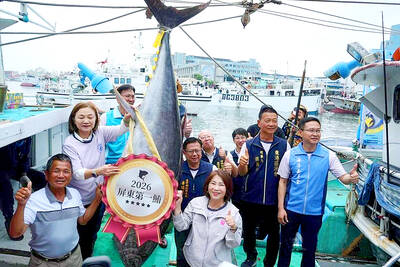
The first bluefin tuna of the season, brought to shore in Pingtung County and weighing 190kg, was yesterday auctioned for NT$10,600 (US$333.5) per kilogram, setting a record high for the local market. The auction was held at the fish market in Donggang Fishing Harbor, where the Siaoliouciou Island-registered fishing vessel Fu Yu Ching No. 2 delivered the “Pingtung First Tuna” it had caught for bidding. Bidding was intense, and the tuna was ultimately jointly purchased by a local restaurant and a local company for NT$10,600 per kilogram — NT$300 ,more than last year — for a total of NT$2.014 million. The 67-year-old skipper


 RSS
RSS