


Chinese Nationalist Party (KMT) Chairwoman Cheng Li-wun (鄭麗文) said she presented a five-point proposal calling for greater mutual trust and expansion of Taiwan’s international space during her meeting with Chinese President Xi Jinping (習近平) in Beijing yesterday.
The meeting took place at 11am in the East Hall of the Great Hall of the People.
After Xi’s opening remarks, Cheng began delivering her address, but Chinese officials abruptly ushered journalists out of the room midway through her speech.
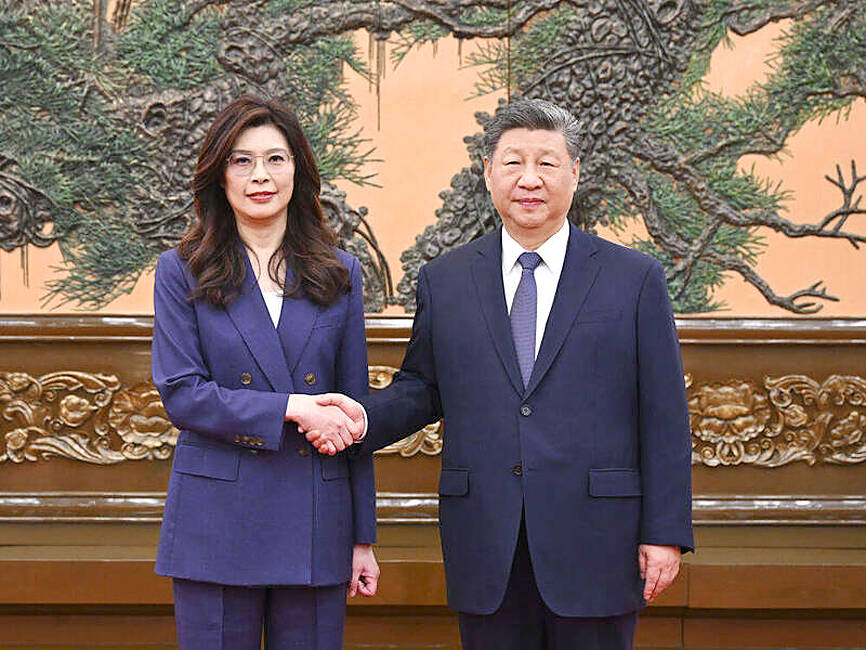
Photo courtesy of Xinhua news agency
According to a transcript provided by the KMT, Cheng said she hoped to promote cross-strait peace for the benefit of the people on both sides of the Taiwan Strait.
Taiwan had previously participated in the WHO and the International Civil Aviation Organization (ICAO) under the so-called “1992 consensus,” but is no longer able to do so, she said.
If mutual political trust is to be restored, steps should be taken to allow Taiwan to rejoin the WHO and the ICAO, and to explore participation in the Interpol, she said.
Cross-strait economic cooperation and Taiwan’s regional economic integration could mutually promote each other, Cheng said, calling for Taiwan to join the Regional Comprehensive Economic Partnership, and the Comprehensive and Progressive Agreement for Trans-Pacific Partnership.
People on both sides of the Strait support the peaceful development of cross-strait relations, and continued engagement would benefit the Chinese people, she said.
Cross-strait ties should not be confrontational, and the Chinese Communist Party (CCP) and the KMT have a responsibility to promote peace, she added.
Cheng called for the restoration of cross-strait dialogue mechanisms, saying that while laws on both sides restrict official state-to-state interaction, the “1992 consensus” allows non-governmental entities to conduct exchanges.
Peace and stability in the Strait should be maintained for mutual benefit, she said.
Cheng also urged both sides to work within existing frameworks, set aside differences and reduce confrontation.
A series of 23 cross-strait agreements covering direct links and economic cooperation, including the Economic Cooperation Framework Agreement, have underpinned shared development and should continue to be advanced, she said.
She called for continued KMT-CCP exchanges, including high-level dialogue, think tank forums and grassroots engagement, saying that such interactions have helped stabilize relations.
Both parties should work to preserve shared Chinese cultural heritage, Cheng said, adding that emphasizing common roots could help resolve differences.
Cheng concluded her address by expressing hope that she could one day host Xi and other Chinese officials in Taiwan.
The “1992 consensus” refers to a tacit understanding between the KMT and the CCP that both sides of the Taiwan Strait acknowledge that there is “one China,” with each side having its own interpretation of what “China” means.
Former Mainland Affairs Council chairman Su Chi (蘇起) in 2006 admitted that he made up the term to break a cross-strait deadlock and alleviate tension.

The military has spotted two Chinese warships operating in waters near Penghu County in the Taiwan Strait and sent its own naval and air forces to monitor the vessels, the Ministry of National Defense (MND) said. Beijing sends warships and warplanes into the waters and skies around Taiwan on an almost daily basis, drawing condemnation from Taipei. While the ministry offers daily updates on the locations of Chinese military aircraft, it only rarely gives details of where Chinese warships are operating, generally only when it detects aircraft carriers, as happened last week. A Chinese destroyer and a frigate entered waters to the southwest

A magnitude 6.1 earthquake struck off the coast of Yilan County at 8:39pm tonight, the Central Weather Administration (CWA) said, with no immediate reports of damage or injuries. The epicenter was 38.7km east-northeast of Yilan County Hall at a focal depth of 98.3km, the CWA’s Seismological Center said. The quake’s maximum intensity, which gauges the actual physical effect of a seismic event, was a level 4 on Taiwan’s 7-tier intensity scale, the center said. That intensity level was recorded in Yilan County’s Nanao Township (南澳), Hsinchu County’s Guansi Township (關西), Nantou County’s Hehuanshan (合歡山) and Hualien County’s Yanliao (鹽寮). An intensity of 3 was

Japanese Prime Minister Sanae Takaichi’s comment last year on Tokyo’s potential reaction to a Taiwan-China conflict has forced Beijing to rewrite its invasion plans, a retired Japanese general said. Takaichi told the Diet on Nov. 7 last year that a Chinese naval blockade or military attack on Taiwan could constitute a “survival-threatening situation” for Japan, potentially allowing Tokyo to exercise its right to collective self-defense. Former Japan Ground Self-Defense Force general Kiyofumi Ogawa said in a recent speech that the remark has been interpreted as meaning Japan could intervene in the early stages of a Taiwan Strait conflict, undermining China’s previous assumptions

Instead of focusing solely on the threat of a full-scale military invasion, the US and its allies must prepare for a potential Chinese “quarantine” of Taiwan enforced through customs inspections, Stanford University Hoover fellow Eyck Freymann said in a Foreign Affairs article published on Wednesday. China could use various “gray zone” tactics in “reconfiguring the regional and ultimately the global economic order without a war,” said Freymann, who is also a nonresident research fellow at the US Naval War College. China might seize control of Taiwan’s links to the outside world by requiring all flights and ships entering or leaving Taiwan


 RSS
RSS