


Taipei prosecutors today indicted former TV producer Lee Neng-chien (李能謙) on suspicion of spying for China, seeking a 12-year sentence.
Lee, the husband of actress Liu Hsiang-chun (劉香君) and a retired air force serviceman, was among five people suspected of being recruited by Chinese intelligence officials and leaking classified military information and personal data in exchange for financial payments and other benefits, the Taipei District Prosecutors’ Office said.
The five face charges under the National Security Act (國家安全法), the National Intelligence Services Act (國家情報工作法) and the Personal Data Protection Act (個人資料保護法), prosecutors said.
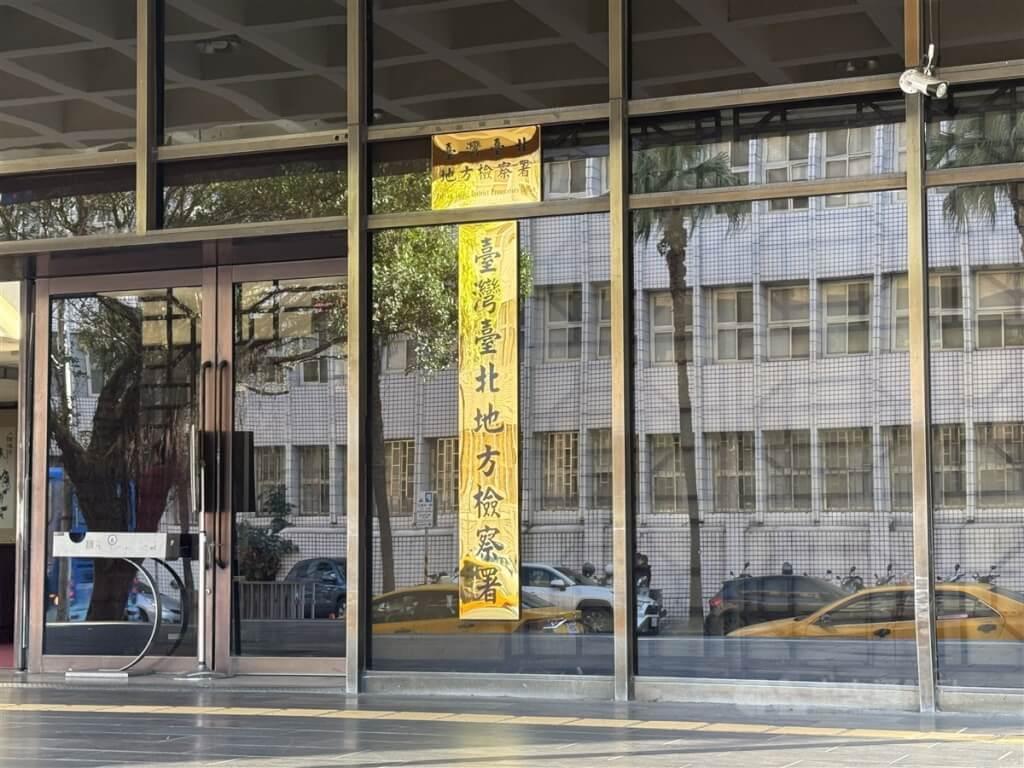
Photo: CNA
The Taipei District Prosecutors’ Office said it initially directed the New Taipei City Police Department’s Criminal Investigation Division to investigate Lee and his associates on suspicion of fraud.
An investigation found that Lee and his coconspirators had posed as famous figures such as Nvidia Corp CEO Jensen Huang (黃仁勳), creating fake Facebook accounts to run fan pages and share fraudulent advertisements for investment schemes, prosecutors said.
It was found that they had defrauded the public of more than NT$13 million (US$409,707), they said.
Police and prosecutors carried out searches in June last year, summoning the five for questioning, prosecutors said, adding that Lee was then released on NT$200,000 bail and restricted from leaving the country or traveling by sea.
Upon examining evidence, it was found that Lee was suspected of contravening the National Security Act, they said.
Prosecutors then coordinated a joint investigation with the New Taipei City Police Department’s Criminal Investigation Division, the Criminal Investigation Bureau’s High-Tech Crime Center and the Military Police Command in Taipei, with assistance from the Ministry of National Defense.
Lee was detained in December last year and held incommunicado.
Lee traveled to Fuzhou, China, in February last year, where he was recruited by a Chinese intelligence operative and agreed to gather, collect and deliver military intelligence in exchange for payment, prosecutors said.
He then instructed an associate, Hsu Yin-hao (徐胤豪), to help obtain files containing more than 3,000 items of personal data, including information on Taiwanese intelligence personnel, military personnel and civilians, they said, adding that Lee sent six of those files to the Chinese intelligence operative in April last year.
In May, he traveled to Guangzhou, China, with an associate to dine with a Chinese military intelligence source and agreed once again to provide sensitive information in exchange for money, prosecutors said.
After returning to Taiwan, Lee then instructed another associate to gather personal data and sensitive information on military personnel, they said.
In May 2024, one of Lee’s associates purchased a file via WeChat containing the personal data of 50 military personnel from an unknown source for NT$5,000, they said.
Lee offered the file to the Chinese military source for 5,000 yuan (US$732), but it was rejected due to the high price, they said.
In April last year, Lee created a Telegram group for the Chinese contact and nine other Chinese nationals, where they attempted to recruit active-duty military personnel from Taiwan, prosecutors said.
They attempted to attract recruits by saying that providing information would “help better protect Taiwan” and “deepen Taiwan-US defense cooperation,” prosecutors added.
No military personnel responded and the scheme failed, they said.
However, Lee did obtain information from retired air force serviceman Ko Meng-yu (柯孟妤) sometime before November last year, they said.
Ko was among those indicted today.
The military has spotted two Chinese warships operating in waters near Penghu County in the Taiwan Strait and sent its own naval and air forces to monitor the vessels, the Ministry of National Defense (MND) said. Beijing sends warships and warplanes into the waters and skies around Taiwan on an almost daily basis, drawing condemnation from Taipei. While the ministry offers daily updates on the locations of Chinese military aircraft, it only rarely gives details of where Chinese warships are operating, generally only when it detects aircraft carriers, as happened last week. A Chinese destroyer and a frigate entered waters to the southwest

A magnitude 6.1 earthquake struck off the coast of Yilan County at 8:39pm tonight, the Central Weather Administration (CWA) said, with no immediate reports of damage or injuries. The epicenter was 38.7km east-northeast of Yilan County Hall at a focal depth of 98.3km, the CWA’s Seismological Center said. The quake’s maximum intensity, which gauges the actual physical effect of a seismic event, was a level 4 on Taiwan’s 7-tier intensity scale, the center said. That intensity level was recorded in Yilan County’s Nanao Township (南澳), Hsinchu County’s Guansi Township (關西), Nantou County’s Hehuanshan (合歡山) and Hualien County’s Yanliao (鹽寮). An intensity of 3 was

Japanese Prime Minister Sanae Takaichi’s comment last year on Tokyo’s potential reaction to a Taiwan-China conflict has forced Beijing to rewrite its invasion plans, a retired Japanese general said. Takaichi told the Diet on Nov. 7 last year that a Chinese naval blockade or military attack on Taiwan could constitute a “survival-threatening situation” for Japan, potentially allowing Tokyo to exercise its right to collective self-defense. Former Japan Ground Self-Defense Force general Kiyofumi Ogawa said in a recent speech that the remark has been interpreted as meaning Japan could intervene in the early stages of a Taiwan Strait conflict, undermining China’s previous assumptions
Instead of focusing solely on the threat of a full-scale military invasion, the US and its allies must prepare for a potential Chinese “quarantine” of Taiwan enforced through customs inspections, Stanford University Hoover fellow Eyck Freymann said in a Foreign Affairs article published on Wednesday. China could use various “gray zone” tactics in “reconfiguring the regional and ultimately the global economic order without a war,” said Freymann, who is also a nonresident research fellow at the US Naval War College. China might seize control of Taiwan’s links to the outside world by requiring all flights and ships entering or leaving Taiwan


 RSS
RSS