


Mandarin Airlines yesterday said it hoped to receive approval to stop operating its Kaohsiung-Hualien and Taichung-Hualien routes because of persistently low demand and rising losses.
Mandarin Airlines chairman Chen Ta-chun (陳大鈞) said the average passenger load for its Taichung-Hualien flights is about 30 percent and 20 percent for Kaohsiung-Hualien flights.
Last year, a flight leaving from Kaohsiung for Hualien carried only five passengers, Chen said.
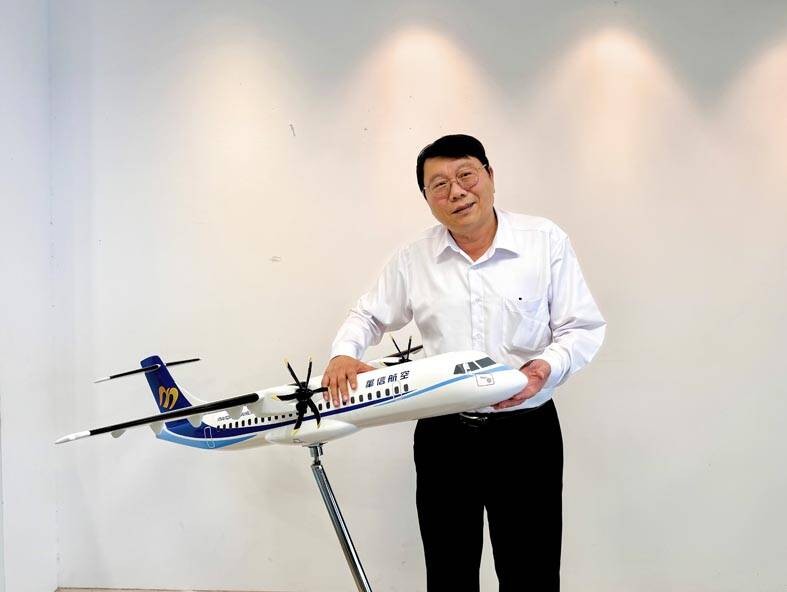
Photo: Huang Yi-ching, Taipei Times
The airline tried to attract railway passengers to fly to their destinations by offering a 50 percent discount on fares, but to no avail, he said.
Calculating costs based on fuel prices, the carrier estimated that it would sustain financial losses of NT$70 million (US$2.2 million) this year if it continues to operate the two routes.
“I keep asking why we continue this pointless struggle. Without the flights, people can still use railway and highway services to Hualien,” Chen said.
“I have no problem increasing flights to outlying islands, because there are fewer options to access them,” he added.
The airline offers three weekly flights between Taichung and Hualien, with roundtrip tickets costing NT$2,472. The Kaohsiung-Hualien flights are available daily, with roundtrip tickets costing NT$2,329.
Based on flight reservations this week, the average load for flights from Kaohsiung to Lienchiang County (Matsu) is about 94 percent and 87 percent for return flights, the airline said.
The average load for flights to Kinmen County is nearly 100 percent and 88 percent for return flights, it added.
The loads for Taipei-Taichung and Taichung-Kinmen flights are more than 80 percent, the airline said.
The airline hopes to receive permission to cancel the two services to Hualien, Chen said, adding that the company is willing to dispatch additional flights to the county when railway and highway services are disrupted due to natural disasters.
That would give it additional capacity to conduct outlying island services, he said.
Domestic flight tickets have not been adjusted for 26 years, but monthly and hourly wages have risen 53 percent and 70 percent respectively over the past 12 years, he said, adding that rent for airport counters and offices, as well as ground service fees, have increased.
Fuel costs accounted for 21 percent of the airline’s overall operating costs, up from 13 percent prior to the war in the Middle East, Chen said.
The company is projected to generate NT$6 billion in revenue this year, but losses might be 10 percent due to rising fuel prices, he said, adding that the airline is seeking to increase advertising revenue through complimentary in-flight items, such as bottled water and napkins.
The Civil Aviation Administration (CAA) said that it understands the flight carrier’s plight and empathizes with the airline, and would carefully assess its recommendations.
The CAA in 1999 set formulas for calculating the upper and lower cap of domestic flight ticket prices by factoring in 14 cost items submitted by airlines.
Domestic flight carriers set the ticket prices based on the scheme. In 2014, it allowed carriers to adjust ticket prices whenever fuel prices change.

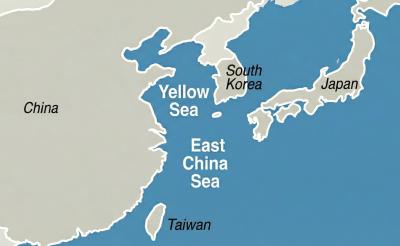
China has reserved offshore airspace in the Yellow Sea and East China Sea from March 27 to May 6, issuing alerts usually used to warn of military exercises, although no such exercises have been announced, the Wall Street Journal (WSJ) reported yesterday. Reserving such a large area for 40 days without explanation is an “unusual step,” as military exercises normally only last a few days, the paper said. These alerts, known as Notice to Air Missions (Notams), “are intended to inform pilots and aviation authorities of temporary airspace hazards or restrictions,” the article said. The airspace reserved in the alert is

NAMING SPAT: The foreign ministry called on Denmark to propose an acceptable solution to the erroneous nationality used for Taiwanese on residence permits Taiwan has revoked some privileges for Danish diplomatic staff over a Danish permit that lists “Taiwan” as “China,” Eric Huang (黃鈞耀), head of the Ministry of Foreign Affairs’ Department of European Affairs, told a news conference in Taipei yesterday. Reporters asked Huang whether the Danish government had responded to the ministry’s request that it correct the nationality on Danish residence permits of Taiwanese, which has been listed as “China” since 2024. Taiwan’s representative office in Denmark continues to communicate with the Danish government, and the ministry has revoked some privileges previously granted to Danish representatives in Taiwan and would continue to review

More than 6,000 Taiwanese students have participated in exchange programs in China over the past two years, despite the Mainland Affairs Council’s (MAC) “orange light” travel advisory, government records showed. The MAC’s publicly available registry showed that Taiwanese college and university students who went on exchange programs across the Strait numbered 3,592 and 2,966 people respectively. The National Immigration Agency data revealed that 2,296 and 2,551 Chinese students visited Taiwan for study in the same two years. A review of the Web sites of publicly-run universities and colleges showed that Taiwanese higher education institutions continued to recruit students for Chinese educational programs without

A bipartisan group of US senators has introduced a bill to enhance cooperation with Taiwan on drone development and to reduce reliance on supply chains linked to China. The proposed Blue Skies for Taiwan Act of 2026 was introduced by Republican US senators Ted Cruz and John Curtis, and Democratic US senators Jeff Merkley and Andy Kim. The legislation seeks to ease constraints on Taiwan-US cooperation in uncrewed aerial systems (UAS), including dependence on China-sourced components, limited access to capital and regulatory barriers under US export controls, a news release issued by Cruz on Wednesday said. The bill would establish a "Blue UAS


 RSS
RSS