


The K-12 Education Administration in collaboration with universities has launched online classes for high-school and vocational school students based on the Python programming language.
The course would provide the economy with an artificial intelligence (AI)-literate workforce, the Ministry of Education-run agency said in a statement yesterday.
Teaching the course online would help bridge the urban-rural divide in access to educational resources, the agency said.
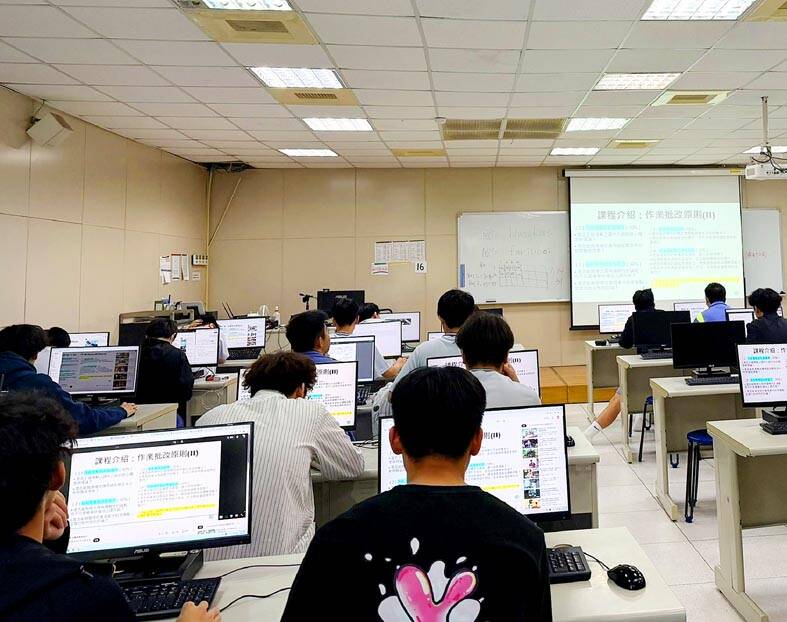
Photo courtesy of the Ministry of Education
The course design emphasizes hands-on learning and encompasses skills ranging from variable operations and differential statements to loops, which are incorporated into realistic tasks for coders, it said.
The core mission of the lessons is to teach students the principles of coding and the ability to apply programming to solve real-life problems, it said.
It cited a student as saying that they had expected coding to involve the rote memorization of commands, instead of learning a language possessing its own syntax and logic to communicate with machines.
Another student was cited as saying that they hope to use their new coding skills to develop games, Web sites and AI designs.
A teacher from New Taipei City Municipal Jinshan High School said in the statement that coding is a good way to sharpen students’ ability to think through problems and think for themselves.
For example, debugging teaches students to rely on their own wits to deal with a puzzle instead of waiting for an answer to be handed down, they said.
Encouraging the spirit of discovery and the courage to overcome fear of failure are invaluable lessons on top of coding skills themselves, the teacher said.
Facing the rapid evolution of AI and digital technology, boosting students’ technological application skills is a key policy direction, the agency said, adding that it would continue to partner with universities and cross-school teaching communities to offer a diverse range of online courses.

FUKUOKA SITUATION: Japanese media reported that the pathogen is expected to be identified by the summer, while the CDC downplayed the idea that it was hMPV A “mysterious cold-like illness” reported in Japan’s Fukuoka Prefecture does not seem to be a new disease, but Japanese authorities have been asked about the situation, the Centers for Disease Control (CDC) said yesterday. The Fukuoka Prefectural Medical Association on Wednesday told a news conference that a “mystery cold” that has become a hot topic on social media is “highly likely to be caused by some kind of viral infection,” Japan’s KBC News reported. “Many people are experiencing symptoms starting with a sore throat, followed by a runny nose, phlegm and a severe cough,” KBC News reported, citing association officials. Health authorities are

Nvidia Corp CEO Jensen Huang (黃仁勳) arrived in Taiwan yesterday ahead of upcoming AI and technology events, saying he plans to meet with clients and Taiwan Semiconductor Manufacturing Co Chairman C.C. Wei (魏哲家) during his visit. After landing at Taipei Songshan Airport, Huang posed for photos with fans and handed out Yakult drinks to reporters and supporters waiting at the scene, saying he has “a lot to do” during the trip. Asked about reports that Nvidia’s planned headquarters site in Taipei’s Beitou Shilin Technology Park could break ground on May 27, Huang said that if the company holds an event, he would

The Ministry of Finance this afternoon announced the winning numbers for the March-April uniform invoice lottery. The winning number for the NT$10 million (US$318,060) special prize is 19531471, and the winning number for the NT$2 million grand prize is 85941329. Three numbers were drawn for the NT$200,000 first prize: 07225810, 20231230 and 83518781. Those with receipts matching the last seven digits of any of the first-prize numbers will win the NT$40,000 second prize, while those matching the last six digits will win the NT$10,000 third prize. Those whose receipts match the last five digits of the first-prize numbers can claim the NT$4,000 fourth prize,
Taiwan Travelogue (臺灣漫遊錄), which earlier this week became the first Taiwanese novel to win the International Booker Prize, is to be adapted into a television series through a Taiwan-Japan coproduction, producer Chang Chen-yu (張辰漁) said yesterday. Chang, a producer at World Softest Production Film Co, wrote on Facebook that the company had been searching for projects with international appeal that retain a strong Taiwanese identity after colleagues and Japanese partners strongly recommended the novel. After reading the book, Chang said he immediately decided to pursue the screen rights. “A great story has the power to transcend time and borders, and connect countless people,”


 RSS
RSS