


Chinese Nationalist Party (KMT) Chairwoman Cheng Li-wun (鄭麗文) today pledged to channel the spirit of her party's founder Sun Yat-sen (孫逸仙) and seek reconciliation with China, offering praise at his tomb in China for the country's achievements following the communist revolution.
In a moment filled with symbolism on her first full day in China, Cheng laid a wreath at Sun's mausoleum in Nanjing, also the capital of the KMT-led Republic of China (ROC) government before it fled to Taiwan in 1949 having lost a civil war with Mao Zedong's (毛澤東) communists.
"The core values of Sun Yat-sen's ideal that 'all under heaven are equal' have always been equality, inclusiveness and unity," Cheng said in footage carried live on Taiwanese television channels.
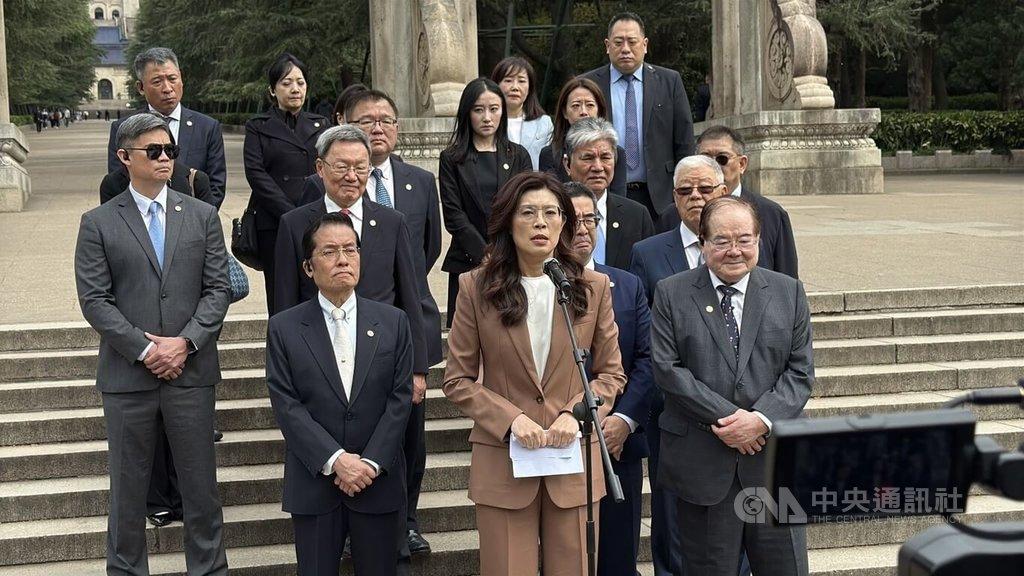
Photo: CNA
"We should work together to promote reconciliation and unity across the [Taiwan] Strait and create regional prosperity and peace," she said.
Sun, who founded the ROC in 1912, died of cancer in 1925.
He is still officially venerated in Taiwan as the founder of the ROC, but also in China by the Chinese Communist Party as a national hero.
Mao declared him the "great revolutionary forerunner."
Cheng said the KMT had eventually honored Sun's founding principles and made Taiwan into a free and democratic society, although she also mentioned the White Terror of the 38 years of martial law Taiwan lived under until 1987.
"Likewise, on the mainland, we have also seen and witnessed progress and development that exceeded everyone's expectations and imagination," she said.
Security was tight for her visit.
"I think this is very important for peaceful exchanges between the two sides of the Taiwan Strait," said student Yang Zihang, 19, who came with his classmate to see Cheng's motorcade.
Cheng says she is on a mission of peace, and that while she supports defense spending, it has to be balanced with dialogue.
Democratic Progressive Party spokesman Justin Wu (吳崢) said if the KMT really wanted stability across the Strait, it should stop blocking defense spending in the legislature.
"Peace has never come from the charity of dictators. It must be safeguarded by Taiwan's own strength," he said in a statement.
President William Lai's (賴清德) government has said that Cheng should also tell Chinese officials, including Chinese President Xi Jinping (習近平) should she meet him, to stop China's regular military harassment of the nation and respect the Taiwanese people's right to choose their own future.
Speaking to reporters at the legislature in Taipei earlier today, National Security Bureau Director-General Tsai Ming-yen (蔡明彥) said he could not comment on what political parties do, but added that China uses a carrot-and-stick approach.
China uses military intimidation and harassment to create an atmosphere of rising military danger and instability across the Taiwan Strait, he said.
"This is intended to make Taiwan's society and public feel the psychological pressure and anxiety of a possible conflict," Tsai added.
"It aims to divide Taiwanese society internally, boosting the visibility of pro-China positions. It can also further obstruct efforts to push forward US arms procurement deals," he said.

FUKUOKA SITUATION: Japanese media reported that the pathogen is expected to be identified by the summer, while the CDC downplayed the idea that it was hMPV A “mysterious cold-like illness” reported in Japan’s Fukuoka Prefecture does not seem to be a new disease, but Japanese authorities have been asked about the situation, the Centers for Disease Control (CDC) said yesterday. The Fukuoka Prefectural Medical Association on Wednesday told a news conference that a “mystery cold” that has become a hot topic on social media is “highly likely to be caused by some kind of viral infection,” Japan’s KBC News reported. “Many people are experiencing symptoms starting with a sore throat, followed by a runny nose, phlegm and a severe cough,” KBC News reported, citing association officials. Health authorities are

Nvidia Corp CEO Jensen Huang (黃仁勳) arrived in Taiwan yesterday ahead of upcoming AI and technology events, saying he plans to meet with clients and Taiwan Semiconductor Manufacturing Co Chairman C.C. Wei (魏哲家) during his visit. After landing at Taipei Songshan Airport, Huang posed for photos with fans and handed out Yakult drinks to reporters and supporters waiting at the scene, saying he has “a lot to do” during the trip. Asked about reports that Nvidia’s planned headquarters site in Taipei’s Beitou Shilin Technology Park could break ground on May 27, Huang said that if the company holds an event, he would

The Ministry of Finance this afternoon announced the winning numbers for the March-April uniform invoice lottery. The winning number for the NT$10 million (US$318,060) special prize is 19531471, and the winning number for the NT$2 million grand prize is 85941329. Three numbers were drawn for the NT$200,000 first prize: 07225810, 20231230 and 83518781. Those with receipts matching the last seven digits of any of the first-prize numbers will win the NT$40,000 second prize, while those matching the last six digits will win the NT$10,000 third prize. Those whose receipts match the last five digits of the first-prize numbers can claim the NT$4,000 fourth prize,
Taiwan Travelogue (臺灣漫遊錄), which earlier this week became the first Taiwanese novel to win the International Booker Prize, is to be adapted into a television series through a Taiwan-Japan coproduction, producer Chang Chen-yu (張辰漁) said yesterday. Chang, a producer at World Softest Production Film Co, wrote on Facebook that the company had been searching for projects with international appeal that retain a strong Taiwanese identity after colleagues and Japanese partners strongly recommended the novel. After reading the book, Chang said he immediately decided to pursue the screen rights. “A great story has the power to transcend time and borders, and connect countless people,”


 RSS
RSS