


A government report released yesterday identified vessels dropping anchor as the most common cause of disruptions to Taiwan’s near-shore undersea cables, highlighting a risk posed by ships flying flags of convenience (FOC).
Over the past four years, 38.3 percent of the seven to eight annual cable disruptions recorded within 24 nautical miles of Taiwan’s coast were caused by anchor damage, according to the report issued by the Ministry of Digital Affairs (MODA).
Of the seven incidents recorded last year, three were caused by anchor strikes (42.9 percent) -- two of which were attributed to FOC vessels anchoring illegally, the report said.
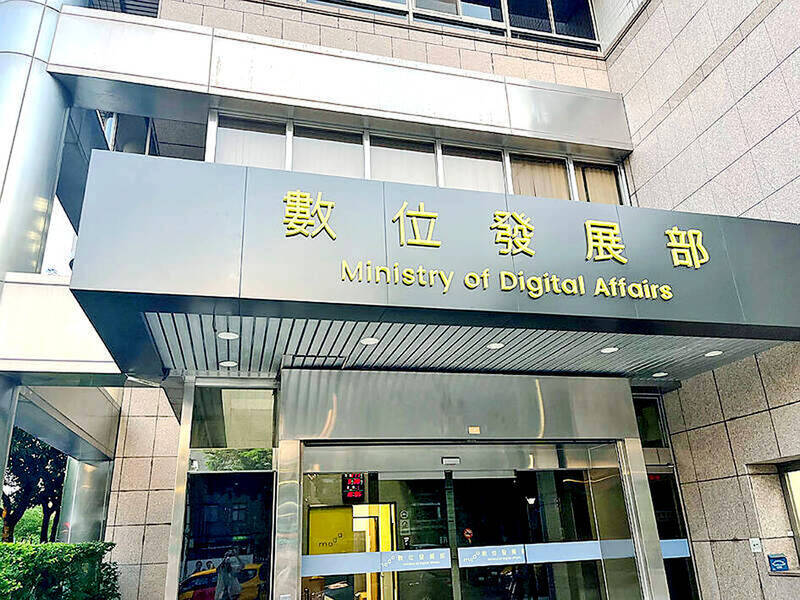
Photo: Hsu Tzu-ling, Taipei Times
One such incident involved the Shunxin 39 -- a Chinese- owned vessel flying a Cameroon flag -- which caused a major disruption to the Trans-Pacific Express (TPE) cable network on Jan. 3 last year off northern Taiwan, according to the report.
Another case occurred on Feb. 25 last year, when the Hong Tai 58 -- also a Chinese-owned vessel flying the flag of the Republic of Togo -- damaged the Tai-Peng No. 3 (TP3) undersea cable connecting Taiwan and Penghu.
Other than anchoring, the report noted that "suspected intentional damage" accounted for two of last year’s incidents, or 28.5 percent, while fishing activities and natural fiber-core degradation each caused one incident (14.3 percent).
The MODA warned that "innocent passage" rights for third-flagged vessels are increasingly being used by the Chinese authorities as a cover for "grey-zone threats" against Taiwan’s telecommunication security.
With a network of 15 international and 10 domestic undersea cables in place as of February this year, these links serve as an irreplaceable "digital lifeline" for Taiwan, making their protection an urgent national priority, the ministry said.
Meanwhile, the report tallied 25 disruptions to international undersea cables in deeper waters -- beyond the 24-nautical-mile limit -- last year.
The primary cause of these deep-sea failures was identified as natural disasters, specifically underwater earthquakes, the report noted.

Yangmingshan National Park authorities yesterday urged visitors to respect public spaces and obey the law after a couple was caught on a camera livestream having sex at the park’s Qingtiangang (擎天崗) earlier in the day. The Shilin Police Precinct in Taipei said it has identified a suspect and his vehicle registration number, and would summon him for questioning. The case would be handled in accordance with public indecency charges, it added. The couple entered the park at about 11pm on Thursday and began fooling around by 1am yesterday, the police said, adding that the two were unaware of the park’s all-day live

Fast food chain McDonald's is to raise prices by up to NT$5 on some products at its restaurants across Taiwan, starting on Wednesday next week, the company announced today. The prices of all extra value meals and sharing boxes are to increase by NT$5, while breakfast combos and creamy corn soup would go up by NT$3, the company said in a statement. The price of the main items of those meals, if ordered individually, would remain the same. Meanwhile, the price of a medium-sized lemon iced tea and hot cappuccino would rise by NT$3, extra dipping sauces for chicken nuggets would go up

Yangmingshan National Park’s Qingtiangang (擎天崗) nature area has gone viral after a park livestream camera observed a couple in the throes of intimate congress, which was broadcast live on YouTube, drawing large late-night crowds and sparking a backlash over noise, bright lights and disruption to wildlife habitat. The area’s livestream footage appeared to show a couple engaging in sexual activity on a picnic table in the park on Friday last week, with the uncensored footage streamed publicly online. The footage quickly spread across social media, prompting a tide of visitors to travel to the site to “check in” and recreate the

Minister of Digital Affairs Lin Yi-ching (林宜敬) yesterday cited regulatory issues and national security concerns as an expert said that Taiwan is among the few Asian regions without Starlink. Lin made the remarks on Facebook after funP Innovation Group chief executive officer Nathan Chiu (邱繼弘) on Friday said Taiwan and four other countries in Asia — China, North Korea, Afghanistan and Syria — have no access to Starlink. Starlink has become available in 166 countries worldwide, including Ukraine, Malaysia, the Philippines and Vietnam, in the six years since it became commercial, he said. While China and North Korea block Starlink, Syria is not


 RSS
RSS