


Maryland Secretary of State Susan Lee (李鳳遷) yesterday welcomed increased investment from Taiwan in the state, citing Maryland’s top-tier talent pool, proximity to federal research institutions, and its strategic position as a key East Coast maritime gateway.
"We want Taiwan companies and investors to come to Maryland because there are so many things that we can offer," Lee said in an interview with the Central News Agency prior to attending a forum on Taiwan-US trade and investment opportunities in Taipei today.
She highlighted commercial sectors such as cybersecurity and life sciences as well as emerging technologies in artificial intelligence, quantum technology and aerospace as areas where Maryland hopes to deepen cooperation with Taiwan.
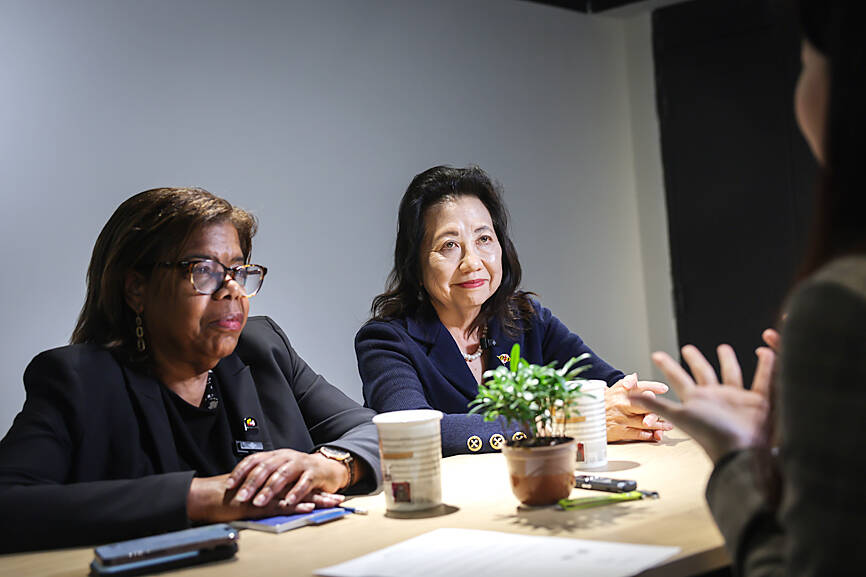
Photo: CNA
Taiwanese companies may have access to public sector financial support in the future, Lee said.
Late last year, the Maryland Technology Development Corp (TEDCO) signed an agreement with the APAC Investment and Innovation Development Association Taiwan (TAIIDA) and SFIC Group, enabling up to US$50 million from TAIIDA and SFIC to be coinvested alongside qualified TEDCO investment programs.
The program is in the early stages of planning, and the details are still being worked out, she said.
According to TEDCO, eligible entities include Taiwanese subsidiaries of Maryland-based businesses; joint ventures between Maryland and Taiwan-based companies; and Maryland firms using the investment to expand manufacturing in Taiwan or pursue market expansion in Asia.
Asked what makes Maryland an attractive destination for Taiwanese investment, Lee pointed to the state’s world-class higher education institutions, such as Johns Hopkins University and the University of Maryland.
These institutions contribute to the state having one of the highest concentrations of scientists in the US.
Maryland also offers proximity to major federal regulatory and research agencies, including the US Food and Drug Administration and the National Institutes of Health, making it easier for companies and researchers to bring products through the commercialization process.
Lee also highlighted the Port of Baltimore, a deep-water port that serves as a gateway for distributing goods across the US.
She welcomed news that Taiwan-based carrier EVA Air is to launch direct flights to Washington in June, helping address the limited number of direct connections between Asia and the southeastern US.
"That will really bring us closer together," she said.
Lee, who became Maryland’s 72nd secretary of state in 2023 after serving more than two decades in the state legislature, said Taiwan and Maryland have enjoyed a decades-long friendship.
She added that Maryland is home to a large Taiwanese-American and Chinese-American population that is highly educated and engaged in civic and community affairs.
"They are very active and serve as informal ambassadors between Taiwan and Maryland," she said.
Lee and Judy Smith, chief strategy officer at Maryland’s Department of Commerce, are visiting Taiwan primarily to attend a one-day forum on Taiwan-US trade and investment opportunities in Taipei today.


UPGRADE: The Kang Ding-class frigate is replacing its Chaparall missiles with Tien Chien II and Hua Yang VLS, which would provide it with long-range, 360° air defense Taiwan plans to produce 1,200 to 1,376 Hai Chien II missiles (海劍二, Sea Sword II) — also known as TC-2N — to serve as the standard air defense system of the navy’s surface combatant fleet, a source said yesterday. Last week, the Hai Chien II, the naval version of the Tien Kung II missile (天劍二, Sky Sword II), completed a live-fire test in waters off the National Chungshan Institute of Science and Technology’s Jiupeng facility (九鵬) in Pingtung County’s Manjhou Township (滿州). The MIM72 Chaparral and other dated air defense missiles that currently arm Taiwanese ships have inadequate range to combat Chinese

REASONS FOR TRAVEL: An assistant professor said that proposed amendments to penalize drivers if they used drugs overseas would not deter people from traveling People who operate a motor vehicle under the influence of marijuana would have their driver’s license revoked, even if they used the substance while overseas, the Ministry of Transportation and Communications said yesterday, citing proposed amendments to the Road Traffic Management and Penalty Act (道路交通管理處罰條例). The amendments would also authorize the government to revoke the licenses of people determined to have used Category 1 or Category 2 narcotics, even if they were not operating a vehicle while under the influence of drugs, as well as ban them from taking the license test for three years, the ministry said. People aged 18 or
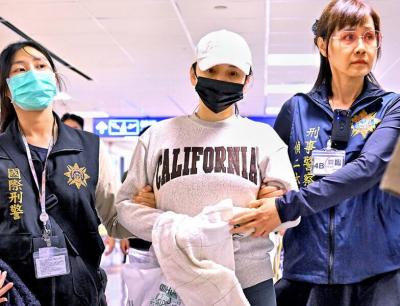
Johanne Liou (劉喬安), a Taiwanese woman who shot to unwanted fame during the Sunflower movement protests in 2014, returned to Taiwan last night after being deported from the US. She is to stand trial in Taiwan for charges involving embezzlement, fraud and drug crimes. The Criminal Investigation Bureau (CIB) said it took her into custody at Taiwan Taoyuan International Airport and would first question her before transferring her to the New Taipei District Prosecutors’ Office. She was arrested upon disembarking a flight from San Francisco that landed shortly before 7pm. Liou absconded to the US in 2019 after jumping bail
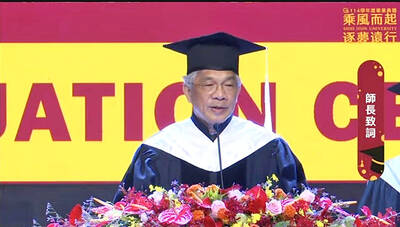
Shih Hsin University President Chen Ching-he (陳清河) yesterday issued a public apology for comments made in his commencement speech last week, stating that he has asked the school to suspend his duties and halt his wages for two months as a show of contrition. At the commencement ceremony on May 30, Chen said, “If you don’t manage your time well, or your own emotions, or your health, then I am telling every one of you — put a quick end to ‘you,’ because the world has no need for ‘you.’” The comments have sparked significant controversy online, and Chen through an open


 RSS
RSS