


The Centers for Disease Control (CDC) yesterday said it plans to purchase more than 7 million doses of government-funded influenza vaccines to prepare for the next flu season, including about 200,000 doses of adjuvanted flu vaccines for the first time, offered to residents of long-term care facilities and nursing homes aged 65 or older.
CDC Epidemic Intelligence Center Director Guo Hung-wei (郭宏偉) said that flu remains the most common respiratory viral pathogen detected in local communities, with influenza B as the dominant strain, accounting for 76 percent of tested cases in the past four weeks.
Emergency room visits accounted for 9.8 percent of all hospital visits for flu-like illnesses last week, indicating that the flu has not entered an epidemic period, he said, adding that hospitals reported 97,662 visits for flu-like illnesses last week.
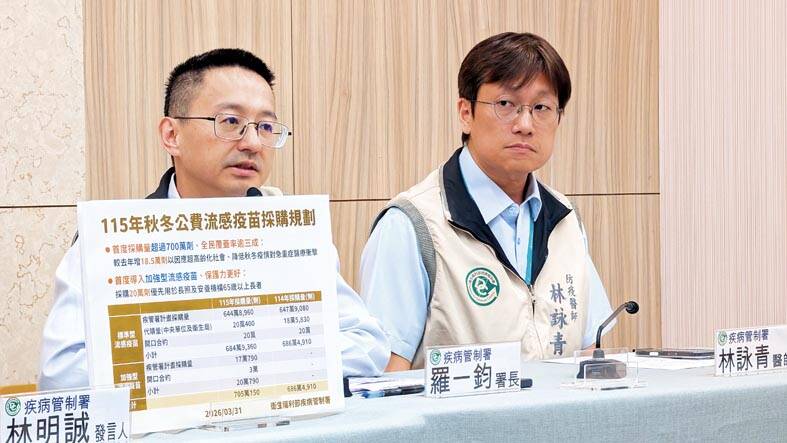
Photo: CNA
The number of visits was lower than the same week last year and the year before, CDC Director-General Philip Lo (羅一鈞) said.
Flu activity during this flu season (starting from October last year) has been relatively lower than previous years, partly because vaccination turnout has been exceptionally high, he said, adding that more than 6.77 million doses of government-funded flu vaccines have been administered, with about 54,000 doses remaining.
The CDC is planning to purchase more than 7 million doses of flu vaccines for the government-funded program in the next flu season (starting on Oct. 1), the most ever, which, if fully administered, would provide a coverage rate of more than 30 percent of the population, he said.
As Taiwan has become a “super-aged” society, the CDC plans to purchase 200,000 doses of adjuvanted flu vaccines for the first time, Lo said.
Adjuvanted flu vaccines, which are to be administered to people aged 65 or older at long-term care facilities and nursing homes, provide better protection for older adults compared with standard vaccines, he said.
The standard vaccines would still be a trivalent vaccine designed to protect against three strains of a virus, based on WHO recommendations, which include subclade K, a new variant of the A(H3N2) virus, he said.
The estimated budget for the vaccines is about NT$1.78 billion (US$55.67 million), and the invitation to tender process has begun, Lo said, adding that tender results are expected to come out by late this month at the earliest.
Meanwhile, two cases of imported measles were reported last week, in a Taiwanese woman in her 50s who returned from the US and a Taiwanese man in his 30s who returned from India, the CDC said.
The woman began experiencing cold-like symptoms two weeks after returning to Taiwan and sought treatment at a clinic, but later visited an emergency room for backache, vomiting, loss of appetite, and persistent fever, but she did not develop rashes — a distinctive symptom of measles, CDC physician Lin Yung-ching (林詠青) said.
As she experienced altered consciousness and was suspected of having encephalitis, she was admitted to an intensive care unit, and later to a negative pressure isolation room after she was confirmed to have measles, he said.
Her fever has gone down, but she is still unconscious after nearly a month of hospitalization, Lin said.
Early symptoms of measles can easily be mistaken for a common cold or flu, and about 5 to 10 percent of cases might develop complications, such as ear infections or encephalitis, he said, adding that infection is frequently more severe in adults.
As measles is one of the most contagious diseases, adults who are born in 1966 or later who are planning to visit places where measles is spreading should visit a travel clinic at least two weeks prior to get evaluated for a measles, mumps and rubella vaccine, CDC Deputy Director-General and spokesman Lin Min-cheng (林明誠) said.
People who have returned from places where measles is spreading should monitor their health for at least three weeks, he said, adding that pregnant women and infants younger than one should avoid travel to those places.

Yangmingshan National Park authorities yesterday urged visitors to respect public spaces and obey the law after a couple was caught on a camera livestream having sex at the park’s Qingtiangang (擎天崗) earlier in the day. The Shilin Police Precinct in Taipei said it has identified a suspect and his vehicle registration number, and would summon him for questioning. The case would be handled in accordance with public indecency charges, it added. The couple entered the park at about 11pm on Thursday and began fooling around by 1am yesterday, the police said, adding that the two were unaware of the park’s all-day live

Fast food chain McDonald's is to raise prices by up to NT$5 on some products at its restaurants across Taiwan, starting on Wednesday next week, the company announced today. The prices of all extra value meals and sharing boxes are to increase by NT$5, while breakfast combos and creamy corn soup would go up by NT$3, the company said in a statement. The price of the main items of those meals, if ordered individually, would remain the same. Meanwhile, the price of a medium-sized lemon iced tea and hot cappuccino would rise by NT$3, extra dipping sauces for chicken nuggets would go up

Yangmingshan National Park’s Qingtiangang (擎天崗) nature area has gone viral after a park livestream camera observed a couple in the throes of intimate congress, which was broadcast live on YouTube, drawing large late-night crowds and sparking a backlash over noise, bright lights and disruption to wildlife habitat. The area’s livestream footage appeared to show a couple engaging in sexual activity on a picnic table in the park on Friday last week, with the uncensored footage streamed publicly online. The footage quickly spread across social media, prompting a tide of visitors to travel to the site to “check in” and recreate the

Minister of Digital Affairs Lin Yi-ching (林宜敬) yesterday cited regulatory issues and national security concerns as an expert said that Taiwan is among the few Asian regions without Starlink. Lin made the remarks on Facebook after funP Innovation Group chief executive officer Nathan Chiu (邱繼弘) on Friday said Taiwan and four other countries in Asia — China, North Korea, Afghanistan and Syria — have no access to Starlink. Starlink has become available in 166 countries worldwide, including Ukraine, Malaysia, the Philippines and Vietnam, in the six years since it became commercial, he said. While China and North Korea block Starlink, Syria is not


 RSS
RSS