


The Mainland Affairs Council (MAC) yesterday said a new Chinese law on ethnic unity could compel people to actively support unification with Taiwan or face legal consequences.
The Law on Promoting Ethnic Unity and Progress, passed by China’s National People’s Congress on March 12 and set to take effect on July 1, would make support for unification a legal obligation, the council said in a social media post.
The law says that Chinese citizens “shall safeguard national sovereignty,” and cites Chinese President Xi Jinping (習近平) as saying that people must “consciously uphold national unity, national security and social stability.”
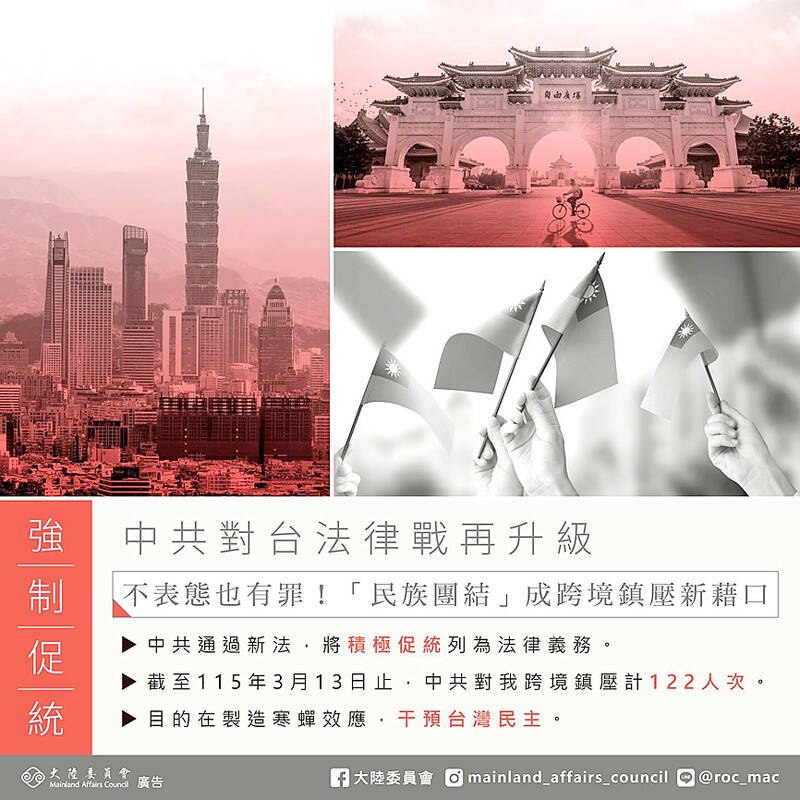
Photo courtesy of the Mainland Affairs Council
The law could provide Beijing with a legal basis to target Taiwanese people or businesses who do not take a pro-unification stance, the MAC said, describing it as a form of “long-arm” jurisdiction.
The council said it expects China to intensify efforts to counter pro-Taiwan independence views, promote unification narratives and expand transnational repression targeting Taiwanese.
China had committed 122 instances of cross-border repression involving Taiwan, affecting 103 people, companies or organizations as of March 13 the MAC said.
The council reiterated that Taiwan and the People’s Republic of China are not subordinate to each other and that Beijing has no jurisdiction over Taiwan.
Any attempts at transnational repression against Taiwanese would have no legal effect in Taiwan, it said, adding that the Chinese Communist Party’s (CCP) actions are meant to intimidate the public and interfere in Taiwan’s democracy.
The government would take all necessary measures to protect those targeted, the MAC said.
It also warned that people in Taiwan who assist or cooperate with the CCP could face legal consequences.
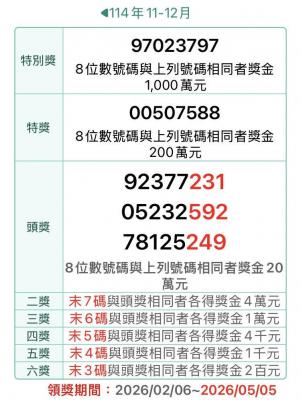
Seven of the 17 NT$10 million (US$311,604) winning receipts from the November-December uniform invoice lottery remain unclaimed as of today, the Ministry of Finance said, urging winners to redeem their prizes by May 5. The reminder comes ahead of the release of the winning numbers for the January-February lottery tomorrow. Among the unclaimed receipts was one for a NT$173 phone bill in Keelung, while others were for a NT$5,913 purchase at Costco in Taipei's Neihu District (內湖), a NT$49 purchase at a FamilyMart in New Taipei City's Tamsui District (淡水), and a NT$500 purchase at a tea shop in New Taipei City's

Taiwanese officials were shown the first of 66 F-16V fighter jets purchased by Taiwan from the United States, the Ministry of National Defense said yesterday, adding the aircraft has completed an initial flight test and is expected to be delivered later this year. A delegation led by Deputy Minister of National Defense Hsu Szu-chien (徐斯儉) visited Lockheed Martin’s F-16 C/D Block 70 (also known as F-16V) assembly line in South Carolina on March 16 to view the aircraft. The jet will undergo a final acceptance flight in the US before being delivered to Taiwan, the
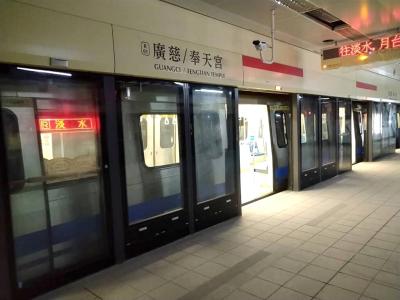
The New Taipei Metro's Sanyin Line and the eastern extension of the Taipei Metro's Tamsui-Xinyi Line (Red Line) are scheduled to begin operations in June, the National Development Council said today. The Red Line, which terminates at Xiangshan Station, would be connected by the 1.4km extension to a new eastern terminal, Guangci/Fengtian Temple Station, while the Sanyin Line would link New Taipei City's Tucheng and Yingge stations via Sanxia District (三峽). The council gave the updates at a council meeting reviewing progress on public construction projects for this year. Taiwan's annual public infrastructure budget would remain at NT$800 billion (US$25.08 billion), with NT$97.3

Deliveries of delayed F-16V jets are expected to begin in September, Minister of National Defense Wellington Koo (顧立雄) said today, after senior defense officials visited the US last week. The US in 2019 approved a US$8 billion sale of Lockheed Martin F-16 jets to Taiwan, a deal that would take the nation’s F-16 fleet to more than 200 jets, but the project has been hit by issues including software problems. Koo appeared today before a meeting of the legislature’s Foreign Affairs and National Defense Committee, which is discussing different versions of the special defense budget this week. The committee is questioning officials today,


 RSS
RSS