


Opposition lawmakers have called the a legal bill proposed by the Cabinet to impose administrative fines of up to NT$1 million (US$31,279) for advocating war-related rhetoric as a form of internet censorship.
The Executive Yuan proposed an amendment to Article 4 of the National Security Act (國家安全法), which would mandate that no person may, by means of text, drawings, sound, speech, images, electronic records or other methods, publicly advocate, promote, or support foreign nations, China, Hong Kong, Macau or external forces to initiate war against Taiwan or the use of non-peaceful means to eliminate Taiwan’s sovereignty.
The draft says that when a breach has been determined by the Ministry of the Interior (MOI) in consultation with the Ministry of Justice (MOJ), the Mainland Affairs Council (MAC) or other agencies, the violator might face a fine from NT$100,000 to NT$1 million.
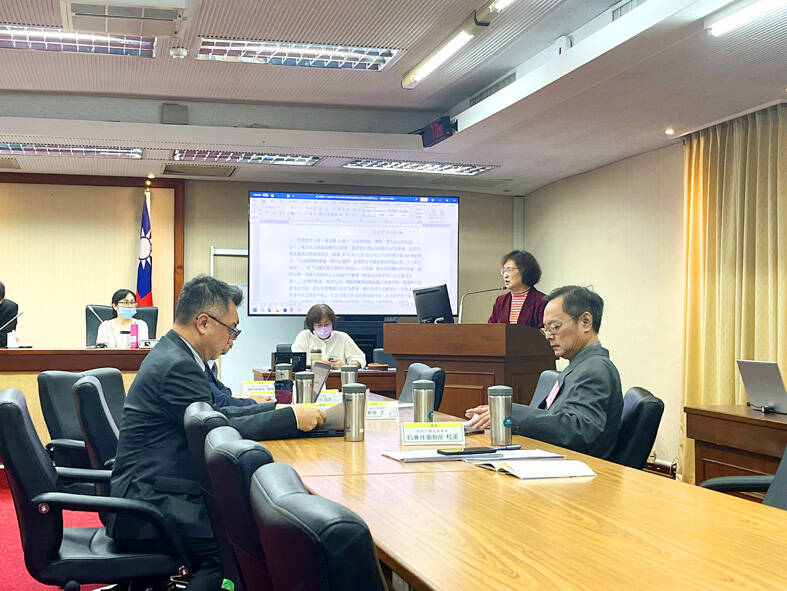
Photo: Lee Wen-hsin, Taipei Times
Democratic Progressive Party (DPP) Legislator Lee Po-yi (李柏毅), a convener of the legislature’s Internal Affairs Committee, said the Executive Yuan maintains that the criteria for determining “war-advocating speech” are strictly defined and would not infringe upon freedom of speech and that this is why the last round of review requires that public hearings must be held to discuss the matter.
KMT Legislator Chang Chih-lun (張智倫) said that former president Tsai Ing-wen’s (蔡英文) administration had drafted a “digital intermediary service act (數位中介服務法)” in 2022 to counter misinformation, but ultimately decided to hold off, as it might have come too close to infringing on freedom of speech and or suppressing information unfavorable to the government.
Chang said that President William Lai (賴清德) could seize broad powers of censorship over public speech, posing a serious threat to the public’s right to freedom of expression.
Violations of the “war advocacy” clause are determined by the MOI in consultation with the MOJ and MAC, which grants these agencies a “grey area” for discretionary judgment, he said.
When a speech is unfavorable to the ruling party, the agencies could easily label it as “misinformation,” Chang said, adding that it would be a form of disguised “cyber martial law,” forcing people to remain silent and trigger a chilling effect.
The KMT supports protecting national security but it cannot accept using it as a pretext for mass executive overreach, he said, urging executive agencies and legislators from all parties to listen closely to the concerns of the public and work together to find better ways to amend the law.
TPP caucus whip Jacky Chen (陳清龍) said that defending national security is something
no one would oppose, “but how exactly is ‘advocating war’ defined?”
The Executive Yuan’s draft amendment has no clear standards, he said, noting that even speech that does not reach the level of endangering national security could, after consultation between the MOI, MOJ, MAC and other agencies, be fined up to NT$1 million.
“The Democratic Progressive Party may be using the banner of resisting China and protecting Taiwan to impose de facto internet martial law, banning anyone with dissenting views,” he said, adding “we firmly oppose this so-called ‘green dictatorship.’”
The DPP intends to use public hearings as a platform for the agencies and legislators to communicate with the public about concerns, Lee said.
By going through the drafted amendments in detail and listening to feedback, the DPP plans incorporate these insights in the next review to ensure a balance is reached between protecting “national security” and “fundamental freedoms,” he said.
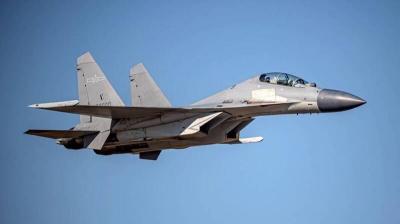
Eight Chinese naval vessels and 24 military aircraft were detected crossing the median line of the Taiwan Strait between 6am yesterday and 6am today, the Ministry of National Defense said this morning. The aircraft entered Taiwan’s northern, central, southwestern and eastern air defense identification zones, the ministry said. The armed forces responded with mission aircraft, naval vessels and shore-based missile systems to closely monitor the situation, it added. Eight naval vessels, one official ship and 36 aircraft sorties were spotted in total, the ministry said.
The Ministry of Foreign Affairs (MOFA) today said that if South Korea does not reply appropriately to its request to correct Taiwan’s name on its e-Arrival card system before March 31, it would take corresponding measures to alter how South Korea is labeled on the online Taiwan Arrival Card system. South Korea’s e-Arrival card system lists Taiwan as “China (Taiwan)” in the “point of departure” and “next destination” fields. The ministry said that it changed the nationality for South Koreans on Taiwan’s Alien Resident Certificates from “Korea” to “South Korea” on March 1, in a gesture of goodwill and based on the
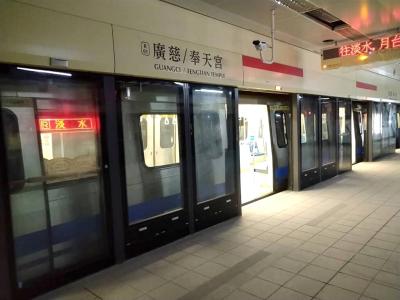
The New Taipei Metro's Sanyin Line and the eastern extension of the Taipei Metro's Tamsui-Xinyi Line (Red Line) are scheduled to begin operations in June, the National Development Council said today. The Red Line, which terminates at Xiangshan Station, would be connected by the 1.4km extension to a new eastern terminal, Guangci/Fengtian Temple Station, while the Sanyin Line would link New Taipei City's Tucheng and Yingge stations via Sanxia District (三峽). The council gave the updates at a council meeting reviewing progress on public construction projects for this year. Taiwan's annual public infrastructure budget would remain at NT$800 billion (US$25.08 billion), with NT$97.3

Taiwanese officials were shown the first of 66 F-16V fighter jets purchased by Taiwan from the United States, the Ministry of National Defense said yesterday, adding the aircraft has completed an initial flight test and is expected to be delivered later this year. A delegation led by Deputy Minister of National Defense Hsu Szu-chien (徐斯儉) visited Lockheed Martin’s F-16 C/D Block 70 (also known as F-16V) assembly line in South Carolina on March 16 to view the aircraft. The jet will undergo a final acceptance flight in the US before being delivered to Taiwan, the


 RSS
RSS