


President William Lai’s (賴清德) announcement that the government is contemplating restarting operations of two nuclear power plants is a belated acknowledgement of the Democratic Progressive Party’s (DPP) years-long energy policy mistakes, the Chinese Nationalist Party (KMT) said yesterday.
Lai earlier in the day announced that work has begun to secure approvals for restarting the decommissioned Guosheng Nuclear Power Plant in New Taipei City’s Wanli District (萬里) and the Ma-anshan Nuclear Power Plant in Pingtung County’s Hengchun Township (恆春) to meet an expected increase in power demand driven by the artificial intelligence sector.
Taiwan ended use of nuclear energy in May last year following the shutdown of the Ma-anshan power plant, part of former president Tsai Ing-wen’s (蔡英文) policy of “nuclear-free homeland” by last year.
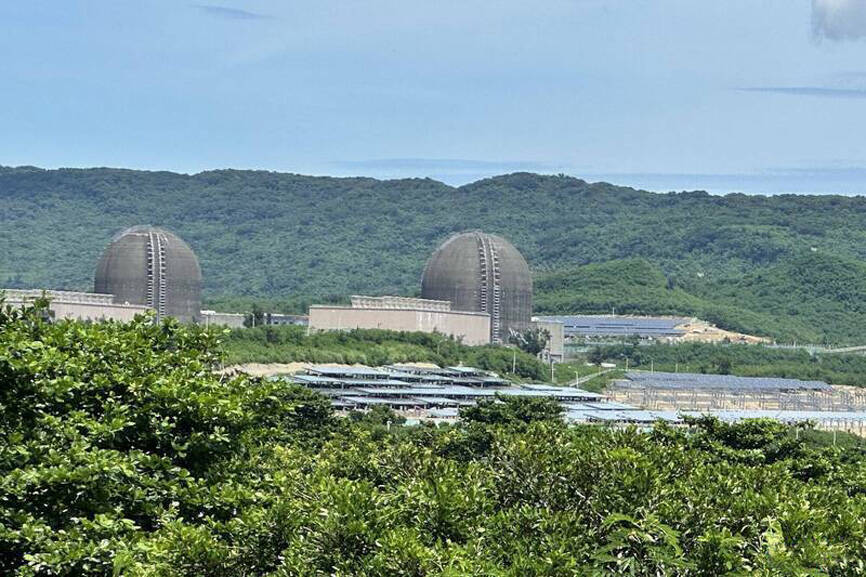
Photo: Taipei Times
The DPP’s non-nuclear homeland is an “utter failure of a policy,” the KMT said.
Lai’s announcement spelled the end of the DPP’s anti-nuclear “dogma,” for which Taiwanese are owed an apology, it added.
Lai should issue an “emergency order” to immediately restart the Ma-anshan Nuclear Power Plant to ensure Taiwan’s energy security, it said.
Taiwan is highly susceptible to gas and electricity shortages, which could be triggered at anytime by the outbreak of conflicts and international competition for energy supplies, the KMT said, adding that submitting a restart plan to the Nuclear Safety Commission by the end of this month would come “far too late” to address the threat.
The government is toying with the nation’s energy security, it said.
Taiwan People’s Party (TPP) yesterday said that if Lai is truly determined to face reality, he should apologize to the public for the DPP’s past policy mistakes.
“We welcome the Lai administration’s return to the right path, acknowledging Taiwan’s technological development, industrial transformation and public needs. By setting aside its anti-nuclear stance and no longer using ideology to dictate the lives of the Taiwanese people, it has made this important and correct decision,” TPP spokeswoman Chang Tung (張彤).
“Yet, knowing this now, why did it have to be this way from the start? Precious time was wasted, national security was sacrificed, industries were gambled with, and in the end, everyone lost,” she said.
Last year, TPP lawmakers pushed to change the nuclear reactor law and proposed to extend the service life of the Ma-anshan Nuclear Power Plant amid fierce opposition from the DPP, she said.
That Taiwan’s energy shortage and global realities forced the government to make a U-turn proved that the ruling party had lied to the public in its smear campaign against the TPP, she said.
Meanwhile, the DPP yesterday said the goal of a non-nuclear homeland at the time was a cross-party consensus.
The government has been conducting safety inspections of nuclear power plants in accordance with the law, and the three conditions for restarting nuclear power — that safety is assured, nuclear waste is manageable and there is social consensus — remain unchanged, it said.
Additional reporting by Chen Cheng-yu and CNA

Yangmingshan National Park authorities yesterday urged visitors to respect public spaces and obey the law after a couple was caught on a camera livestream having sex at the park’s Qingtiangang (擎天崗) earlier in the day. The Shilin Police Precinct in Taipei said it has identified a suspect and his vehicle registration number, and would summon him for questioning. The case would be handled in accordance with public indecency charges, it added. The couple entered the park at about 11pm on Thursday and began fooling around by 1am yesterday, the police said, adding that the two were unaware of the park’s all-day live

A former soldier and an active-duty army officer were yesterday indicted for allegedly selling classified military training materials to a Chinese intelligence operative for a total of NT$79,440. The Taipei District Prosecutors’ Office indicted Chen Tai-yin (陳泰尹) and Lee Chun-ta (李俊達) for contravening the National Security Act (國家安全法) and the Anti-Corruption Act (貪污治罪條例). Chen left the military in September 2013 after serving alongside then-staff sergeant Lee, now an army lieutenant, at the 21st Artillery Command of the army’s Sixth Corps from 2011 to 2013, according to the indictment. Chen met a Chinese intelligence operative identified as “Wang” (王) through a friend in November

Minister of Digital Affairs Lin Yi-ching (林宜敬) yesterday cited regulatory issues and national security concerns as an expert said that Taiwan is among the few Asian regions without Starlink. Lin made the remarks on Facebook after funP Innovation Group chief executive officer Nathan Chiu (邱繼弘) on Friday said Taiwan and four other countries in Asia — China, North Korea, Afghanistan and Syria — have no access to Starlink. Starlink has become available in 166 countries worldwide, including Ukraine, Malaysia, the Philippines and Vietnam, in the six years since it became commercial, he said. While China and North Korea block Starlink, Syria is not
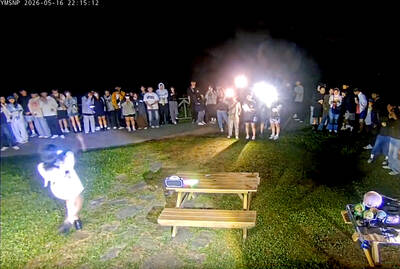
Yangmingshan National Park’s Qingtiangang (擎天崗) nature area has gone viral after a park livestream camera observed a couple in the throes of intimate congress, which was broadcast live on YouTube, drawing large late-night crowds and sparking a backlash over noise, bright lights and disruption to wildlife habitat. The area’s livestream footage appeared to show a couple engaging in sexual activity on a picnic table in the park on Friday last week, with the uncensored footage streamed publicly online. The footage quickly spread across social media, prompting a tide of visitors to travel to the site to “check in” and recreate the


 RSS
RSS