


A proposed amendment to the National Security Act (國家安全法) that would impose penalties on people advocating for China to take over Taiwan by force has drawn mixed reactions from security experts, with some urging the government to regulate only mobilization propaganda directly inciting the hostile regime to invade Taiwan through military action.
The amendment to Article 4 of the act proposed by the Executive Yuan prohibits anyone from advocating or supporting foreign countries, China, Hong Kong, Macau or other hostile regimes in launching wars against Taiwan or terminating Taiwan’s sovereignty using non-peaceful means.
Those who breach the regulations would face a fine of NT$100,000 to NT$1 million (US$3,129.6 to NT$31,296).
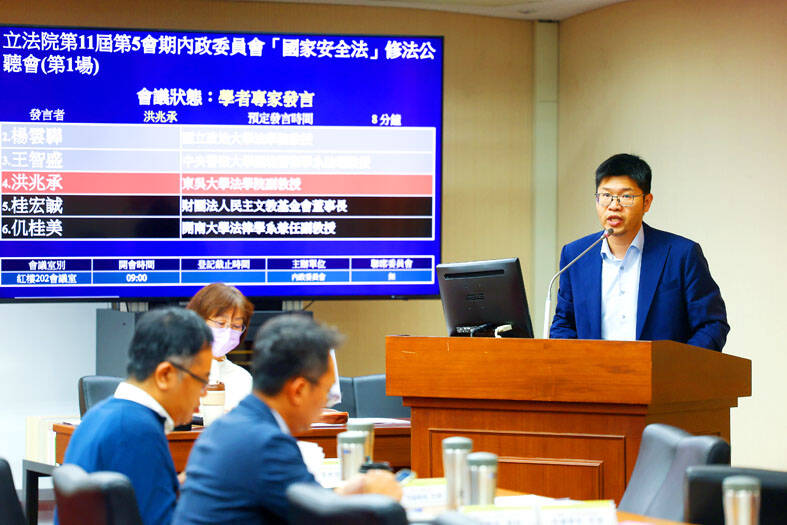
Photo: CNA
At a hearing hosted by legislature yesterday, Wang Chih-sheng (王智盛), an assistant professor at the Central Police University’s Border Police Department, said that the key question is how to draw the line between political commentaries on cross-strait matters and statements threatening national security, while ensuring that people expressing their political opinions are not mistakenly penalized.
The Executive Yuan’s proposal uses very vague terms, Wang said.
“It should specifically ban mobilization rhetoric inciting hostile regimes to invade Taiwan by force and explicitly state that policy discussions, debates over Taiwanese independence or unification with China and academic analyses are excluded,” Wang said.
The government should also aim to prevent people from being exposed to foreign infiltration forces, he added.
“People are contacted by these [hostile] forces through the Internet, pledge allegiance to them and get assigned tasks [on infiltration]. If we always tackle the problems only after the damage is done, we would never find the organizations planning and operating the infiltration work in the first place,” Wang said, adding that cutting off contact with the infiltration force is key.
Current national security laws make it difficult to convict offenders as they require a clear intent to harm national security or social stability, he said.
The proposed amendment would consider an act unlawful if it is deemed on its own to be capable of causing harm, without requiring proof that actual harm occurred.
National Chengchi University law professor Yang Yun-hua (楊雲驊) said that military personnel, teachers and civil servants found guilty of national security offenses should receive no pension.
“It is still way too generous that they get 50 percent of their pension after being convicted. The government should not use taxpayers’ money to take care of them when they retire, while they use this money to threaten national security,” Yang said.
Liao Yi-ming (廖義銘), a professor at National Kaohsiung University’s Department of Political Science and Law, said in an interview after the hearing that the draft amendment’s broad clause — acts “sufficient to harm national security or social stability”— amounts to a “blank check,” effectively granting unlimited discretion to administrative and law enforcement agencies such as the Mainland Affairs Council and the Ministry of the Interior.
The most serious issue is that the amendment does not require authorities to prove that the person acted with malice, he said, adding that a unilateral determination that the act is “potentially harmful” is enough to convict the person.
Such legal concepts, lacking objective standards of evidence, risk enabling arbitrary expansion of administrative power, Liao said.

Fast food chain McDonald's is to raise prices by up to NT$5 on some products at its restaurants across Taiwan, starting on Wednesday next week, the company announced today. The prices of all extra value meals and sharing boxes are to increase by NT$5, while breakfast combos and creamy corn soup would go up by NT$3, the company said in a statement. The price of the main items of those meals, if ordered individually, would remain the same. Meanwhile, the price of a medium-sized lemon iced tea and hot cappuccino would rise by NT$3, extra dipping sauces for chicken nuggets would go up
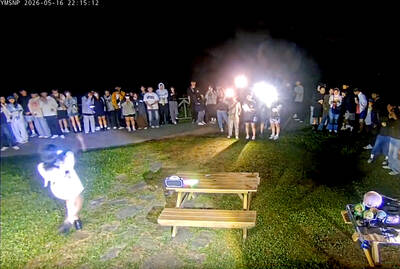
Yangmingshan National Park’s Qingtiangang (擎天崗) nature area has gone viral after a park livestream camera observed a couple in the throes of intimate congress, which was broadcast live on YouTube, drawing large late-night crowds and sparking a backlash over noise, bright lights and disruption to wildlife habitat. The area’s livestream footage appeared to show a couple engaging in sexual activity on a picnic table in the park on Friday last week, with the uncensored footage streamed publicly online. The footage quickly spread across social media, prompting a tide of visitors to travel to the site to “check in” and recreate the

Minister of Digital Affairs Lin Yi-ching (林宜敬) yesterday cited regulatory issues and national security concerns as an expert said that Taiwan is among the few Asian regions without Starlink. Lin made the remarks on Facebook after funP Innovation Group chief executive officer Nathan Chiu (邱繼弘) on Friday said Taiwan and four other countries in Asia — China, North Korea, Afghanistan and Syria — have no access to Starlink. Starlink has become available in 166 countries worldwide, including Ukraine, Malaysia, the Philippines and Vietnam, in the six years since it became commercial, he said. While China and North Korea block Starlink, Syria is not
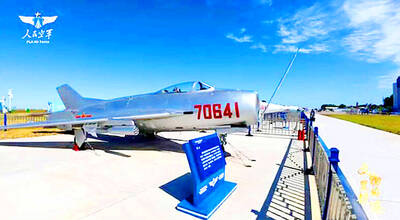
GROUNDED: A KMT lawmaker proposed eliminating drone development programs and freezing funding for counterdrone systems, despite China’s adoption of the technology China has deployed attack drones at air bases near the Taiwan Strait in a strategy aimed at overwhelming Taiwan’s air defense systems through saturation attacks, the Mainland Affairs Council (MAC) said. The council’s latest quarterly report on China said that satellite imagery and open-source intelligence indicate that the Chinese People’s Liberation Army (PLA) had converted retired J-6 fighter jets into J-6W drones, which the PLA has stationed at six air bases near Taiwan, five in China’s Fujian Province and one in Guangdong Province. The report cited J. Michael Dahm, a senior fellow at the US-based Mitchell Institute, as saying that China has


 RSS
RSS