


It is not unusual to see lines of people at the FEDS XinYi A13 department store in Taipei’s Xinyi District (信義), either to visit a popular restaurant or a pop-up shop. However, on Saturday, the crowd was hoping to get hold of one of the potted plants that were being distributed that day.
The activity was one of 165 events held nationwide, with 90,000 saplings of 98 tree species being given away throughout the Tree-Planting Month.
Since 2003, March has been established as Tree-Planting Month in Taiwan — an extension on Taiwan’s Arbor Day on March 12, which was set up to commemorate the death anniversary of Republic of China founder Sun Yat-sen (孫中山).
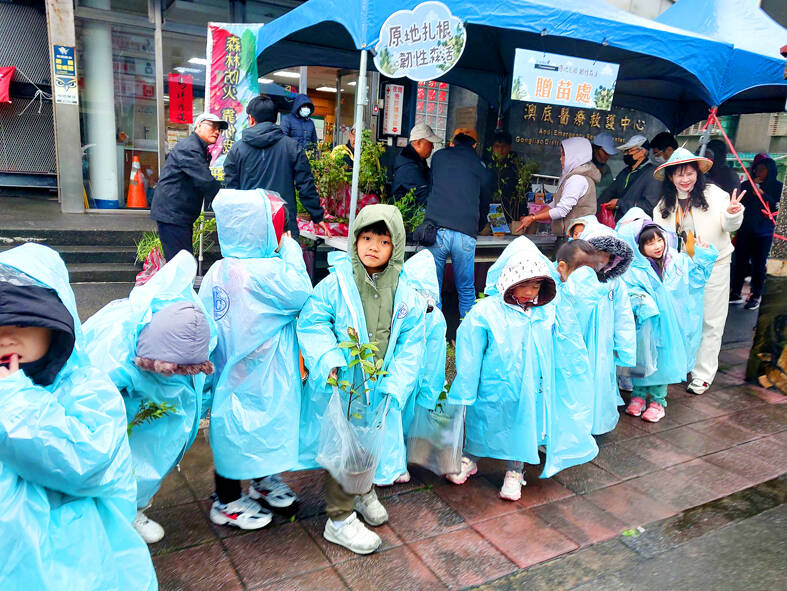
Photo courtesy of the Forestry and Nature Conservation Agency
The focus of sapling giveaways during Tree-Planting Month has shifted from conserving timber resources to ecological afforestation and restoration in line with the Forestry and Nature Conservation Agency’s Taiwan Ecological Network program launched in 2018, agency official Hsu Hsien-pin (許賢斌) told the Taipei Times.
Sapling giveaways are part of the effort to restore wildlife habitats scattered across lowland hills, plains or coastal areas, so that they can be connected to the Central Mountain Range Conservation Corridor to form an ecological network, he said.
Saplings given away during these events are mainly shrubs or small trees that can grow well on balconies of urban households, but would not grow into a big tree within five years, Hsu said.
They prefer living under forest canopy and do not need full sunlight, he said, adding that most of the tree species are commonly seen on lowland hills.
Although flowering plants — such as naturalized azaleas that arrived in Taiwan more than a century ago — used to dominate these events, the focus has shifted to indigenous plants in recent years, including native azaleas, Hsu said.
Restoration of endangered species, such as the Taitung firethorn, is another key focus in this year’s sapling giveaways, he said.
Asked if saplings of endangered tree species would be more difficult for adopters to nurture, Hsu said all saplings selected for giveaways are easy to grow in home environments.
Most endangered plants are endangered by human activities, climate change or pests and diseases, he said.
People are encouraged to transplant their adopted saplings from pots to land after they have grown big enough, officially adding their greenery to the Taiwan Ecological Network, Hsu said.
If they plan to transplant their trees on public land, they can contact schools, government agencies or community authorities to see if there is vacant land, he said.
All saplings are free, but rules on how to get them might differ according to local authorities, Hsu said, adding that people can get more information about all events from the agency’s Facebook page.
The saplings that the agency’s Pingtung branch gave away this year were mainly native species, including trincomalee wood, negundo chaste tree, jasmin orange, whole-leaf hawthorn, boxleaf eugenia, five-stamens China laurel, Fukien tea tree, Taiwan incense cedar, Lanyu podocarp and dwarf umbrella tree, said Lin Hsiang-ling (林湘玲), an official at the Pingtung branch.
All of them are suitable for growing in southern Taiwan, she said, adding that the saplings were cultivated in nurseries managed by the branch.
Indigenous plant species, having evolved over time, have adapted to local climate and soil conditions and are less prone to pests and diseases compared with invasive species, making them more resilient against the impact of climate change, Lin said.
While Taiwan incense cedar is popular with sapling adopters due to its fragrant branches and leaves, jasmin orange and whole-leaf hawthorn are also widely loved for their colorful fruits, she said.
Trincomalee wood, an endangered species listed in the Red List of Vascular Plants of Taiwan, has become rare in the wild, Lin said.
It was included in the branch’s giveaway event, as lowland hills in southern Taiwan are a favorable growing environment, she said, adding that the branch expects adopters to help expand Trincomalee wood’s wild population.
Huang Wan-ju (黃婉如), technical specialist at the agency’s Hsinchu branch, said cape jasmine, a shrub with white flowers and strong fragrance, is one of the branch’s most popular giveaway species.
Flowering plants appeal to most adopters, such as rose myrtle, whole-leaf hawthorn or short-style camellia, she said.
At a sapling giveaway event in Yilan on Saturday, Aisa said she adopted a Wulai azalea.
“I wanted sweet osmanthus because I like its scent, but they were all gone,” she said.
Wulai azalea looks beautiful, but is scentless, she said, adding: “I will plant it on my balcony.”


China has reserved offshore airspace in the Yellow Sea and East China Sea from March 27 to May 6, issuing alerts usually used to warn of military exercises, although no such exercises have been announced, the Wall Street Journal (WSJ) reported yesterday. Reserving such a large area for 40 days without explanation is an “unusual step,” as military exercises normally only last a few days, the paper said. These alerts, known as Notice to Air Missions (Notams), “are intended to inform pilots and aviation authorities of temporary airspace hazards or restrictions,” the article said. The airspace reserved in the alert is

South Korea is planning to revise its controversial electronic arrival card, a step Taiwanese officials said prompted them to hold off on planned retaliatory measures, a South Korean media report said yesterday. A Yonhap News Agency report said that the South Korean Ministry of Foreign Affairs is planning to remove the “previous departure place” and “next destination” fields from its e-arrival card system. The plan, reached after interagency consultations, is under review and aims to simplify entry procedures and align the electronic form with the paper version, a South Korean ministry official said. The fields — which appeared only on the electronic form

A bipartisan group of US senators has introduced a bill to enhance cooperation with Taiwan on drone development and to reduce reliance on supply chains linked to China. The proposed Blue Skies for Taiwan Act of 2026 was introduced by Republican US senators Ted Cruz and John Curtis, and Democratic US senators Jeff Merkley and Andy Kim. The legislation seeks to ease constraints on Taiwan-US cooperation in uncrewed aerial systems (UAS), including dependence on China-sourced components, limited access to capital and regulatory barriers under US export controls, a news release issued by Cruz on Wednesday said. The bill would establish a "Blue UAS

More than 6,000 Taiwanese students have participated in exchange programs in China over the past two years, despite the Mainland Affairs Council’s (MAC) “orange light” travel advisory, government records showed. The MAC’s publicly available registry showed that Taiwanese college and university students who went on exchange programs across the Strait numbered 3,592 and 2,966 people respectively. The National Immigration Agency data revealed that 2,296 and 2,551 Chinese students visited Taiwan for study in the same two years. A review of the Web sites of publicly-run universities and colleges showed that Taiwanese higher education institutions continued to recruit students for Chinese educational programs without


 RSS
RSS