


A 20-year follow-up study showed that high exposure to the plasticizer di-(2-ethylhexyl) phthalate (DEHP), metabolic susceptibility and early menarche can increase breast cancer risk by up to seven times among women, Academia Sinica said yesterday.
The large-scale longitudinal cohort study was led by academician and former vice president Chen Chien-jen (陳建仁), a distinguished research fellow at Academia Sinica’s Genomics Research Center, and a research team composed of members from the National Health Research Institutes (NHRI) and several local universities.
The results of the 20-year study were published last month in the Proceedings of the National Academy of Sciences of the US, one of the world’s most-cited and comprehensive multidisciplinary scientific journals.
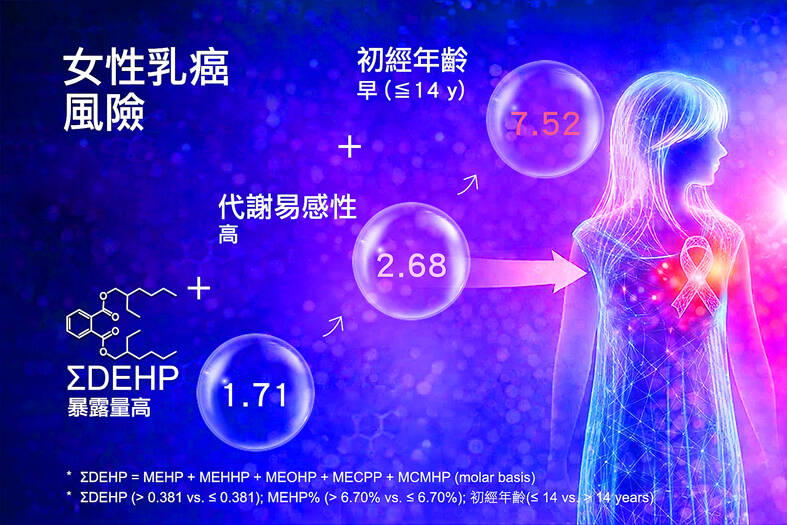
Photo courtesy of Academia Sinica
Breast cancer has long been the most common type of cancer among women in Taiwan and many developed countries, with the trend also rising among younger women, but previous studies on the chronological link between DEHP exposure and breast cancer onset are not clear, the institution said.
The nested case-control study recruited 11,923 women in Taiwan in 1991 and 1992, and followed them through 2010, establishing a causal timeline that confirmed DEHP exposure preceded the development of breast cancer, they said.
Academia Sinica cited Chen as saying that the study collected urine samples from participants at the beginning, while keeping track of their lifestyle habits and environmental exposure for 20 years.
By linking their data with the national cancer registry data, the research team identified people from the group who were later diagnosed with breast cancer, and selected a matched control group of cancer-free women, he said.
Urine samples from 119 invasive breast cancer cases and 245 matched controls were retrieved from the frozen biospecimen bank to analyze DEHP metabolites, and the results indicated that people with higher urinary concentrations of DEHP metabolites have significantly increased risk of developing breast cancer during the follow-up period, Chen was cited as saying.
Academia Sinica quoted Chen Hui-chi (陳慧祺), the first author of the paper and former postdoctoral fellow at Academia Sinica’s Genomics Research Center, as saying that one of the study’s most significant breakthroughs is finding metabolic susceptibility (MEHP%) as a new and better biomarker reflecting a person’s ability to metabolize DEHP.
After DEHP enters the body, it is first metabolized into a more toxic primary metabolite, which is later converted into less toxic secondary metabolites, she said.
A higher residual percentage of primary metabolites in the body indicates that the person has a lower metabolic efficiency for the substance, she added.
Women with high MEHP% and high exposure to DEHP are 2.68 times more likely to develop breast cancer, she said.
When combined with the risk factor of early onset of menstruation (under 14 years old), the risk of developing breast cancer rises to 7.52 times, she said.
MEHP% reflects a person’s physiological capacity to metabolize DEHP, and the differences among individuals may be due to variations in innate biological constitutions, lifestyles, dietary choices and environments, making some women more susceptible to breast cancer even with the same level of DEHP exposure, she said.
Local and international studies have not yet recognized the importance of MEHP%, so this discovery offers a new entry point for future breast cancer risk assessment, she added.
Chen Chien-jen said DEHP is an endocrine disruptor widely used in plastic products, and the study serves as a reminder for high-risk groups to reduce their exposure to plasticizers, while emphasizing the importance of breast cancer screening.
The institution also cited Academia Sinica President James Liao (廖俊智) as saying the study explicitly showed that DEHP is a significant environmental carcinogen for breast cancer, providing a crucial scientific basis for future prevention strategies and risk assessments.

Yangmingshan National Park authorities yesterday urged visitors to respect public spaces and obey the law after a couple was caught on a camera livestream having sex at the park’s Qingtiangang (擎天崗) earlier in the day. The Shilin Police Precinct in Taipei said it has identified a suspect and his vehicle registration number, and would summon him for questioning. The case would be handled in accordance with public indecency charges, it added. The couple entered the park at about 11pm on Thursday and began fooling around by 1am yesterday, the police said, adding that the two were unaware of the park’s all-day live

Fast food chain McDonald's is to raise prices by up to NT$5 on some products at its restaurants across Taiwan, starting on Wednesday next week, the company announced today. The prices of all extra value meals and sharing boxes are to increase by NT$5, while breakfast combos and creamy corn soup would go up by NT$3, the company said in a statement. The price of the main items of those meals, if ordered individually, would remain the same. Meanwhile, the price of a medium-sized lemon iced tea and hot cappuccino would rise by NT$3, extra dipping sauces for chicken nuggets would go up

Yangmingshan National Park’s Qingtiangang (擎天崗) nature area has gone viral after a park livestream camera observed a couple in the throes of intimate congress, which was broadcast live on YouTube, drawing large late-night crowds and sparking a backlash over noise, bright lights and disruption to wildlife habitat. The area’s livestream footage appeared to show a couple engaging in sexual activity on a picnic table in the park on Friday last week, with the uncensored footage streamed publicly online. The footage quickly spread across social media, prompting a tide of visitors to travel to the site to “check in” and recreate the

Minister of Digital Affairs Lin Yi-ching (林宜敬) yesterday cited regulatory issues and national security concerns as an expert said that Taiwan is among the few Asian regions without Starlink. Lin made the remarks on Facebook after funP Innovation Group chief executive officer Nathan Chiu (邱繼弘) on Friday said Taiwan and four other countries in Asia — China, North Korea, Afghanistan and Syria — have no access to Starlink. Starlink has become available in 166 countries worldwide, including Ukraine, Malaysia, the Philippines and Vietnam, in the six years since it became commercial, he said. While China and North Korea block Starlink, Syria is not


 RSS
RSS