


The Chinese public maintains relatively amicable sentiments toward Taiwan and strongly prefers non-military routes to improving cross-strait relations, a survey conducted by the US-based Carter Center and Emory University showed.
The “China Pulse” research project, which polled 2,506 adults between Oct. 27 last year and Jan. 1 this year, found that 86 percent of respondents support strengthening cultural ties, while 81 percent favor deepening economic interaction.
The report, co-authored by political scientists at Emory University and advisors at the Carter Center, indicates that the Chinese public views Taiwan’s importance through a lens of shared history and culture rather than geopolitical or technological competition.
Photo: Reuters
Regarding Taiwan’s semiconductor industry, only 45 percent of Chinese respondents cited high-tech manufacturing as a key factor in Taiwan’s value.
Instead, 80 percent believe unification would resolve a “long-standing historical issue” and end the “century of humiliation.”
Despite the focus on peaceful engagement, the survey found no clear mandate for either pacifism or militarism.
The percentage of respondents who believe unification should not be achieved by force “under any circumstances” fell from 51 percent in a pilot poll between July 7 and Aug. 15 last year to 38 percent in the new poll.
However, half of the respondents said that the use of military force would only make the Taiwan issue worse.
In a hypothetical scenario where Taiwan declared independence, 81 percent of the Chinese public would support limited military operations on outlying islands.
In contrast, only 32 percent expressed support for a full-scale military attack against Taiwan.
Demographic data indicate that peaceful views are most prevalent among women, lower-income people and those with less formal education.
For instance, 54 percent of the lowest-earning respondents supported a peaceful-only approach, compared with roughly a quarter of high earners.
Ultimately, the findings indicate that while the Chinese public remains committed to unification in principle, there is significant reticence regarding the risks of a major conflict.
Most prefer a negotiated peace and policies that encourage Taiwanese students and businesspeople to live and work in China.

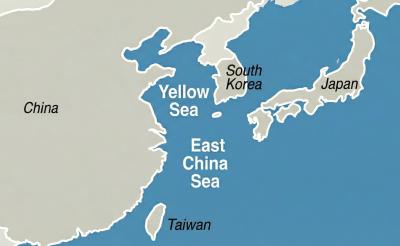
China has reserved offshore airspace in the Yellow Sea and East China Sea from March 27 to May 6, issuing alerts usually used to warn of military exercises, although no such exercises have been announced, the Wall Street Journal (WSJ) reported yesterday. Reserving such a large area for 40 days without explanation is an “unusual step,” as military exercises normally only last a few days, the paper said. These alerts, known as Notice to Air Missions (Notams), “are intended to inform pilots and aviation authorities of temporary airspace hazards or restrictions,” the article said. The airspace reserved in the alert is

South Korea is planning to revise its controversial electronic arrival card, a step Taiwanese officials said prompted them to hold off on planned retaliatory measures, a South Korean media report said yesterday. A Yonhap News Agency report said that the South Korean Ministry of Foreign Affairs is planning to remove the “previous departure place” and “next destination” fields from its e-arrival card system. The plan, reached after interagency consultations, is under review and aims to simplify entry procedures and align the electronic form with the paper version, a South Korean ministry official said. The fields — which appeared only on the electronic form

A bipartisan group of US senators has introduced a bill to enhance cooperation with Taiwan on drone development and to reduce reliance on supply chains linked to China. The proposed Blue Skies for Taiwan Act of 2026 was introduced by Republican US senators Ted Cruz and John Curtis, and Democratic US senators Jeff Merkley and Andy Kim. The legislation seeks to ease constraints on Taiwan-US cooperation in uncrewed aerial systems (UAS), including dependence on China-sourced components, limited access to capital and regulatory barriers under US export controls, a news release issued by Cruz on Wednesday said. The bill would establish a "Blue UAS
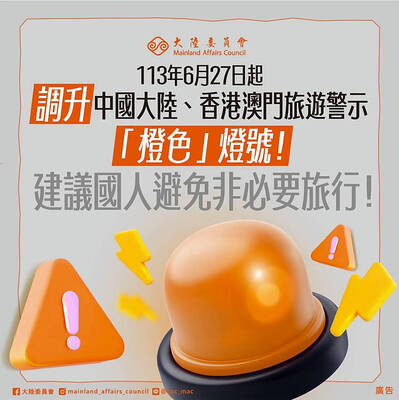
More than 6,000 Taiwanese students have participated in exchange programs in China over the past two years, despite the Mainland Affairs Council’s (MAC) “orange light” travel advisory, government records showed. The MAC’s publicly available registry showed that Taiwanese college and university students who went on exchange programs across the Strait numbered 3,592 and 2,966 people respectively. The National Immigration Agency data revealed that 2,296 and 2,551 Chinese students visited Taiwan for study in the same two years. A review of the Web sites of publicly-run universities and colleges showed that Taiwanese higher education institutions continued to recruit students for Chinese educational programs without


 RSS
RSS