


Premier Cho Jung-tai (卓榮泰) yesterday presented receipts from his trip to Tokyo, where he attended the World Baseball Classic, showing that he paid for the NT$2.14 million (US$67,047) trip himself.
Cho said he made the disclosure as the public has the right to know, and in response to allegations from opposition parties that he had misused public funds for his trip and tried to cover up his itinerary.
The trip was the first time a sitting Taiwanese premier visited Japan since the two countries severed formal diplomatic ties in 1972.
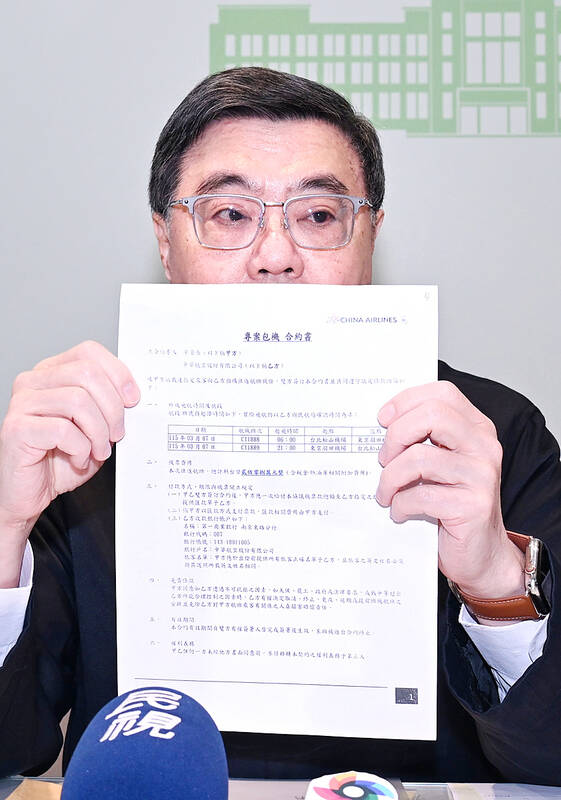
Photo: Fang Pin-chao, Taipei Times
Cho said he took a private one-day trip to the Tokyo Dome to support Team Taiwan, and presented receipts for the charter flight, tickets to the game, tour bus and a yen exchange slip as evidence.
The chartered China Airlines flight cost NT$2.08 million and the receipt showed that the premier had remitted money to the airline under his name.
“I willingly paid for this private trip myself,” Cho said. “It was very important to go there, as the significance far outweights any monetary expenditure.”
He rejected accusations by Chinese Nationalist Party (KMT) legislators, who said Cho “embezzled millions” by taking money from public accounts for the trip.
It was baseless slander from people who were angry that he broke through restrictions against top Taiwan officials visiting foreign countries due to political pressure from Beijing, Cho said.
KMT Legislator Hsu Chiao-hsin (徐巧芯) and other party members said they have a duty to scrutinize public spending.
She accused Cho of making a “secret arrangement” to use the military airbase at Taipei International Airport (Songshan airport) to deceive the public and “hush up” the details of his trip.
The KMT said the trip could escalate tensions between Beijing and Tokyo, and would not help Taiwan-Japan relations.
Tensions between China and Japan have been high since Japanese Prime Minister Sanae Takaichi’s remarks on a “Taiwan contingency” in November last year.
Retired air force lieutenant general Chang Yen-ting (張延廷) said that Cho’s flight departed from the military apron of the Songshan airport, which suggested that the trip was not purely private.
There was no precedent for a private trip using the military apron for immigration clearance, Chang said.
Cho said charter flights are commonly used for security reasons.
Separately, Democratic Progressive Party (DPP) Taipei City Councilor Chien Shu-pai (簡書培) said the KMT was misleading the public.
Cho could not be open about his travel arrangements, as revealing plans beforehand would open the door for China to pressure foreign governments into blocking the trip, Chien said.
Several DPP members also accused the KMT of having a double standard, as several KMT legislators have visited China and met with Chinese officials six times over the past few years, yet they never disclosed whether those were personal visits or official business, nor revealed who paid for the travel and accommodation.
DPP caucus deputy chief executive Chen Pei-yu (陳培瑜) said she had filed a written request with the Legislative Secretariat Office for the bills, receipts and documents related to KMT legislators’ visits to China, but she had not received a reply yet.
“As Cho has provided all his bills, we request that Legislative Speaker Han Kuo-yu (韓國瑜) ask KMT legislators to do the same,” Chen added.
Additional reporting by CNA
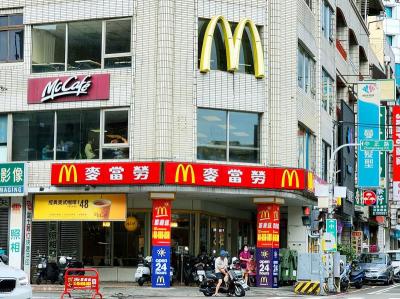
Fast food chain McDonald's is to raise prices by up to NT$5 on some products at its restaurants across Taiwan, starting on Wednesday next week, the company announced today. The prices of all extra value meals and sharing boxes are to increase by NT$5, while breakfast combos and creamy corn soup would go up by NT$3, the company said in a statement. The price of the main items of those meals, if ordered individually, would remain the same. Meanwhile, the price of a medium-sized lemon iced tea and hot cappuccino would rise by NT$3, extra dipping sauces for chicken nuggets would go up
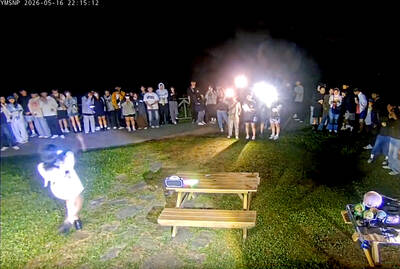
Yangmingshan National Park’s Qingtiangang (擎天崗) nature area has gone viral after a park livestream camera observed a couple in the throes of intimate congress, which was broadcast live on YouTube, drawing large late-night crowds and sparking a backlash over noise, bright lights and disruption to wildlife habitat. The area’s livestream footage appeared to show a couple engaging in sexual activity on a picnic table in the park on Friday last week, with the uncensored footage streamed publicly online. The footage quickly spread across social media, prompting a tide of visitors to travel to the site to “check in” and recreate the

Minister of Digital Affairs Lin Yi-ching (林宜敬) yesterday cited regulatory issues and national security concerns as an expert said that Taiwan is among the few Asian regions without Starlink. Lin made the remarks on Facebook after funP Innovation Group chief executive officer Nathan Chiu (邱繼弘) on Friday said Taiwan and four other countries in Asia — China, North Korea, Afghanistan and Syria — have no access to Starlink. Starlink has become available in 166 countries worldwide, including Ukraine, Malaysia, the Philippines and Vietnam, in the six years since it became commercial, he said. While China and North Korea block Starlink, Syria is not
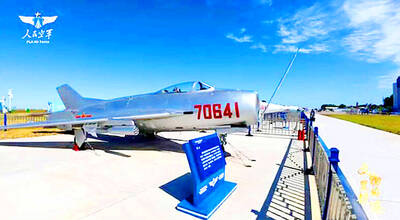
GROUNDED: A KMT lawmaker proposed eliminating drone development programs and freezing funding for counterdrone systems, despite China’s adoption of the technology China has deployed attack drones at air bases near the Taiwan Strait in a strategy aimed at overwhelming Taiwan’s air defense systems through saturation attacks, the Mainland Affairs Council (MAC) said. The council’s latest quarterly report on China said that satellite imagery and open-source intelligence indicate that the Chinese People’s Liberation Army (PLA) had converted retired J-6 fighter jets into J-6W drones, which the PLA has stationed at six air bases near Taiwan, five in China’s Fujian Province and one in Guangdong Province. The report cited J. Michael Dahm, a senior fellow at the US-based Mitchell Institute, as saying that China has


 RSS
RSS