


Deputy Legislative Speaker Johnny Chiang (江啟臣) of the Chinese Nationalist Party (KMT) visited former Australian prime minister Malcolm Turnbull yesterday, the Legislative Yuan said today.
Turnbull welcomed Chiang and expressed support for Chiang's proposed "3D" principles of deterrence, dialogue and democracy for maintaining regional peace and stability, the legislature said in a statement.
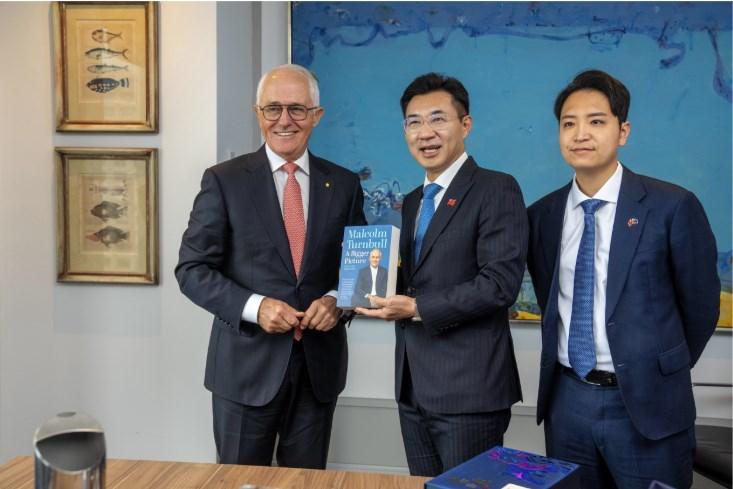
Photo courtesy of the Legislative Yuan via CNA
Turnbull agreed that maintaining communication could help reduce misunderstandings and create opportunities to ease tensions, the statement said.
Chiang said regional stability and economic security are the main challenges facing countries amid rapid global changes, and hoped that Taiwan and Australia could develop a more comprehensive partnership as bilateral trade continues to grow, it added.
Taiwan's leading role in the global semiconductor supply chain and Australia's abundant mineral and agricultural resources are highly complementary, Chiang said.
Chiang also expressed the hope that Turnbull could use his influence to support Taiwan's bid to join the Comprehensive and Progressive Agreement for Trans-Pacific Partnership.
Taiwan's participation would bring positive effects to the trade bloc because of the complementary nature of Taiwanese and Australian industries, he added.
Later the same day, Chiang visited the US Studies Centre at the University of Sydney, the statement said.
Chiang departed for Sydney on Saturday evening with a delegation of lawmakers to attend events with the World Taiwanese Chambers of Commerce and engage in parliamentary diplomacy, the legislature said.
It said he would be in Australia for two-and-a-half days, but did not specify when he would return to Taiwan.

SECURITY: Starlink owner Elon Musk has taken pro-Beijing positions, and allowing pro-China companies to control Taiwan’s critical infrastructure is risky, a legislator said Starlink was reluctant to offer services in Taiwan because of the nation’s extremely high penetration rates in 4G and 5G services, the Ministry of Digital Affairs said yesterday. The ministry made the comments at a meeting of the legislature’s Transportation Committee, which reviewed amendments to Article 36 of the Telecommunications Management Act (電信管理法). Article 36 bans foreigners from holding more than 49 percent of shares in public telecommunications networks, while shares foreigners directly and indirectly hold are also capped at 60 percent of the total, unless specified otherwise by law. The amendments, sponsored by Chinese Nationalist Party (KMT) Legislator Ko

The military has spotted two Chinese warships operating in waters near Penghu County in the Taiwan Strait and sent its own naval and air forces to monitor the vessels, the Ministry of National Defense (MND) said. Beijing sends warships and warplanes into the waters and skies around Taiwan on an almost daily basis, drawing condemnation from Taipei. While the ministry offers daily updates on the locations of Chinese military aircraft, it only rarely gives details of where Chinese warships are operating, generally only when it detects aircraft carriers, as happened last week. A Chinese destroyer and a frigate entered waters to the southwest
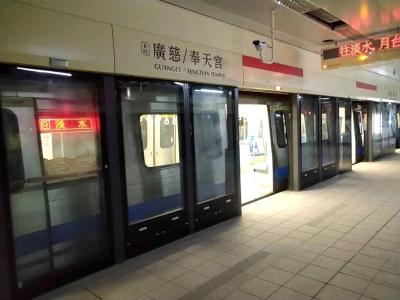
The eastern extension of the Taipei MRT Red Line could begin operations as early as late June, the Taipei Department of Rapid Transit Systems said yesterday. Taipei Rapid Transit Corp said it is considering offering one month of free rides on the new section to mark its opening. Construction progress on the 1.4km extension, which is to run from the current terminal Xiangshan Station to a new eastern terminal, Guangci/Fengtian Temple Station, was 90.6 percent complete by the end of last month, the department said in a report to the Taipei City Council's Transportation Committee. While construction began in October 2016 with an
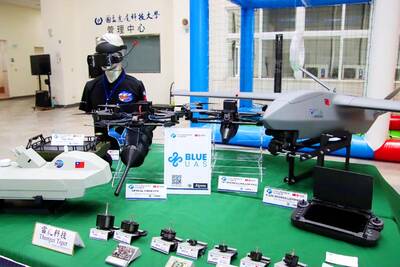
NON-RED SUPPLY: Boosting the nation’s drone industry is becoming increasingly urgent as China’s UAV dominance could become an issue in a crisis, an analyst said Taiwan’s drone exports to Europe grew 41.7-fold from 2024 to last year, with demand from Ukraine’s fight against Russian aggression the most likely driver of growth, a study showed. The Institute for Democracy, Society and Emerging Technology (DSET) in a statement on Wednesday said it found that many of Taiwan’s uncrewed aerial vehicle (UAV) sales were from Poland and the Czech Republic. These countries likely transferred the drones to Ukraine to aid it in its fight against the Russian invasion that started in 2022, it said. Despite the gains, Taiwan is not the dominant drone exporter to these markets, ranking second and fourth


 RSS
RSS