


The Central Weather Administration (CWA) announced amendments to the Meteorological Act (氣象法) aimed at curbing sensationalism in media reporting to ensure the accuracy of public information.
The amendments would require the media to use terminology issued by the agency in headlines and news content, while the use of descriptive terms would be prohibited.
If an outlet publishes exaggerated reports and fails to issue a correction or improvement within a specified time frame, it would face fines ranging from NT$100,000 to NT$500,000, with penalties imposed repeatedly for continued contraventions.
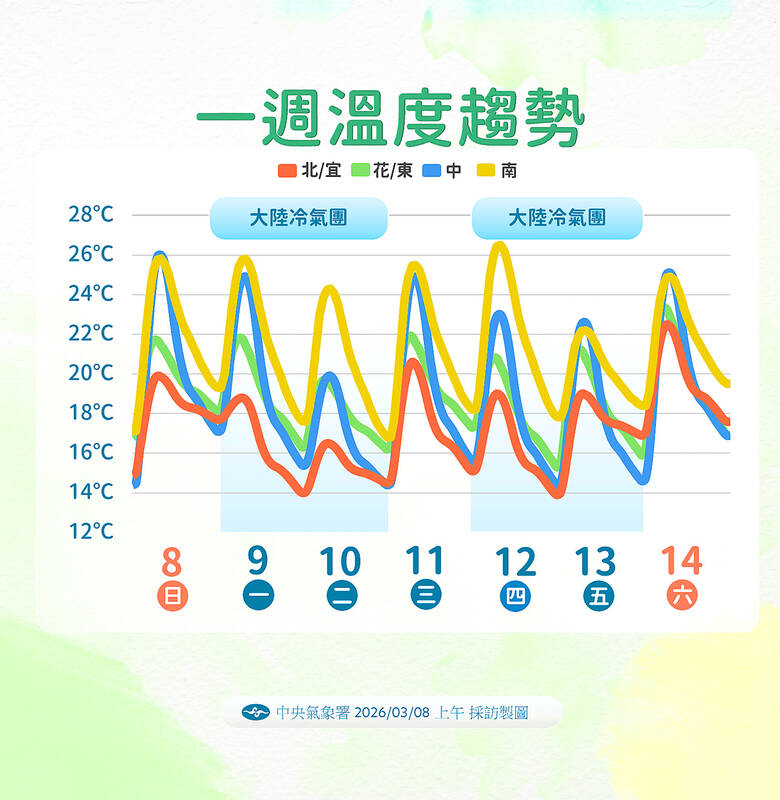
Photo provided by the Central Weather Administration
Some media outlets cite weather forecasts posted by anonymous online fan pages or social media accounts with unclear sources, the CWA said.
Government agencies, schools, organizations and people must obtain a permit before issuing forecasts, the agency said, citing Regulations on the Authorization of Forecast Service of Meteorological and Marine Meteorological Phenomena (從事氣象海象預報業務許可辦法), it added.
The revisions would also stipulate that when media outlets cite forecasts, warnings or reports issued by the CWA, they should report them accurately and clearly indicate the source, release time and the full name of the issuing agency or individual.
CWA Administrator Lu Kuo-chen (呂國臣) said that while the agency monitors seismic activity, it does not forecast earthquakes.
Making unfounded earthquake predictions might contravene the Social Order Maintenance Act (社會秩序維護法), he said.
The draft amendment is open for public review until Monday next week.
It is to be sent to the Executive Yuan for approval and then, if no major objections are raised, to the Legislative Yuan for review.
In other news, the CWA yesterday said the nation would see chilly and wet weather this week as two cold air masses move in, with one arriving today and another on Thursday.
The CWA forecast the cold air mass arriving today would begin lowering temperatures and bring showers to northern and eastern Taiwan, the Hengchun Peninsula (恆春半島), and mountainous regions today and tomorrow.
Central Taiwan might also experience sporadic showers tomorrow.
Lows are expected to fall to 14°C to 15°C in northern Taiwan, 15°C to 16°C in the central region, and 17°C to 18°C in the south, the CWA said.
Independent meteorologist Daniel Wu (吳德榮) yesterday said temperatures below 10°C could be recorded in low-lying areas from tonight to early tomorrow morning, as well as early on Wednesday.
The eastern half of the nation might see localized showers on Wednesday as daytime temperatures rebound slightly, he said.
A second cold air mass arriving on Thursday would again push temperatures down in northern Taiwan, while other parts of the nation would also experience chilly nighttime weather, the CWA forecast.
On Thursday and Friday, the mercury could hover between 14°C to 20°C in northern Taiwan, 13°C to 24°C in central Taiwan and 17°C to 28°C in southern Taiwan, according to CWA data.
Keelung North Coast, eastern Taiwan, the Hengchun Peninsula and mountainous areas in Greater Taipei might see sporadic showers, while other parts of the nation would have cloudy to sunny weather, the CWA said.
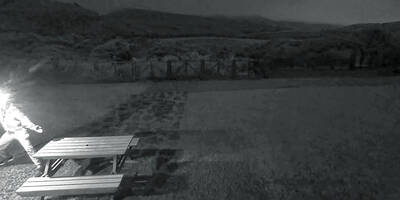
Yangmingshan National Park authorities yesterday urged visitors to respect public spaces and obey the law after a couple was caught on a camera livestream having sex at the park’s Qingtiangang (擎天崗) earlier in the day. The Shilin Police Precinct in Taipei said it has identified a suspect and his vehicle registration number, and would summon him for questioning. The case would be handled in accordance with public indecency charges, it added. The couple entered the park at about 11pm on Thursday and began fooling around by 1am yesterday, the police said, adding that the two were unaware of the park’s all-day live

Fast food chain McDonald's is to raise prices by up to NT$5 on some products at its restaurants across Taiwan, starting on Wednesday next week, the company announced today. The prices of all extra value meals and sharing boxes are to increase by NT$5, while breakfast combos and creamy corn soup would go up by NT$3, the company said in a statement. The price of the main items of those meals, if ordered individually, would remain the same. Meanwhile, the price of a medium-sized lemon iced tea and hot cappuccino would rise by NT$3, extra dipping sauces for chicken nuggets would go up
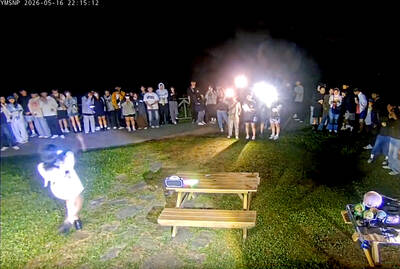
Yangmingshan National Park’s Qingtiangang (擎天崗) nature area has gone viral after a park livestream camera observed a couple in the throes of intimate congress, which was broadcast live on YouTube, drawing large late-night crowds and sparking a backlash over noise, bright lights and disruption to wildlife habitat. The area’s livestream footage appeared to show a couple engaging in sexual activity on a picnic table in the park on Friday last week, with the uncensored footage streamed publicly online. The footage quickly spread across social media, prompting a tide of visitors to travel to the site to “check in” and recreate the

Minister of Digital Affairs Lin Yi-ching (林宜敬) yesterday cited regulatory issues and national security concerns as an expert said that Taiwan is among the few Asian regions without Starlink. Lin made the remarks on Facebook after funP Innovation Group chief executive officer Nathan Chiu (邱繼弘) on Friday said Taiwan and four other countries in Asia — China, North Korea, Afghanistan and Syria — have no access to Starlink. Starlink has become available in 166 countries worldwide, including Ukraine, Malaysia, the Philippines and Vietnam, in the six years since it became commercial, he said. While China and North Korea block Starlink, Syria is not


 RSS
RSS