


Chinese air force activity around Taiwan has fallen sharply in the past few weeks, with no flights at all in the past week, a sudden drop in what had been daily military maneuvers that could signal Beijing is recalibrating its pressure on Taipei.
China has dispatched 460 military planes — from fighter jets to drones — into Taiwan’s air defense identification zone so far this year, a 46.5 percent drop compared with a year earlier, according to Taiwanese government data compiled by research group Secure Taiwan Associate Corp (STA).
Taiwan last month detected 190 Chinese aircraft, the lowest monthly tally since the Ministry of National Defense began publishing detailed daily figures in 2022.
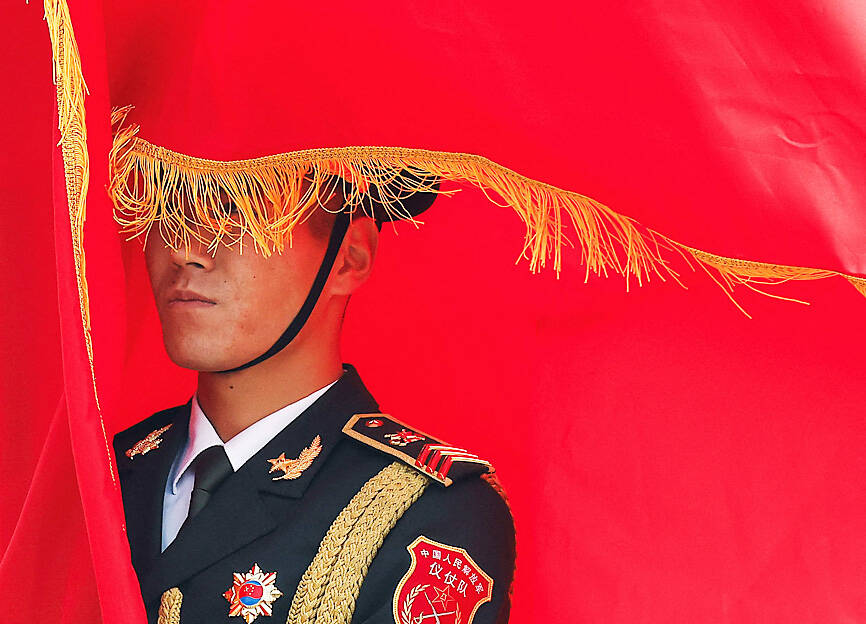
Photo: AFP
Chinese President Xi Jinping (習近平) might be toning down visible pressure tactics to create a better atmosphere ahead of his anticipated meeting with US President Donald Trump at the end of this month, two Taiwanese officials said.
Facing Trump, “Beijing might be trying to create a false impression: I am peaceful, I am moving toward peace, so you should stop selling weapons to Taiwan,” a senior Taiwanese security official said, requesting anonymity due to the sensitivity of the matter.
Neither the Chinese Ministry of National Defense nor its Taiwan Affairs Office responded to requests for comment.
China has not dispatched any military planes near Taiwan since Friday last week, marking an unprecedented six-day lull in such operations that coincided with the war in Iran, STA researcher Tristan Tang (湯廣正) said.
Unlike this extended lull, past pauses were brief, usually tied to typhoons or Chinese holidays.
Another interpretation is China’s military corruption purge.
Su Tzu-yun (蘇紫雲), a research fellow at the Institute for National Defense and Security Research, said the purge could be the “primary reason,” with Chinese forces undergoing changes to their command structure that are likely undermining overall readiness.
A defense official, also speaking on condition of anonymity, suggested Beijing is using the lull to digest lessons from recent large drills.
However, China’s navy and coast guard remain active, the Taiwanese defense ministry said, showing that Beijing had only dialed down the more politically sensitive air activity.
“Just because they’re not coming now doesn’t mean they won’t come back in the future, and we can’t rule out that they may be preparing for an even larger operation,” another senior security official said. “We should not project any change in Beijing’s intentions based solely on a few days of activity.”
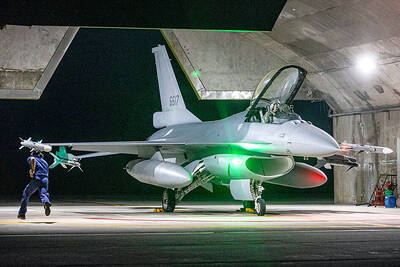
Taiwan has received more than US$70 million in royalties as of the end of last year from developing the F-16V jet as countries worldwide purchase or upgrade to this popular model, government and military officials said on Saturday. Taiwan funded the development of the F-16V jet and ended up the sole investor as other countries withdrew from the program. Now the F-16V is increasingly popular and countries must pay Taiwan a percentage in royalties when they purchase new F-16V aircraft or upgrade older F-16 models. The next five years are expected to be the peak for these royalties, with Taiwan potentially earning
STAY IN YOUR LANE: As the US and Israel attack Iran, the ministry has warned China not to overstep by including Taiwanese citizens in its evacuation orders The Ministry of Foreign Affairs (MOFA) yesterday rebuked a statement by China’s embassy in Israel that it would evacuate Taiwanese holders of Chinese travel documents from Israel amid the latter’s escalating conflict with Iran. Tensions have risen across the Middle East in the wake of US and Israeli airstrikes on Iran beginning Saturday. China subsequently issued an evacuation notice for its citizens. In a news release, the Chinese embassy in Israel said holders of “Taiwan compatriot permits (台胞證)” issued to Taiwanese nationals by Chinese authorities for travel to China — could register for evacuation to Egypt. In Taipei, the ministry yesterday said Taiwan
Taiwan is awaiting official notification from the US regarding the status of the Agreement on Reciprocal Trade (ART) after the US Supreme Court ruled US President Donald Trump's global tariffs unconstitutional. Speaking to reporters before a legislative hearing today, Premier Cho Jung-tai (卓榮泰) said that Taiwan's negotiation team remains focused on ensuring that the bilateral trade deal remains intact despite the legal challenge to Trump's tariff policy. "The US has pledged to notify its trade partners once the subsequent administrative and legal processes are finalized, and that certainly includes Taiwan," Cho said when asked about opposition parties’ doubts that the ART was
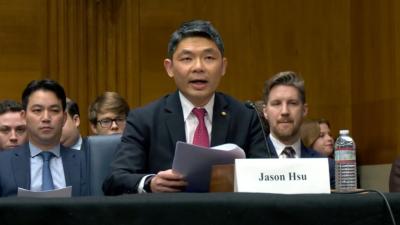
If China chose to invade Taiwan tomorrow, it would only have to sever three undersea fiber-optic cable clusters to cause a data blackout, Jason Hsu (許毓仁), a senior fellow at the Hudson Institute and former Chinese Nationalist Party (KMT) legislator, told a US security panel yesterday. In a Taiwan contingency, cable disruption would be one of the earliest preinvasion actions and the signal that escalation had begun, he said, adding that Taiwan’s current cable repair capabilities are insufficient. The US-China Economic and Security Review Commission (USCC) yesterday held a hearing on US-China Competition Under the Sea, with Hsu speaking on


 RSS
RSS