


Incorporating Taiwan into existing security frameworks to create a more robust US-led regional defense architecture is key to deterring Chinese aggression, Minister of Foreign Affairs Lin Chia-lung (林佳龍) told the Japan Times in an interview published yesterday.
To effectively deter Beijing’s attempts to expand its influence in the Pacific, “the most important thing is to embed Taiwan more fully into Indo-Pacific security frameworks,” Lin told the newspaper last week.
While Washington has long had bilateral security treaties with a number of countries in the region, “new challenges, particularly the rapid rise of China and intensifying territorial and maritime disputes, have led to the emergence of ‘minilateralism,’ or several small US-led country groupings aiming to tackle shared security concerns,” the report said.
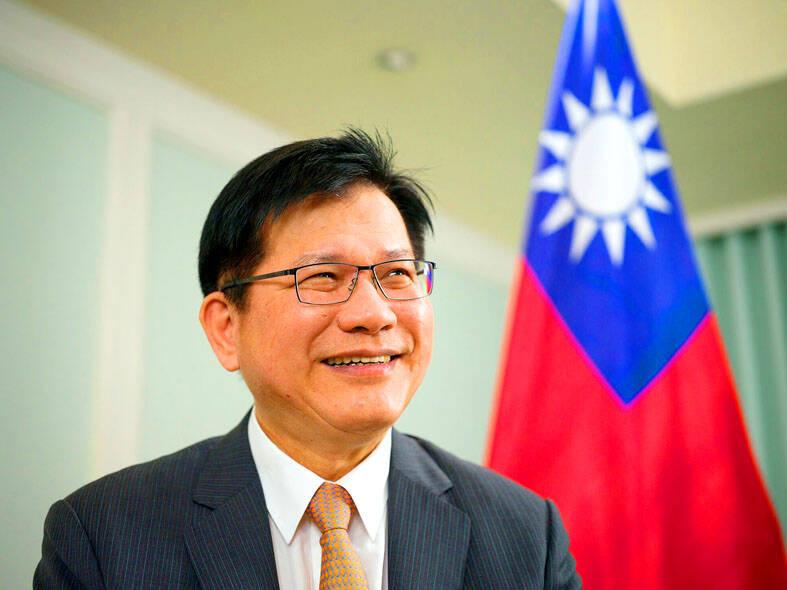
Photo: Lam Yik Fei, Bloomberg
None of them include Taiwan, it said.
“There shouldn't be any missing [security] link in the first island chain, and I believe that Taiwan is the missing link right now,” Lin was quoted as saying, referring to the strategic line of islands running from Japan to Borneo.
Lin called on Japan, the Philippines and other countries to improve cooperation in areas such as intelligence-sharing, joint exercises, defense-industry tie-ups, data links and dealing with hybrid threats such as China’s “gray zone” activities, the report said.
Another key field for cooperation would be contingency planning, which would include extensive coordination in the event of a Chinese quarantine, blockade or military incursion against Taiwan, Lin said.
“If there is a contingency, the US Indo-Pacific Command can lead response efforts, but Taiwan and every other country — South Korea, Japan, the Philippines, Australia, New Zealand — need to know what to do ... and what role they can play,” Lin said.
“I do not mean that the first island chain [members] should form a military alliance, or that we need to have a NATO mechanism,” but it is important to “divide and coordinate” the different roles that each would play in the event of a crisis, he said, adding that there is a need for “burden-sharing” and working together to combat aggression.
“When we look at the radar, we can see lots of Chinese warplanes and warships deployed all across the first island chain, not only in the Taiwan Strait, but also in the East China Sea and South China Sea,” Lin said. “China is trying to create a new normal, so I believe that first island chain nations should react together.”
Without Taiwan, any regional security net would have a huge hole, he said.
There is a need to deepen multiple kinds of exchanges and bolster cooperation to better "deter China's attempt to change the ‘status quo,’" Lin said.
"I believe that security is about survival, so it's more important than just diplomacy,” he said.
Although Taiwan does not have official security frameworks with Japan or the Philippines, each nation would “seek every means to try to overcome diplomatic obstacles to protect their own national interests,” he said.
"We’ve held dialogue with Japan, the Philippines and other first island chain countries," he said.
“In peacetime we need to talk and perhaps hold drills together, so that we can truly coordinate efforts in case of a contingency,” he said.
The talks could also include topics such as weapons integration and defense-industrial cooperation through frameworks such as the US-led Partnership for Indo-Pacific Industrial Resilience and the Taiwan Security Cooperation Initiative, he added.
Washington’s weapons sales to Taipei — including its approval of a US$11 billion arms package in December last year — are mostly intended to foster burden-sharing and “help balance the military capabilities in the region,” Lin said.
“Having an arms race with China is not Taiwan's goal,” he added.
Taiwan’s ties with the US are developing “positively,” he said.
Lin brushed away concerns that US President Donald Trump could make Taiwan-related concessions while pursuing a wide-ranging trade agreement with China, the report said.
He also said that Trump’s remark in October that “Taiwan is Taiwan” highlighted the president’s view that the nation is “not a chess piece to be used in a transaction with China.”
Lin said that he welcomed Japan’s reassessment of its three key security policy documents and its aim of strengthening its defense industry.
Such moves create new opportunities for technological cooperation with Taiwan in areas such as drones, semiconductors and low-Earth orbit satellites, he said.
Lin said he would welcome a greater leadership role in regional security for Japan.
Tokyo would need to be more proactive to become a “normal” security actor, particularly regarding the development of its defense industry, he said.
“The most important thing is that we all face the same kind of bully and the same kind of conditions from China,” he said.

UNREASONABLE SURVEILLANCE: A camera targeted on an road by a neighbor captured a man’s habitual unsignaled turn into home, netting him dozens of tickets The Taichung High Administrative Court has canceled all 45 tickets given to a man for failing to use a turn signal while driving, as it considered long-term surveillance of his privacy more problematic than the traffic violations. The man, surnamed Tseng (曾), lives in Changhua County and was reported 45 times within a month for failing to signal while driving when he turned into the alley where his residence is. The reports were filed by his neighbor, who set up security cameras that constantly monitored not only the alley but also the door and yard of Tseng’s house. The surveillance occurred from July

Actor Darren Wang (王大陸) was sentenced to six months in prison, commutable to a fine, by the New Taipei District Court today for contravening the Personal Data Protection Act (個人資料保護法) in a case linked to an alleged draft-dodging scheme. Wang allegedly paid NT$3.6 million (US$114,380) to an illegal group to help him evade mandatory military service through falsified medical documents, prosecutors said. He transferred the funds to Chen Chih-ming (陳志明), the alleged mastermind of a draft-evasion ring, although he lost contact with him as he was already in detention on fraud charges, they said. Chen is accused of helping a

SECURITY: Starlink owner Elon Musk has taken pro-Beijing positions, and allowing pro-China companies to control Taiwan’s critical infrastructure is risky, a legislator said Starlink was reluctant to offer services in Taiwan because of the nation’s extremely high penetration rates in 4G and 5G services, the Ministry of Digital Affairs said yesterday. The ministry made the comments at a meeting of the legislature’s Transportation Committee, which reviewed amendments to Article 36 of the Telecommunications Management Act (電信管理法). Article 36 bans foreigners from holding more than 49 percent of shares in public telecommunications networks, while shares foreigners directly and indirectly hold are also capped at 60 percent of the total, unless specified otherwise by law. The amendments, sponsored by Chinese Nationalist Party (KMT) Legislator Ko
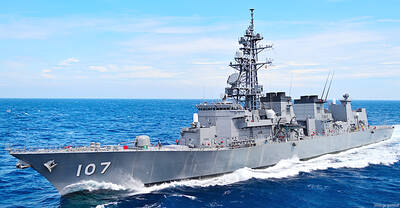
A Japan Self-Defense Forces vessel entered the Taiwan Strait yesterday, Japanese media reported. After passing through the Taiwan Strait, the Ikazuchi was to proceed to the South China Sea to take part in a joint military exercise with the US and the Philippines, the reports said. Japan Self-Defense Force vessels were first reported to have passed through the strait in September, 2024, with two further transits taking place in February and June last year, the Asahi Shimbun reported. Yesterday’s transit also marked the first time since Japanese Prime Minister Sanae Takaichi took office that a Japanese warship has been sent through the Taiwan


 RSS
RSS