


The government is to purchase 100 more graphics processing units (GPUs) to boost Taiwan’s high-performance computing power that is essential to the development of the artificial intelligence (AI) industry, the Ministry of Digital Affairs (MODA) said yesterday.
The ministry plans to procure 100 more GPUs this year if the legislature approves its proposed budget, Administration for Digital Industries Director-General Lin Jiunn-shiow (林俊秀) told a news conference.
“The number of GPUs owned by the government would reach 140, including the 40 GPUs purchased in 2024,” he said, adding that computing power generated by GPUs would be available to use by AI start-up firms and information service providers.

Photo: CNA
Minister of Digital Affairs Lin Yi-jing (林宜敬) said that the government was unable to boost the computing power last year because of a comprehensive budget cut.
“Computing power is crucial to the development of the AI industry in Taiwan. We hope that the legislature would quickly pass the budget plan,” Lin Yi-jing said.
Ministry of Economic Affairs data showed that Taiwan has sufficient electricity to build computing power centers, he said.
“We hope such facilities would be built and funded by the private sector to ensure that their cloud data centers would continue to operate with enough electricity,” he added.
Lin Yi-jing detailed the four goals that the ministry aims to accomplish this year: stepping up efforts to crack down on online scams, developing the software industry, bolstering cybersecurity resilience and building a digital government.
As of Tuesday last week, the ministry’s network had received reports of 614,971 online scam cases, of which 298,299 cases had been taken down.
“We will continue to expand our anti-scam team by including online service providers in the private sector. Meta, which owns Facebook, has used 300,000 scam messages to train its AI system to flag scams,” Lin Yi-jing said.
Specific measures to develop the software industry include providing free computing power to AI start-up teams; proposing a data innovation and utilization development bill (促進資料創新利用發展條例); establishing the Taiwan Sovereign AI Training Corpus; issuing AI talent industry accreditation guidelines (AI人才產業認定指引); jointly setting up the AI Civil Service Talent Development Office with the Directorate-General of Personnel Administration; organizing industry matchmaking events; and introducing National Development Fund capital to advance the “Enhanced Investment in AI Start-ups Implementation Program,” he said.
Comprehensive protection measures would be implemented across legal, technological and commercial dimensions, with the goal of enhancing cybersecurity resilience across land, sea and air domains, he said.
As for building a digital government, the ministry is to promote the Digital Certificate Wallet policy, providing integrated, one-stop digital services across agencies, from birth and schooling to employment and old age, he said.

More than half of the bamboo vipers captured in Tainan in the past few years were found in the city’s Sinhua District (新化), while other districts had smaller catches or none at all. Every year, Tainan captures about 6,000 snakes which have made their way into people’s homes. Of the six major venomous snakes in Taiwan, the cobra, the many-banded krait, the brown-spotted pit viper and the bamboo viper are the most frequently captured. The high concentration of bamboo vipers captured in Sinhua District is puzzling. Tainan Agriculture Bureau Forestry and Nature Conservation Division head Chu Chien-ming (朱健明) earlier this week said that the
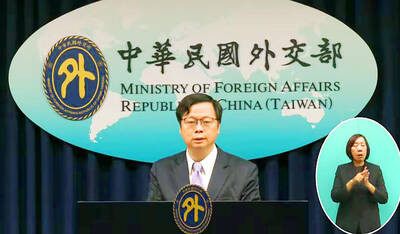
NAMING SPAT: The foreign ministry called on Denmark to propose an acceptable solution to the erroneous nationality used for Taiwanese on residence permits Taiwan has revoked some privileges for Danish diplomatic staff over a Danish permit that lists “Taiwan” as “China,” Eric Huang (黃鈞耀), head of the Ministry of Foreign Affairs’ Department of European Affairs, told a news conference in Taipei yesterday. Reporters asked Huang whether the Danish government had responded to the ministry’s request that it correct the nationality on Danish residence permits of Taiwanese, which has been listed as “China” since 2024. Taiwan’s representative office in Denmark continues to communicate with the Danish government, and the ministry has revoked some privileges previously granted to Danish representatives in Taiwan and would continue to review
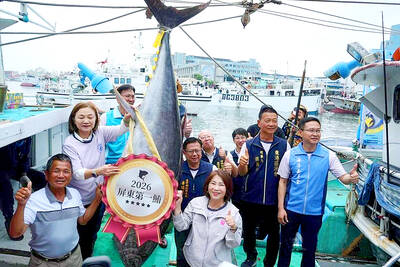
The first bluefin tuna of the season, brought to shore in Pingtung County and weighing 190kg, was yesterday auctioned for NT$10,600 (US$333.5) per kilogram, setting a record high for the local market. The auction was held at the fish market in Donggang Fishing Harbor, where the Siaoliouciou Island-registered fishing vessel Fu Yu Ching No. 2 delivered the “Pingtung First Tuna” it had caught for bidding. Bidding was intense, and the tuna was ultimately jointly purchased by a local restaurant and a local company for NT$10,600 per kilogram — NT$300 ,more than last year — for a total of NT$2.014 million. The 67-year-old skipper

China has reserved offshore airspace over the Yellow Sea and East China Sea from March 27 to May 6, issuing alerts that are usually used to warn of military exercises, although no such exercises have been announced, the Wall Street Journal (WSJ) reported on Sunday. Reserving such a large area for 40 days without explanation is an “unusual step,” as military exercises normally only last a few days, the paper said. The alerts, known as notice to air missions (NOTAMs), “are intended to inform pilots and aviation authorities of temporary airspace hazards or restrictions,” the article said. The airspace reserved in the alert


 RSS
RSS