


A vow by China’s Taiwan Affairs Office (TAO) to investigate Minister of the Interior Liu Shyh-fang’s (劉世芳) nephew is a case of transnational repression and is detrimental to cross-strait interactions, Mainland Affairs Council (MAC) Minister Chiu Chui-cheng (邱垂正) said in an interview published yesterday.
On Friday, Hong Kong newspaper Ta Kung Pao (大公報) reported that Liu had received political donations from her nephew Yen Wen-chun (顏文群).
Yen holds executive positions at three firms in China, the Chinese state-owned publication said.
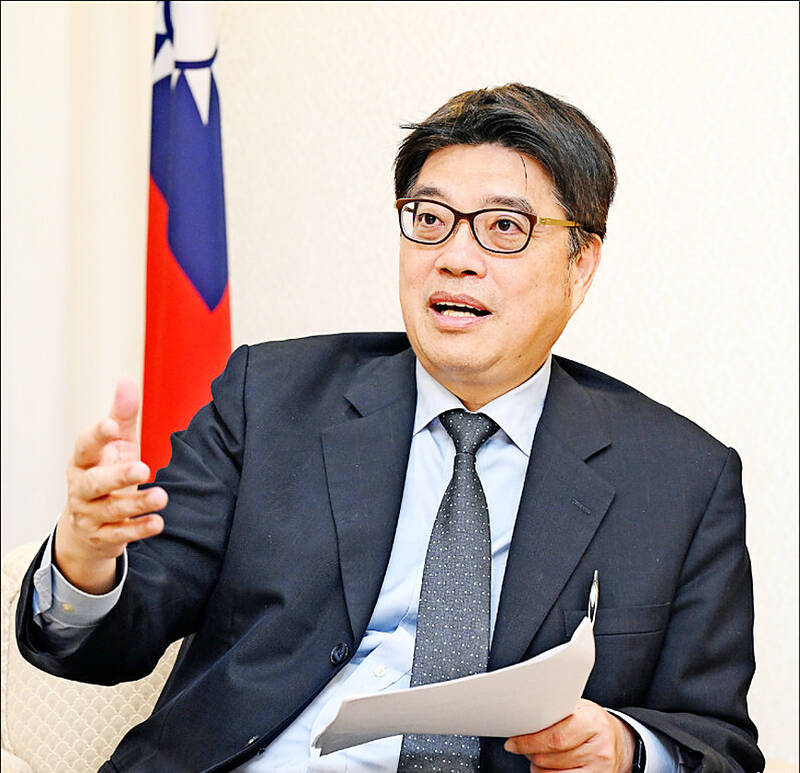
Photo: Taipei Times
The TAO said that it is looking into the issue and that Beijing would not allow those who support Taiwanese independence and ruin cross-strait relations to use money earned in China to undermine Beijing.
The office in January listed Liu as a “diehard Taiwanese independence separatist,” and banned her and members of her family from entering China and its territories.
The sanctions also ban businesses associated with “separatists” from operating in China, applicable for life.
The Chinese Communist Party (CCP) has been waging legal warfare against Taiwan since 2024 with its “22 guidelines,” Chiu told the Chinese-language Liberty Times (sister paper of the Taipei Times) in the interview.
The guidelines grant Beijing the pretext to launch investigations into people it suspects of supporting Taiwanese independence, he said.
The “22 guidelines” could result in the death penalty and even if the CCP is unable to bring those it accuses to court, they could be tried in absentia, he said.
For relatives of those accused or the accused themselves who are doing business in China, the guidelines allow the CCP to confiscate their property and assets, Chiu said, adding that the CCP encourages people to report incidents of “separatism.”
The laws cross “every line of the civilized world,” he said.
Yen made the donations in 2019 and only started working in China in 2023, Chiu said.
Yen is innocent in the matter, as he is just a relative of Liu’s and might not even know her that well, he added.
The council denounces the TAO’s actions as a clear abuse of state authority aimed at distorting personal information to oppress and intimidate people to advance political goals, Chiu said.
The TAO’s brutish actions, which run contrary to the rule of law, serve only to damage efforts to maintain normal cross-strait relations, Chiu said.
Taiwanese should reassess investing and doing business in China, as the economic and political risks have sharply increased over the past few years, he added.

Actor Darren Wang (王大陸) was sentenced to six months in prison, commutable to a fine, by the New Taipei District Court today for contravening the Personal Data Protection Act (個人資料保護法) in a case linked to an alleged draft-dodging scheme. Wang allegedly paid NT$3.6 million (US$114,380) to an illegal group to help him evade mandatory military service through falsified medical documents, prosecutors said. He transferred the funds to Chen Chih-ming (陳志明), the alleged mastermind of a draft-evasion ring, although he lost contact with him as he was already in detention on fraud charges, they said. Chen is accused of helping a

UNREASONABLE SURVEILLANCE: A camera targeted on an road by a neighbor captured a man’s habitual unsignaled turn into home, netting him dozens of tickets The Taichung High Administrative Court has canceled all 45 tickets given to a man for failing to use a turn signal while driving, as it considered long-term surveillance of his privacy more problematic than the traffic violations. The man, surnamed Tseng (曾), lives in Changhua County and was reported 45 times within a month for failing to signal while driving when he turned into the alley where his residence is. The reports were filed by his neighbor, who set up security cameras that constantly monitored not only the alley but also the door and yard of Tseng’s house. The surveillance occurred from July

SECURITY: Starlink owner Elon Musk has taken pro-Beijing positions, and allowing pro-China companies to control Taiwan’s critical infrastructure is risky, a legislator said Starlink was reluctant to offer services in Taiwan because of the nation’s extremely high penetration rates in 4G and 5G services, the Ministry of Digital Affairs said yesterday. The ministry made the comments at a meeting of the legislature’s Transportation Committee, which reviewed amendments to Article 36 of the Telecommunications Management Act (電信管理法). Article 36 bans foreigners from holding more than 49 percent of shares in public telecommunications networks, while shares foreigners directly and indirectly hold are also capped at 60 percent of the total, unless specified otherwise by law. The amendments, sponsored by Chinese Nationalist Party (KMT) Legislator Ko

A Japan Self-Defense Forces vessel entered the Taiwan Strait yesterday, Japanese media reported. After passing through the Taiwan Strait, the Ikazuchi was to proceed to the South China Sea to take part in a joint military exercise with the US and the Philippines, the reports said. Japan Self-Defense Force vessels were first reported to have passed through the strait in September, 2024, with two further transits taking place in February and June last year, the Asahi Shimbun reported. Yesterday’s transit also marked the first time since Japanese Prime Minister Sanae Takaichi took office that a Japanese warship has been sent through the Taiwan


 RSS
RSS