


The National Security Bureau (NSB) has established a task force at President William Lai’s (賴清德) request to prevent foreign interference in the Nov. 28 local elections, the bureau said yesterday.
The task force would seek to prevent attempts to manipulate the nine-in-one local elections by outside forces, an NSB statement cited Lai as saying at an event yesterday marking the 71st anniversary of the bureau’s founding and the graduation of new agents.
China is expected to use disinformation, fake polls, election gambling, and the lure of tourism and economic exchange to meddle in the elections, he said.
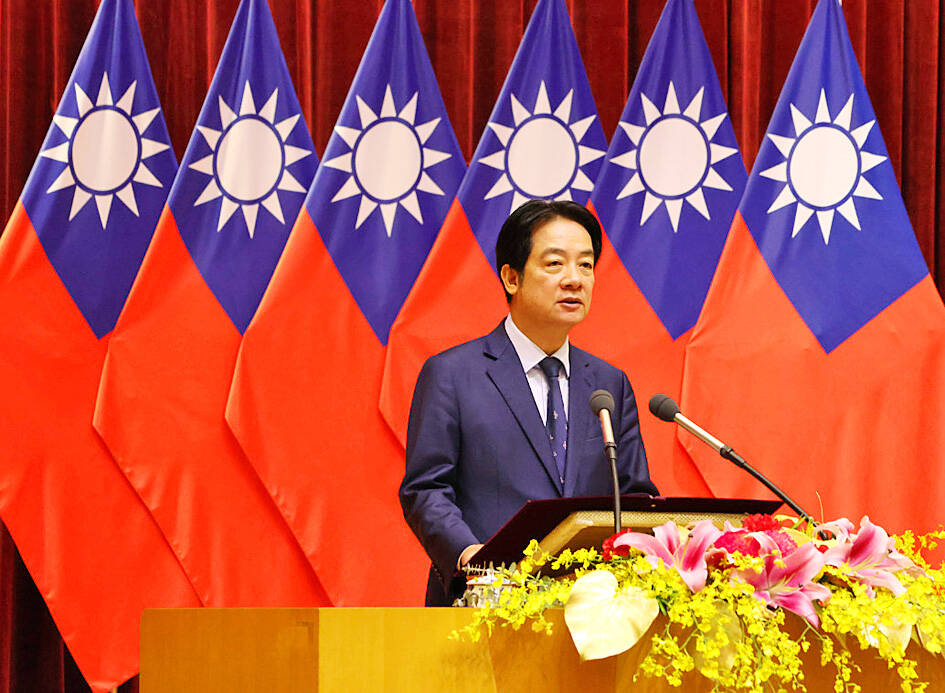
Photo: CNA
Taiwan faces new types of national security threats emanating from China amid a rapidly changing geopolitical environment, Lai said.
He highlighted Beijing’s hostile actions aimed at Taiwan, including military and economic coercion, “gray zone” activity, cyberattacks, cognitive warfare campaigns and attempts to infiltrate the government, armed forces, civic groups and key companies in the private sector.
The actions are part of a coordinated multi-domain effort to sow division in Taiwan and weaken the nation’s credibility among its friends and allies, Lai said.
Countering China’s “united front” tactics, attempts at infiltration and threats of annexation are the NSB’s top priority, he said, adding that the bureau must concentrate its efforts and cooperate with law enforcement to protect the nation’s democracy.
Taiwan, which is on the front line of authoritarian expansionism, has valuable intelligence to offer to allies, Lai said, urging the NSB to increase intelligence sharing and cooperation with its counterparts in friendly countries.
The president also praised the NSB for on Monday declassifying political archives from the Martial Law period and transferring them to the National Archives Administration, which he said was a milestone in transitional justice.
In related news, Lai told Taiwanese investors with businesses in China that his administration’s consistent policy has been to seek common ground with Beijing by improving the well-being of people on both sides of the Taiwan Strait.
Taiwan and China should strive for peaceful co-development through dialogue, understanding and reconciliation, as the two sides have a common enemy in climate change and common interest in peace and prosperity, he said at an event in Taichung.
He highlighted the goals in an address he gave during a 2014 visit to Shanghai’s Fudan University, Lai said.
The Lai administration continues former president Tsai Ing-wen’s (蔡英文) policy aims of putting the economy first and creating business opportunities for the private sector, he said.
Taiwan’s economy performed well last year despite US tariffs, and officials are projecting 7.71 percent GDP growth for this year following Taipei’s trade negotiations with Washington, Lai said.
The government is also implementing 10 new artificial intelligence (AI)-centric infrastructure investment projects, he added.
They include facilitating an ecosystem for AI start-ups, introducing the technology to small and medium-sized businesses, and promoting its use in the daily lives of Taiwanese, Lai said.
Straits Exchange Foundation chairman Su Jia-chyuan (蘇嘉全) said at the Taichung event that the government would not forget the collective contribution of Taiwanese entrepreneurs to national prosperity.
The substance of cross-strait ties does not lie in slogans, but in the links of understanding and commerce between the two peoples that are deeply embedded in society, Su said.
Mainland Affairs Council Minister Chiu Chui-cheng (邱垂正) urged Taiwanese businesspeople to exercise caution in managing geopolitical and economic risks amid intensifying rivalry between the US and China.
The council and foundation would remain the shield and protectors of entrepreneurs in their work to create wealth for a democratic Taiwan, he said.
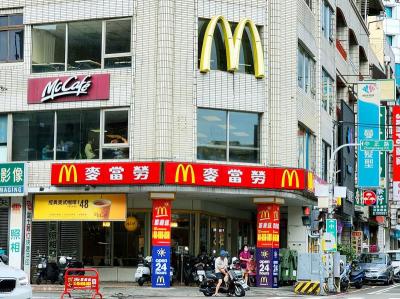
Fast food chain McDonald's is to raise prices by up to NT$5 on some products at its restaurants across Taiwan, starting on Wednesday next week, the company announced today. The prices of all extra value meals and sharing boxes are to increase by NT$5, while breakfast combos and creamy corn soup would go up by NT$3, the company said in a statement. The price of the main items of those meals, if ordered individually, would remain the same. Meanwhile, the price of a medium-sized lemon iced tea and hot cappuccino would rise by NT$3, extra dipping sauces for chicken nuggets would go up

Nvidia Corp CEO Jensen Huang (黃仁勳) arrived in Taiwan yesterday ahead of upcoming AI and technology events, saying he plans to meet with clients and Taiwan Semiconductor Manufacturing Co Chairman C.C. Wei (魏哲家) during his visit. After landing at Taipei Songshan Airport, Huang posed for photos with fans and handed out Yakult drinks to reporters and supporters waiting at the scene, saying he has “a lot to do” during the trip. Asked about reports that Nvidia’s planned headquarters site in Taipei’s Beitou Shilin Technology Park could break ground on May 27, Huang said that if the company holds an event, he would

Carrefour Taiwan is to begin using a new name from the start of July, but it cannot divulge the name until then, the chairman of the supermarket chain's parent company said today. President Chain Store Co chairman Lo Chih-hsien (羅智先) was asked by reporters after a shareholders' meeting to confirm whether the company has settled on a new name for the supermarket brand. In March, the government-registered name of two Carrefour Taiwan branches was quietly changed to "Le Chia Kang" (樂家康) in Chinese, raising speculation that has been selected as the name. Lo said that because of local regulations and contractual obligations, the

FUKUOKA SITUATION: Japanese media reported that the pathogen is expected to be identified by the summer, while the CDC downplayed the idea that it was hMPV A “mysterious cold-like illness” reported in Japan’s Fukuoka Prefecture does not seem to be a new disease, but Japanese authorities have been asked about the situation, the Centers for Disease Control (CDC) said yesterday. The Fukuoka Prefectural Medical Association on Wednesday told a news conference that a “mystery cold” that has become a hot topic on social media is “highly likely to be caused by some kind of viral infection,” Japan’s KBC News reported. “Many people are experiencing symptoms starting with a sore throat, followed by a runny nose, phlegm and a severe cough,” KBC News reported, citing association officials. Health authorities are


 RSS
RSS