


Drivers who encounter heavy traffic and fatigue during the Lunar New Year holiday might need an under-utilized feature of the national freeway — drivers’ lounges.
The government opened the first drivers’ lounges in 1982, but closed them all in 1991 as operational costs far exceeded the nominal fees charged for their use, the Freeway Bureau said.
To reduce the number of road traffic accidents related to driver fatigue, the government began gradually opening new drivers’ lounges in October 2011.
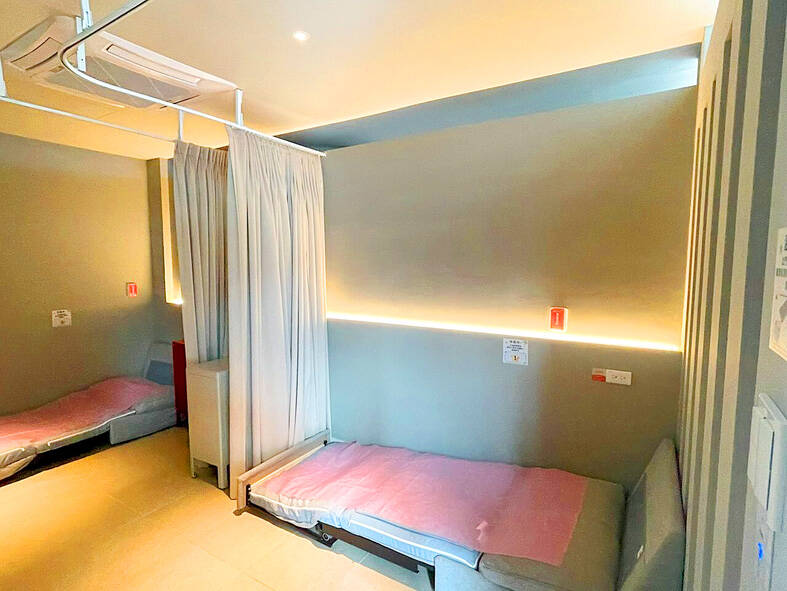
Photo courtesy of the Freeway Bureau via CNA
Fourteen of the 15 freeway service areas — all except the Shiding service area on Chiang Wei-shui Memorial Freeway (Freeway No. 5) — have drivers’ lounges, which have been used more than 540,000 times as of the end of last year, the bureau said.
While open to all, the lounges on the National Sun Yat-sen Freeway (National Freeway No. 1) typically attract truckers and business travelers, while those on the Formosa Freeway (National Freeway No. 3) — such as Cingshuei service area in Taichung and Sihu service area in Miaoli — draw more leisure travelers, the bureau said.
Freeway Bureau section chief Tsai Hsin-yuan (蔡欣宛) said the contractors operating the rest areas have steadily improved the quality of the lounges.
All 14 lounges, minus Yilan County’s Suao (蘇澳), provide all-hours services, with some equipped with amenities such as showers and massage chairs.
The lounge in Yunlin County’s Siluo service area even has washing machines and dryers, Tsai said.
The facilities vary by location, she said.
Some offer individual rooms, while others are separated only by curtains, Tsai said, adding that some have reclining chairs instead of beds.
To use the lounges, drivers must present an ID at the check-in counter, or inquire at the service area’s convenience store during late hours, Tsai said.
Drivers can use the lounge for up to two hours for free, she said.
The bureau said that during the Lunar Holiday Period, the lounges would only be open from 8am to 8pm daily.
To maintain parking space turnover, lounge usage time would also be cut to 30 minutes, with one extension possible, the bureau said.

Yangmingshan National Park authorities yesterday urged visitors to respect public spaces and obey the law after a couple was caught on a camera livestream having sex at the park’s Qingtiangang (擎天崗) earlier in the day. The Shilin Police Precinct in Taipei said it has identified a suspect and his vehicle registration number, and would summon him for questioning. The case would be handled in accordance with public indecency charges, it added. The couple entered the park at about 11pm on Thursday and began fooling around by 1am yesterday, the police said, adding that the two were unaware of the park’s all-day live
Fast food chain McDonald's is to raise prices by up to NT$5 on some products at its restaurants across Taiwan, starting on Wednesday next week, the company announced today. The prices of all extra value meals and sharing boxes are to increase by NT$5, while breakfast combos and creamy corn soup would go up by NT$3, the company said in a statement. The price of the main items of those meals, if ordered individually, would remain the same. Meanwhile, the price of a medium-sized lemon iced tea and hot cappuccino would rise by NT$3, extra dipping sauces for chicken nuggets would go up
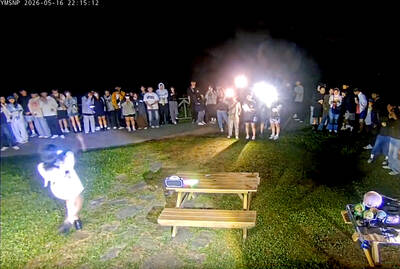
Yangmingshan National Park’s Qingtiangang (擎天崗) nature area has gone viral after a park livestream camera observed a couple in the throes of intimate congress, which was broadcast live on YouTube, drawing large late-night crowds and sparking a backlash over noise, bright lights and disruption to wildlife habitat. The area’s livestream footage appeared to show a couple engaging in sexual activity on a picnic table in the park on Friday last week, with the uncensored footage streamed publicly online. The footage quickly spread across social media, prompting a tide of visitors to travel to the site to “check in” and recreate the

Minister of Digital Affairs Lin Yi-ching (林宜敬) yesterday cited regulatory issues and national security concerns as an expert said that Taiwan is among the few Asian regions without Starlink. Lin made the remarks on Facebook after funP Innovation Group chief executive officer Nathan Chiu (邱繼弘) on Friday said Taiwan and four other countries in Asia — China, North Korea, Afghanistan and Syria — have no access to Starlink. Starlink has become available in 166 countries worldwide, including Ukraine, Malaysia, the Philippines and Vietnam, in the six years since it became commercial, he said. While China and North Korea block Starlink, Syria is not


 RSS
RSS