


Taiwan would lift its quotas on vehicles manufactured in accordance with US regulations and would eliminate tariffs on sedans imported from the US, under the terms of a bilateral trade deal signed in Washington on Thursday.
Vehicles conforming to the US Federal Motor Vehicle Safety Standards would be exempt from import quotas, the Cabinet said yesterday.
Importers must obtain a safety certificate from the Ministry of Transportation and Communications, it said.
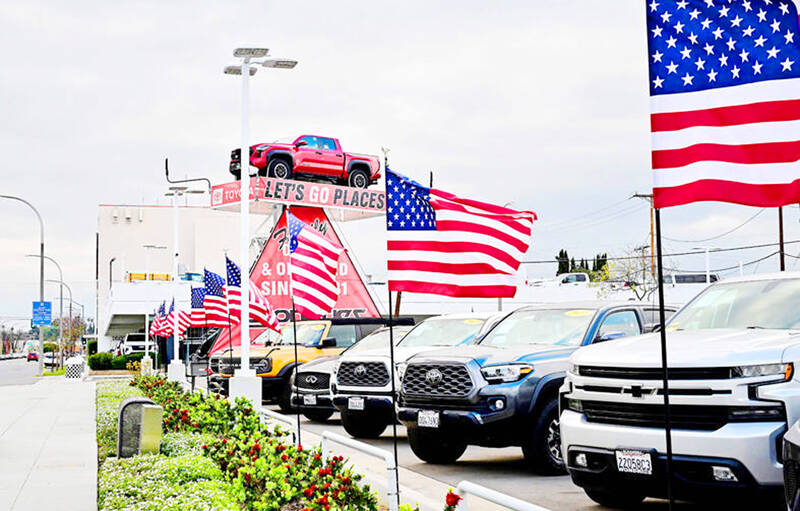
Photo: AFP
Importers must apply to the ministries of economic affairs and the environment for three certificates, the Cabinet said.
Easing import quotas is part of the trade deal signed by Taipei and Washington to open the Taiwanese market wider to US products, given Taiwan’s US$73.9 billion trade surplus with the US in 2024, the sixth largest among US trade partners.
The import quota — defined by the number of units of the same model a single importer might apply for annually — had shrunk from 2,000 in 2008 to just 75 in 2023, disincentivizing the import of US vehicles to Taiwan.
Minister of Economic Affairs Kung Ming-hsin (龔明鑫) said Wednesday that lifting the 17.5 percent tariff on vehicles imported from the US is expected to reduce the total tax burden on consumers by about 10 percent.
Based on projections from a think-tank model, Kung said lowering tariffs on US-made vehicles is estimated to affect domestic automobile output by about 1.94 percent, or roughly NT$4 billion (US$126.9 million) per year.
The change is likely to impact European and Japanese car manufacturers more than Taiwanese automakers, he said.
Wu Jui-hung (吳睿弘), executive director of PG Union Corp Taiwan, yesterday said that the trade deal should not have any significant impact on domestic vehicle manufacturers main models for the next three years.
He said US-spec vehicles are usually priced at about US$40,000 in the US and are subject to a 25 percent commodity tax in Taiwan.
This “gives imported vehicles little edge” compared with mainstream models produced by domestic carmakers, which are mostly priced at NT$800,000 to NT$1.1 million, Wu said.
While local consumers would appreciate having more options, in the long run, the share of imported vehicles could expand from 50 percent to about 60 percent, he said.
Last year, imported vehicles held a 48.7 percent share of the Taiwan market, with sales of 202,000 units, according to Ministry of Economic Affairs data.
The market share for domestically produced vehicles has steadily declined, dropping from 63.2 percent in 2015 to 51.3 percent last year, the data showed.

Kenting National Park service technician Yang Jien-fon (楊政峰) won a silver award in World Grand Prix Photography Awards Spring Season for his photograph of two male rat snakes intertwined in combat. Yang’s colleagues at Kenting National Park said he is a master of nature photography who has been held back by his job in civil service. The awards accept entries in all four seasons across six categories: architectural and urban photography, black-and-white and fine art photography, commercial and fashion photography, documentary and people photography, nature and experimental photography, and mobile photography. Awards are ranked according to scores and divided into platinum, gold and

More than half of the bamboo vipers captured in Tainan in the past few years were found in the city’s Sinhua District (新化), while other districts had smaller catches or none at all. Every year, Tainan captures about 6,000 snakes which have made their way into people’s homes. Of the six major venomous snakes in Taiwan, the cobra, the many-banded krait, the brown-spotted pit viper and the bamboo viper are the most frequently captured. The high concentration of bamboo vipers captured in Sinhua District is puzzling. Tainan Agriculture Bureau Forestry and Nature Conservation Division head Chu Chien-ming (朱健明) earlier this week said that the
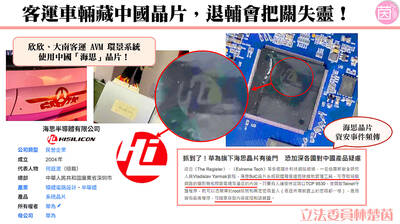
BREACH OF CONTRACT: The bus operators would seek compensation and have demanded that the manufacturer replace the chips with ones that meet regulations Two bus operators found to be using buses with China-made chips are to demand that the original manufacturers replace the systems and provide compensation for breach of contract, the Veterans Affairs Council said yesterday. Democratic Progressive Party Legislator Michelle Lin (林楚茵) yesterday said that Da Nan Bus Co and Shin-Shin Bus Co Ltd have fielded a total of 82 buses that are using Chinese chips. The bus models were made by Tron-E, while the systems provider was CYE Electronics, Lin said. Lin alleged that the buses were using chips manufactured by Huawei subsidiary HiSilicon Co, which presents a national security risk if the

The National Immigration Agency has banned two Chinese from returning to Taiwan, after they published social media content it described as disrespectful to national sovereignty. The agency imposed a two-month ban on a Chinese man surnamed Liang (梁) and a permanent ban on a woman surnamed Yang (楊), an influencer with 23 million followers, in October last year and last week respectively. Minister of the Interior Liu Shyh-fang (劉世芳) yesterday said on the sidelines of a legislative meeting that Chinese visitors to Taiwan are required to comply with the rules and regulations governing their entry permits. The government has handled the ban and


 RSS
RSS