


The Ministry of the Interior has asked Taiwan People’s Party (TPP) Legislator Li Zhengxiu (李貞秀) to submit proof she has applied to renounce Chinese citizenship by today, the Executive Yuan said yesterday.
Li’s eligibility to assume public office in Taiwan was again called into question after it was reported that she did not give up her Chinese household registration until March last year, even though she has been living in Taiwan for more than three decades.
The Act Governing Relations Between the People of the Taiwan Area and the Mainland Area (臺灣地區與大陸地區人民關係條例) stipulates that Chinese nationals are eligible to run for public office after they have become a naturalized Taiwanese citizen for at least 10 years.
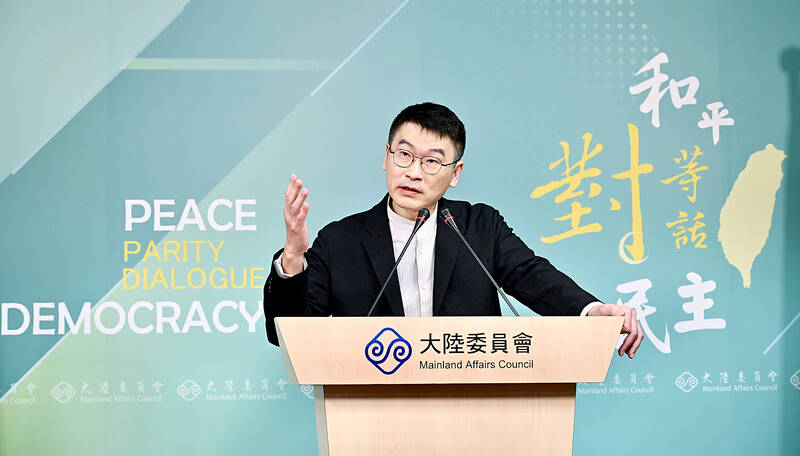
Photo: Lo Pei-de, Taipei Times
Moreover, the Nationality Act (國籍法) requires all elected officials to renounce non-Taiwanese citizenships within one year of being elected.
Executive Yuan spokeswoman Michelle Lee (李慧芝) told a news conference that the ministry had notified the Legislative Yuan through official letters on Jan. 28, Tuesday last week and Wednesday that it must submit proof that Li was in the process of renouncing her Chinese citizenship before she was sworn into office last week, adding that the same documents were sent to Li on Jan. 30, Monday last week and Wednesday.
“In the letter dated Feb. 11, both the legislature and Li were informed that they need to submit the required documents by Feb. 13,” Lee said.
Deputy Minister of the Interior Tung Chien-hung (董建宏) said that Chinese nationals must abide by Article 20 of the Nationality Act after becoming Taiwanese citizens and running for public office, which requires elected officials to have only Taiwanese citizenship.
“The requirement is non-negotiable,” Tung said.
Li said that she had received the letters from the ministry, but did not bother to open them, saying the ministry was contravening the law.
China’s Taiwan Affairs Office has said that Li’s request to renounce her Chinese citizenship would be denied, meaning that she remains a Chinese citizen.
Meanwhile, MAC Minister Chiu Chui-cheng (邱垂正) said on a morning radio show yesterday that a Chinese national who came to Taiwan as the spouse or dependent of a Taiwanese must have lived in Taiwan for at least six years to apply for a Taiwanese household registration and Taiwanese national ID.
Moreover, to qualify to run for public office, they must be registered Taiwanese citizens for at least 10 years, Chiu said.
The Chinese-language Liberty Times (the sister paper of the Taipei Times) said in a report on Wednesday that Li traveled to China in March last year to apply and obtain proof of giving up her Chinese household registration.
Chiu said that if Li did not give up her Chinese household registration until March last year, that means she did not meet the requirement to run for public office.
MAC Deputy Minister Liang Wen-chieh (梁文傑) told a news conference yesterday that the council has never encountered any case similar to Li’s.
“There are three clear principles in handling cross-strait affairs: First, Chinese nationals cannot run for office in Taiwan. Second, they can register and run for election only after becoming a registered Taiwanese citizen for 10 years. And third, they have three months to renounce their Chinese citizenship after they become registered Taiwanese citizens and must submit proof to the National Immigration Agency [NIA]. Chinese nationals would only be considered to have completed the naturalization process when they meet all three conditions,” Liang said.
The problem is that the government had never strictly enforced the third condition, even after an amendment to the cross-strait act was passed in 2004, Liang said.
Last year, the council identified about 12,000 cases involving Chinese who neither renounced their Chinese citizenship nor provided proof to the NIA after they became registered Taiwanese citizens, Liang said, adding that it spent an entire year making sure that they fulfill all legal requirements.
“Although Li is now a Taiwanese legislator, she would be treated as other Chinese nationals. There would not be any special treatment for her,” Liang said.
As Li had dual citizenship when she was listed as a legislator-at-large for the TPP, the council would meet with officials with the interior ministry and Central Election Commission after the Lunar New Year holiday to discuss the possibility of setting up a mechanism to vet candidates’ eligibility, particularly if they still have Chinese citizenship, Liang said.

FUKUOKA SITUATION: Japanese media reported that the pathogen is expected to be identified by the summer, while the CDC downplayed the idea that it was hMPV A “mysterious cold-like illness” reported in Japan’s Fukuoka Prefecture does not seem to be a new disease, but Japanese authorities have been asked about the situation, the Centers for Disease Control (CDC) said yesterday. The Fukuoka Prefectural Medical Association on Wednesday told a news conference that a “mystery cold” that has become a hot topic on social media is “highly likely to be caused by some kind of viral infection,” Japan’s KBC News reported. “Many people are experiencing symptoms starting with a sore throat, followed by a runny nose, phlegm and a severe cough,” KBC News reported, citing association officials. Health authorities are

Nvidia Corp CEO Jensen Huang (黃仁勳) arrived in Taiwan yesterday ahead of upcoming AI and technology events, saying he plans to meet with clients and Taiwan Semiconductor Manufacturing Co Chairman C.C. Wei (魏哲家) during his visit. After landing at Taipei Songshan Airport, Huang posed for photos with fans and handed out Yakult drinks to reporters and supporters waiting at the scene, saying he has “a lot to do” during the trip. Asked about reports that Nvidia’s planned headquarters site in Taipei’s Beitou Shilin Technology Park could break ground on May 27, Huang said that if the company holds an event, he would

The Ministry of Finance this afternoon announced the winning numbers for the March-April uniform invoice lottery. The winning number for the NT$10 million (US$318,060) special prize is 19531471, and the winning number for the NT$2 million grand prize is 85941329. Three numbers were drawn for the NT$200,000 first prize: 07225810, 20231230 and 83518781. Those with receipts matching the last seven digits of any of the first-prize numbers will win the NT$40,000 second prize, while those matching the last six digits will win the NT$10,000 third prize. Those whose receipts match the last five digits of the first-prize numbers can claim the NT$4,000 fourth prize,

SIX SUBSIDIES: The monthly allowance for older farmers is to increase to NT$10,000, and NT$5,000 is to be given to homemakers under the national pension system, Lai said The government is to implement major welfare policies for disadvantaged groups, including raising the monthly allowance for older farmers to NT$10,000 and providing homemakers with NT$5,000 per month, President William Lai (賴清德) said yesterday. Lai made the remarks during a visit to Wangling Temple in Chiayi County, saying that the planned increases were being introduced amid economic growth and an increase in tax revenue. Touting a policy, in which the government plans to provide a monthly allowance of NT$5,000 for every child under the age of 18 in a bid to address Taiwan’s low birthrate, Lai said that if received for the


 RSS
RSS