


Taiwan is willing to restore diplomatic relations with Honduras without setting preconditions, the Ministry of Foreign Affairs said yesterday, after the new government in Tegucigalpa signaled interest in resuming formal ties.
Ministry spokesman Hsiao Kuang-wei (蕭光偉) said Taiwan acknowledges an earlier statement by Honduran Vice President Maria Antonieta Mejia Sanchez indicating that the country is exploring a resumption of normal bilateral relations.
The ministry is to deal with Honduras’ proposals with openness and pragmatism, without setting preconditions, he said.
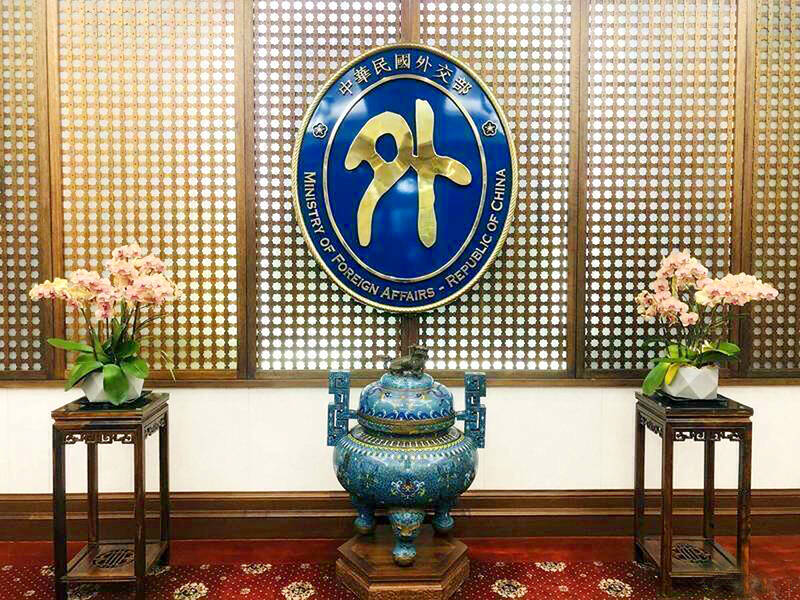
Photo: Fang Wei-li, Taipei Times
The government’s policy stance on Honduras is to pursue mutually beneficial ties that would facilitate Taiwan’s diplomatic strategy and economic growth of friendly countries under the Diplomatic Allies Prosperity Project, Hsiao said.
Honduran President Nasry Asfura, who was sworn into office last month, had said on the campaign trail that his administration would seek to reverse then-Honduran president Xiomara Castro’s switch of diplomatic recognition from Taiwan to China.
Honduras is in the process of reviewing various agreements it signed with Beijing as part of a push to develop ties with Taipei, Meija was cited as saying by the Honduran newspaper La Tribuna in a report published on Monday.
Telegucialpa must fully examine the repercussions of resuming relations with Taiwan before making a decision, as the country has inked 16 economic pacts with China, she said.
The Nasry administration is to decide on a course of action that best serves Honduras’ national interests, Meija said.
In related news, the Guardian in a report on Tuesday said that Beijing is donating luxury vehicles to Pacific leaders in a campaign to broaden China’s influence in the region.
The Chinese government in a state ceremony last month gifted a Hongqi-brand car to Fijian President Ratu Naiqama Lalabalavu, the report said.
Yun Sun, director of the US-based think tank Stimson Center’s China Program, said the gesture was the latest example in what she called China’s “prestige diplomacy.”
“This is more symbolic than substantive,” Yun was quoted as saying. “It is part of China’s aid program that aims to build good personal relationships with leaders.”
Foreign states have long donated vehicles to develop rapport with nations in the region, but strategic competition has turned the gifts into “visible markers of rival efforts to court Pacific governments and solidify partnerships,” she was quoted as saying.
Australia, the US, New Zealand and Japan are among the other countries that have donated vehicles to court nations in the Pacific, a practice China has engaged in as early as 2013, the paper said.
China has been providing developmental aid and infrastructure programs in addition to high-profile gifts to countries in the strategically important region, aiming to further its influence and undercut Taiwan’s diplomatic efforts, it said.
Tuvalu, the Marshall Islands and Palau are the only three Pacific island nations that recognize Taiwan, down from six countries seven years ago, the paper said.
Following the receipt of the car, Lalabalavu in a speech reaffirmed Fiji’s commitment to its “one China” policy.
Blake Johnson, regional expert and senior analyst at the Development Intelligence Lab, was cited by the Guardian as saying that the link between gifts and foreign messaging is frequently explicit.
“That reiteration of support for the ‘one China’ policy is a common phrase that comes along with most kinds of ceremonies where [Pacific leaders] receive gifts or thank China for the aid and support,” he said.

Considering that most countries issue more than five denominations of banknotes, the central bank has decided to redesign all five denominations, the bank said as it prepares for the first major overhaul of the banknotes in more than 24 years. Central bank Governor Yang Chin-lung (楊金龍) is expected to report to the Legislative Yuan today on the bank’s operations and the redesign’s progress. The bank in a report sent to the legislature ahead of today’s meeting said it had commissioned a survey on the public’s preferences. Survey results showed that NT$100 and NT$1,000 banknotes are the most commonly used, while NT$200 and NT$2,000

The Centers for Disease Control (CDC) yesterday reported the first case of a new COVID-19 subvariant — BA.3.2 — in a 10-year-old Singaporean girl who had a fever upon arrival in Taiwan and tested positive for the disease. The girl left Taiwan on March 20 and the case did not have a direct impact on the local community, it said. The WHO added the BA.3.2 strain to its list of Variants Under Monitoring in December last year, but this was the first imported case of the COVID-19 variant in Taiwan, CDC Deputy Director-General Lin Ming-cheng (林明誠) said. The girl arrived in Taiwan on

ANNUAL EVENT: Two massive Pokemon balloons are to be set up in Daan Park, with an event zone operating from 10am to 6pm This year’s Taipei Floral Picnic is to be held at Daan Park today and tomorrow, featuring an exclusive Pokemon Go event, a themed food market, a coffee rave picnic area and stage performances, the Taipei Department of Information and Tourism said yesterday. Two massive Pokemon balloons are to be set up in the park as attractions, with an exclusive event zone operating from 10am to 6pm, it said. Participants who complete designated tasks on-site would have a chance to receive limited-edition souvenirs, it added. People could also try the newly launched game Pokemon Pokopia in the trial area, the department said. Three PokeStops are

South Korea is planning to revise its controversial electronic arrival card, a step Taiwanese officials said prompted them to hold off on planned retaliatory measures, a South Korean media report said yesterday. A Yonhap News Agency report said that the South Korean Ministry of Foreign Affairs is planning to remove the “previous departure place” and “next destination” fields from its e-arrival card system. The plan, reached after interagency consultations, is under review and aims to simplify entry procedures and align the electronic form with the paper version, a South Korean ministry official said. The fields — which appeared only on the electronic form


 RSS
RSS