


The Legislative Yuan sent the Taiwan People’s Party’s (TPP) defense bill to committee for review today, after continuing to block the Executive Yuan’s NT$1.25 trillion (US$39.52 billion) special defense budget.
The opposition again blocked the Executive Yuan’s eight-year special defense budget during the Procedure Committee’s meeting on Tuesday, preventing it from being added to the Legislative Yuan’s agenda for today’s meeting.
The Legislative Yuan was set to review amendments to the Housing Act (住宅法), Satellite Broadcasting Act (衛星廣播電視法) and the Act Governing the Settlement of Ill-gotten Properties by Political Parties and Their Affiliate Organizations (政黨及其附隨組織不當取得財產處理條例) when it convened this afternoon.
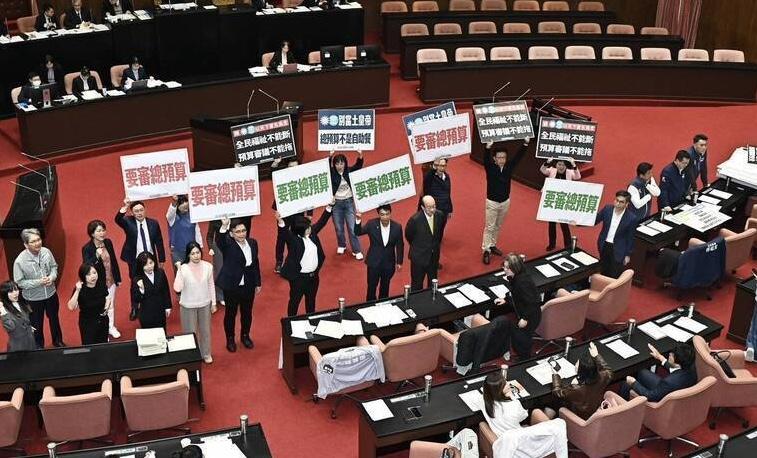
Photo: Tu Chien-jung, Taipei Times
The Democratic Progressive Party caucus proposed adding a review of the Executive Yuan’s special defense budget, but the opposition parties blocked it with their majority.
Under the opposition’s majority, the legislature then voted to send the TPP’s proposed “national security and asymmetric warfare procurement bill” to committee review.
The TPP’s proposal lists five items, including the High Mobility Artillery Rocket System (HIMARS), with total spending of NT$400 billion to be budgeted on an annual basis.
It allocates NT$126.7 billion for 60 M109A7 self-propelled howitzers along with 4,080 rounds of precision munitions, and NT$127.6 billion for 82 HIMARS multiple rocket missile systems.
It also covers anti-armor loitering munition systems, capped at NT$34.7 billion, 70 Javelin anti-armor missile launchers and 1,050 missiles, capped at NT$11.8 billion, and 24 TOW 2B anti-armor missile launchers and 1,545 missiles, capped at NT$11.1 billion.
Several preapproved US weapons sales present in the Cabinet's special budget are omitted, including US$1.01 billion for tactical mission network software, US$96 million for AH-1W helicopter parts and US$91.4 million for Harpoon missile support.
Funding for partnerships with the local arms industry, procurement of 200,000 drones, and the T-Dome multilayered air defense system are also absent.
The Executive Yuan’s version allocates NT$1.25 trillion to strengthen asymmetric warfare capabilities over eight years.
Repeatedly blocking the Executive Yuan’s special defense budget ignores the nation’s true needs, delaying national defense development and hindering joint operations, Executive Yuan spokesperson Michelle Lee (李慧芝) said.
The TPP’s proposed budget merely copies information made public by the Ministry of National Defense (MND) and cuts up the Executive Yuan’s version, Lee said.
It lacks strategic vision, military development planning, contradicts military procurement procedures and overlooks self-defense, she said.
It also threatens to obstruct arms purchases from the US and impact Taiwan’s sustainable combat capabilities, she added.
The MND previously said that the TPP’s proposal would only procure part of the necessary equipment and lacks supporting measures, which would make it hard to implement and may have serious long-term repercussions.
The Executive Yuan’s proposed budget was made through close communication with the US, Lee said, adding that it includes a comprehensive strategy and military development plan, aligns with procurement procedures and would enhance Taiwan’s self-defense capabilities.
As the TPP’s proposal lacks these elements, the Executive Yuan’s budget must be sent to committee review to truly build Taiwan’s national defense, she said.
The legislature has repeatedly blocked a review of the Cabinet's special defense budget since President William Lai (賴清德) announced it in November last year, with the opposition demanding that Lai first brief lawmakers and take questions on the proposal — a request Lai has rejected.

Japan has deployed long-range missiles in a southwestern region near China, the Japanese defense minister said yesterday, at a time when ties with Beijing are at their lowest in recent years. The missiles were installed in Kumamoto in the southern region of Kyushu, as Japan is attempting to shore up its military capacity as China steps up naval activity in the East China Sea. “Standoff defense capabilities enable us to counter the threat of enemy forces attempting to invade our country ... while ensuring the safety of our personnel,” Japanese Minister of Defense Shinjiro Koizumi said. “This is an extremely important initiative for

Chinese Nationalist Party (KMT) Chairwoman Cheng Li-wun (鄭麗文) today accepted an invitation from Chinese President Xi Jinping (習近平) to lead a delegation to China next month, saying she hopes to promote the peaceful development of cross-strait relations and bring stability to the Taiwan Strait. “I am grateful and happy to accept this invitation,” Cheng said in a statement from the KMT chairperson’s office. Cheng said she hopes both sides can work together to promote the peaceful development of cross-strait relations, enhance exchange and cooperation, bring stability to the Taiwan Strait and improve people’s livelihoods. At today's news conference, Cheng said any efforts to

MORE POPULAR: Taiwan Pass sales increased by 59 percent during the first quarter compared with the same period last year, the Tourism Administration said The Tourism Administration yesterday said that it has streamlined the Taiwan Pass, with two versions available for purchase beginning today. The tourism agency has made the pass available to international tourists since 2024, allowing them to access the high-speed rail, Taiwan Railway Corp services, four MRT systems and four Taiwan Tourist Shuttles. Previously, five types of Taiwan Pass were available, but some tourists have said that the offerings were too complicated. The agency said only two types of Taiwan Pass would be available, starting from a three-day pass with the high-speed rail and a three-day pass with Taiwan Railway Corp. The former costs NT$2,800

The nation’s fastest supercomputer, Nano 4 (晶創26), is scheduled to be launched in the third quarter, and would be used to train large language models in finance and national defense sectors, the National Center for High-Performance Computing (NCHC) said. The supercomputer, which would operate at about 86.05 petaflops, is being tested at a new cloud computing center in the Southern Taiwan Science Park in Tainan. The exterior of the server cabinet features chip circuitry patterns overlaid with a map of Taiwan, highlighting the nation’s central position in the semiconductor industry. The center also houses Taiwania 2, Taiwania 3, Forerunner 1 and


 RSS
RSS