


President William Lai (賴清德) on Tuesday urged the legislature to approve a trade agreement with the US that has yet to be finalized, warning that failure to do so could lead the US to hike tariffs on Taiwanese goods to 25 percent or higher.
In an interview with the FTV News channel, Lai said the tentative deal his administration reached with the US followed extensive negotiations and investment commitments by Taiwanese companies.
The terms of the agreement are “very good,” Lai said, adding that he hoped the legislature would approve the finalized version of the deal and not cause Taiwan to go back on its word.
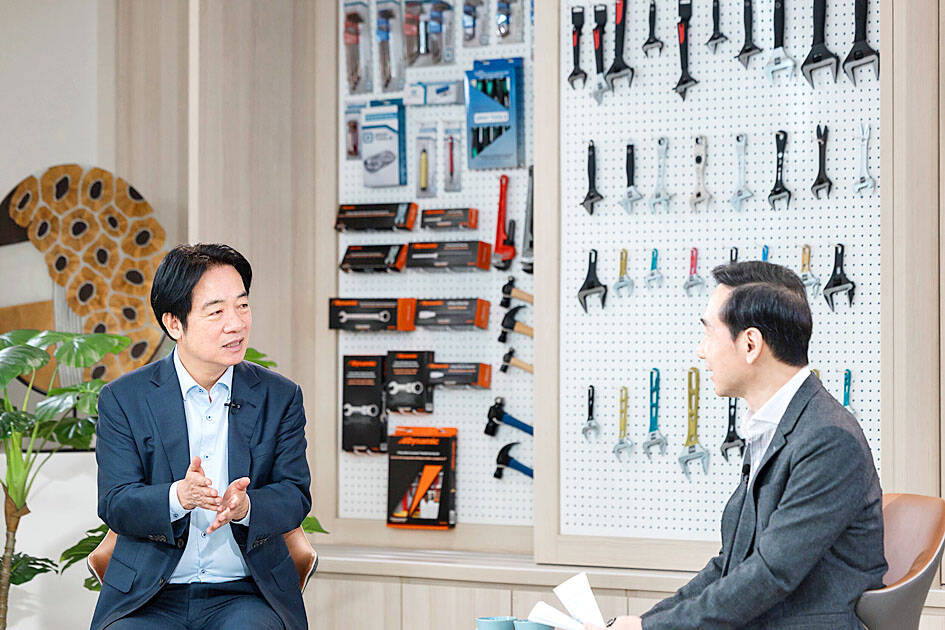
Photo courtesy of the Presidential Office
Lai was referring to a tentative agreement with the US this month under which the US would lower tariffs on Taiwanese goods from 20 percent to 15 percent.
In return, Taiwan committed Taiwanese companies to provide up to US$250 billion in direct investment in the US, while the government would provide up to US$250 billion in credit guarantees for companies investing in the US.
Vice Premier Cheng Li-chiun (鄭麗君), who led the negotiations, said the deal would also grant Taiwanese semiconductors and other products the most favorable treatment under Section 232 of the US Trade Expansion Act, although the final tariff rates and quotas have yet to be finalized.
Once a deal is signed, it needs to be approved by the legislature. Its fate could also be complicated by an upcoming US Supreme Court ruling on Trump’s authority to impose tariffs.
Lai said that if the legislature delayed approving the agreement, the US could raise its tariffs on Taiwan to 25 percent “or even higher.”
Lai was likely hinting at the situation in South Korea, with US President Donald Trump on Monday threatening to raise tariffs from 15 percent to 25 percent for “not living up to” a trade deal reached last year.
Aside from the positive response from Taiwanese companies and the stock market to the deal with the US, the “anxiety” in South Korea shows that such an agreement is desirable, Lai said.
Lai also urged the legislature to approve the NT$1.25 trillion (US$39.91 billion) special defense budget his administration has proposed, while criticizing a competing plan put forward by an opposition party.
The legislature is primarily responsible for “oversight,” and lawmakers should respect the professional judgement of the Ministry of National Defense, which proposed the budget, he said.
The special defense budget is “NT$1.25 trillion over eight years, or NT$150 to NT$160 billion per year, which the government would use to build T-Dome — a smart air defense system — and advance the defense industry, all of which is interconnected and indispensable,” Lai said.
The Taiwan People’s Party, by contrast, has proposed cutting the budget to NT$400 billion, Lai said, warning that this would require giving up purchases that would leave T-Dome with a “hole” in it.
The passage of either special budget bill would be a significant expenditure for Taiwan, where overall defense spending in the government’s budget proposal, which remains stalled in the legislature, was about NT$950 billion.
The Chinese Nationalist Party (KMT) has not yet decided whether to review the government’s special defense budget or propose its own, a KMT lawmaker told the Central News Agency on condition of anonymity.
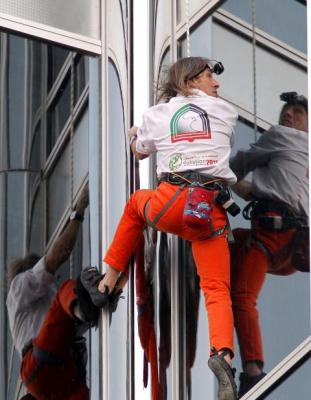
Alain Robert, known as the "French Spider-Man," praised Alex Honnold as exceptionally well-prepared after the US climber completed a free solo ascent of Taipei 101 yesterday. Robert said Honnold's ascent of the 508m-tall skyscraper in just more than one-and-a-half hours without using safety ropes or equipment was a remarkable achievement. "This is my life," he said in an interview conducted in French, adding that he liked the feeling of being "on the edge of danger." The 63-year-old Frenchman climbed Taipei 101 using ropes in December 2004, taking about four hours to reach the top. On a one-to-10 scale of difficulty, Robert said Taipei 101
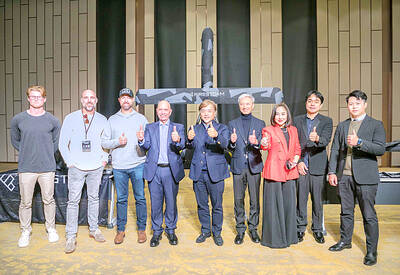
Taiwanese and US defense groups are collaborating to introduce deployable, semi-autonomous manufacturing systems for drones and components in a boost to the nation’s supply chain resilience. Taiwan’s G-Tech Optroelectronics Corp subsidiary GTOC and the US’ Aerkomm Inc on Friday announced an agreement with fellow US-based Firestorm Lab to adopt the latter’s xCell, a technology featuring 3D printers fitted in 6.1m container units. The systems enable aerial platforms and parts to be produced in high volumes from dispersed nodes capable of rapid redeployment, to minimize the risk of enemy strikes and to meet field requirements, they said. Firestorm chief technology officer Ian Muceus said
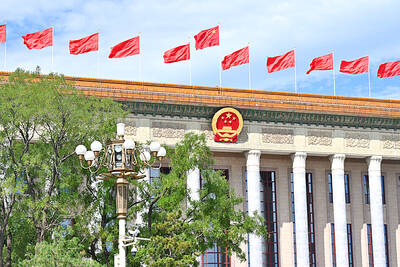
MORE FALL: An investigation into one of Xi’s key cronies, part of a broader ‘anti-corruption’ drive, indicates that he might have a deep distrust in the military, an expert said China’s latest military purge underscores systemic risks in its shift from collective leadership to sole rule under Chinese President Xi Jinping (習近平), and could disrupt its chain of command and military capabilities, a national security official said yesterday. If decisionmaking within the Chinese Communist Party has become “irrational” under one-man rule, the Taiwan Strait and the regional situation must be approached with extreme caution, given unforeseen risks, they added. The anonymous official made the remarks as China’s Central Military Commission Vice Chairman Zhang Youxia (張又俠) and Joint Staff Department Chief of Staff Liu Zhenli (劉振立) were reportedly being investigated for suspected “serious
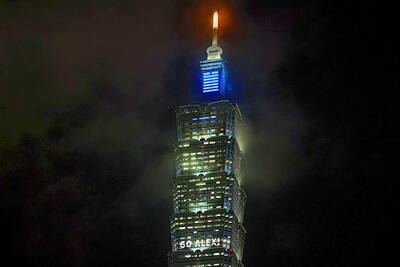
American climber Alex Honnold is to attempt a free climb of Taipei 101 today at 9am, with traffic closures around the skyscraper. To accommodate the climb attempt and filming, the Taipei Department of Transportation said traffic controls would be enforced around the Taipei 101 area. If weather conditions delay the climb, the restrictions would be pushed back to tomorrow. Traffic controls would be in place today from 7am to 11am around the Taipei 101 area, the department said. Songzhi Road would be fully closed in both directions between Songlian Road and Xinyi Road Sec 5, it said, adding that bidirectional traffic controls would


 RSS
RSS