


Taiwan’s annual Han Kuang military exercises are set to begin in the spring, with sources saying that the duration of the drills might be extended again.
In July last year, the military’s 41st annual exercises involved 10 days and nine nights of live-troop drills, compared with previous drills that lasted seven days and six nights or five days and four nights.
Last year’s exercises incorporated additional response measures to “gray zone” harassment and continued the “no spoilers” approach introduced the previous year, testing the ability of personnel at all levels to respond to unexpected situations.
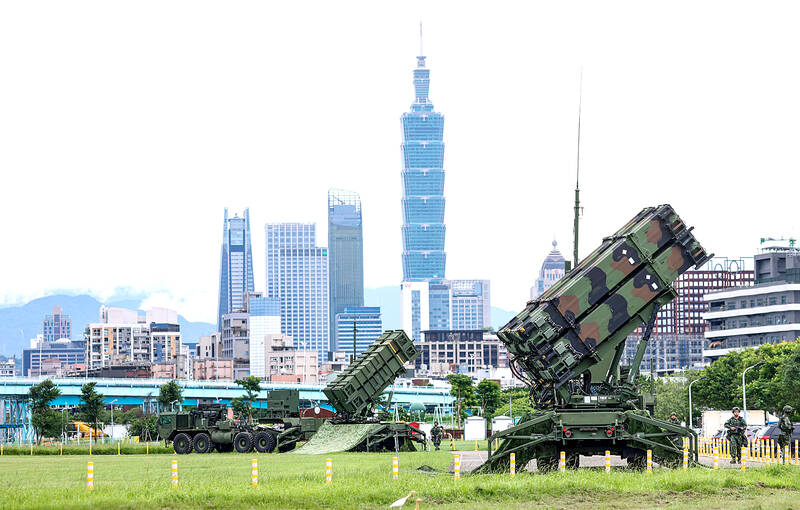
Photo: I-Hwa Cheng, AFP
An official with knowledge of the matter, speaking on condition of anonymity, yesterday said that after assessing last year’s training outcomes, the military might further extend the duration of this year’s Han Kuang No. 42 live-troop exercise.
How many additional days would be added and which training components would be included are still under deliberation, sources said.
Unscripted simulated engagements would again be a prominent feature of this year’s drills to emphasize the importance of being able to respond flexibly and proportionately to China’s “gray zone” tactics, the sources added.
The Ministry of National Defense’s Military News Agency reported that the Fifth Combat Theater Command, which is responsible for military operations in central Taiwan, including Taichung, Changhua, Nantou, Yunlin and Chiayi counties, held a meeting on Monday for the command staff of the subordinate units participating in the upcoming exercises.
Fifth Combat Theater Command head Army Lieutanent General Shao Chih-chun (邵智君) instructed staff at the meeting to review the threat environment, increase troop readiness and make detailed plans, the report said.
Commanders were enjoined to seize the initiative, make full use of terrain features and ensure the capability of units to deftly redeploy to different positions to meet the demands of real war, it said.
Subordinate commands were reminded about the importance of operational security and dedication to duty in the face of the threat from Chinese espionage and informational warfare activities.
In related news, Minister of National Defense Wellington Koo (顧立雄) yesterday reaffirmed the importance of the military reserves to national resilience at an event on promoting and commending government personnel tasked with counseling reservists.
Reservists must exemplify patriotism and dedication to duty to fulfill their crucial role as an indispensable force in national defense and societal resilience, Koo said at the event held in New Taipei City.
The national defense policy’s emphasis on all-of-society defense resilience concept is aimed at dealing with a complex security picture consisting of China’s “gray zone” threats, cognitive warfare and natural disaster risks, he said.
The contribution of the military reserves is an essential component alongside local governments and civil society in the nation’s quest to achieve resilience, he said.
Civil servants working in organizations counseling reservists need to cultivate deep roots in local communities to facilitate the rapid mobilization of reservists and maintain civilian morale, he said.
Reservist counseling organizations should continue to communicate with the public on the nation’s defense reform goals to enhance their capability to support a comprehensive array of national defense tasks, Koo said.

Considering that most countries issue more than five denominations of banknotes, the central bank has decided to redesign all five denominations, the bank said as it prepares for the first major overhaul of the banknotes in more than 24 years. Central bank Governor Yang Chin-lung (楊金龍) is expected to report to the Legislative Yuan today on the bank’s operations and the redesign’s progress. The bank in a report sent to the legislature ahead of today’s meeting said it had commissioned a survey on the public’s preferences. Survey results showed that NT$100 and NT$1,000 banknotes are the most commonly used, while NT$200 and NT$2,000

The Centers for Disease Control (CDC) yesterday reported the first case of a new COVID-19 subvariant — BA.3.2 — in a 10-year-old Singaporean girl who had a fever upon arrival in Taiwan and tested positive for the disease. The girl left Taiwan on March 20 and the case did not have a direct impact on the local community, it said. The WHO added the BA.3.2 strain to its list of Variants Under Monitoring in December last year, but this was the first imported case of the COVID-19 variant in Taiwan, CDC Deputy Director-General Lin Ming-cheng (林明誠) said. The girl arrived in Taiwan on

ANNUAL EVENT: Two massive Pokemon balloons are to be set up in Daan Park, with an event zone operating from 10am to 6pm This year’s Taipei Floral Picnic is to be held at Daan Park today and tomorrow, featuring an exclusive Pokemon Go event, a themed food market, a coffee rave picnic area and stage performances, the Taipei Department of Information and Tourism said yesterday. Two massive Pokemon balloons are to be set up in the park as attractions, with an exclusive event zone operating from 10am to 6pm, it said. Participants who complete designated tasks on-site would have a chance to receive limited-edition souvenirs, it added. People could also try the newly launched game Pokemon Pokopia in the trial area, the department said. Three PokeStops are

South Korea is planning to revise its controversial electronic arrival card, a step Taiwanese officials said prompted them to hold off on planned retaliatory measures, a South Korean media report said yesterday. A Yonhap News Agency report said that the South Korean Ministry of Foreign Affairs is planning to remove the “previous departure place” and “next destination” fields from its e-arrival card system. The plan, reached after interagency consultations, is under review and aims to simplify entry procedures and align the electronic form with the paper version, a South Korean ministry official said. The fields — which appeared only on the electronic form


 RSS
RSS